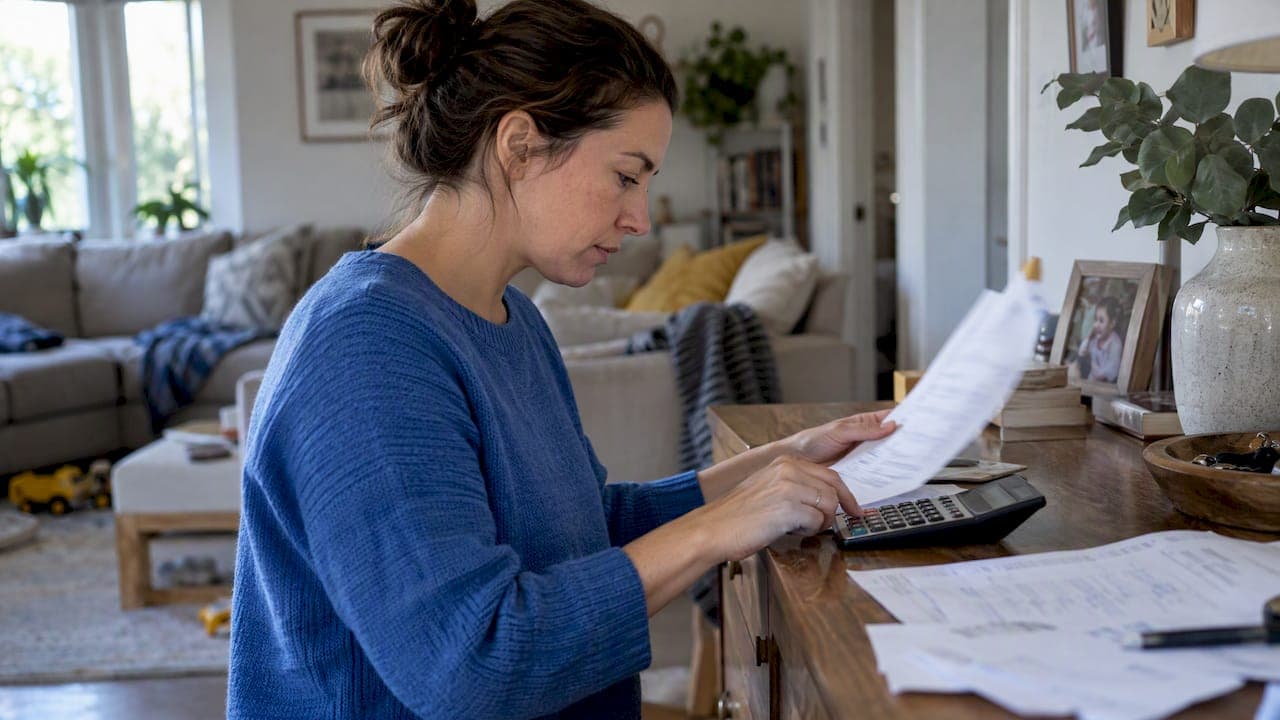
The most common nanny payroll mistakes are treating your nanny as a contractor, waiting until tax season to set up payroll, missing the $3,000 tax threshold, and keeping no reliable record of hours. All of them are avoidable, and most are fixable if you catch them early. This guide walks through each mistake, what the rules say, and what to do about it.
If you hire a nanny, au pair or in-home caregiver, you are usually a household employer. That is a small business role nobody warns you about when you are just looking for good childcare or senior care. The good news is that the rules are manageable once you see them laid out.
TL;DR
- If you control what your nanny does and how, the IRS treats her as your employee, whatever the paperwork says.
- Pay one household employee $3,000 or more in cash wages in 2026 and you owe Social Security and Medicare taxes totaling 15.3%.
- Get an EIN before the first pay date, not in April.
- Keep daily hour records for at least three years. No special form is required, but the records must be accurate.
- For 2026 wages, W-2s are due February 1, 2027, and Schedule H is due with your personal return on April 15, 2027.
Table of Contents
- Mistake 1: Calling your nanny an independent contractor
- Mistake 2: Waiting until tax season to think about payroll
- Mistake 3: Skipping the EIN or using your Social Security number
- Mistake 4: Missing the $3,000 threshold
- Mistake 5: Not keeping real records of hours
- Mistake 6: Ignoring overtime and unpaid work time
- Mistake 7: Assuming live-in means no rules
- Mistake 8: Missing the year-end deadlines
- Mistake 9: Treating cash and "under the table" as the easy option
- What our experience says
- If you have already made one of these mistakes
- Quick self-check
- FAQ
- Sources
Mistake 1: Calling your nanny an independent contractor
This is the most expensive error, and it often starts with good intentions. A nanny is referred by a friend, asks to be paid by check or cash, and the arrangement feels informal. Calling it "contract work" seems simpler.
The IRS looks at the relationship, not the label. According to the IRS, a worker is your employee if you can control not only what work is done but how it is done. If you set the schedule, provide the tools and direct the care routine, that describes an employee. A signed statement that she is self-employed does not change this.
The IRS Taxpayer Advocate Service has also written about parents who hire help for childcare, and the point is the same: the facts of the arrangement decide who is an employer.
What to do: Treat a nanny who works in your home, on your schedule, as a W-2 employee. Our guide to W-2 vs 1099 rules for nannies shows what changes in the tax picture. If you have already paid someone as a 1099 contractor, do not wait. Correcting it sooner is almost always cheaper than correcting it later.

Mistake 2: Waiting until tax season to think about payroll
Many parents first think about household employment when they sit down to file their own return. That is when "payroll shock" hits. The household employment taxes are added on top of your regular income tax bill, and they may cover a full year of wages at once.
A better rhythm looks like this:
- Before the first day of work, agree on pay, schedule and how hours will be recorded.
- Before the first pay date, get an employer identification number (EIN).
- Each pay period, calculate wages and any withholding.
- At year end, prepare the W-2 and Schedule H.
The IRS Publication 926 is the official household employer's tax guide and the place to confirm current figures. Our own walkthrough, Nanny Payroll Setup for U.S. Household Employers, covers the setup order in more detail.
Mistake 3: Skipping the EIN or using your Social Security number
An EIN is the identifier for you as an employer. Using your personal Social Security number on employer paperwork is a common error and it creates avoidable filing problems. Request the EIN before you issue the first paycheck so it is ready when you need it for payroll records and year-end forms.
This is a small task. It takes little time and it removes a headache from the following February.
Mistake 4: Missing the $3,000 threshold
For 2026, the IRS says that if you pay any one household employee cash wages of $3,000 or more, you must withhold and pay Social Security and Medicare taxes. The total is 15.3% of cash wages. Your employee's share is 7.65%, and you can choose to pay that share yourself rather than withhold it. Your own employer share is another 7.65%.
Two details trip people up:
- The threshold applies per employee, per year. A part-time nanny and a weekend sitter are counted separately.
- Once you cross it, the tax applies to all cash wages paid to that employee in the year, not just the amount above $3,000.
Here is a simple worked example. Say you pay your nanny $30,000 in 2026. The combined Social Security and Medicare tax is 15.3% of that, or $4,590. Half, $2,295, is the employer share. The other $2,295 is the employee share, which you either withhold from her pay or cover yourself. State unemployment and other state taxes may be due on top, and they vary by state, so check with your state's labor or tax agency.
We break down the arithmetic in How to Calculate Nanny Taxes and the classification rules in Avoid Penalties: $2,800 Rule for Classifying U.S. Household Employees. Because the threshold changes over time, always check the current year's figure in the IRS guide before you rely on any number, including ours.
Mistake 5: Not keeping real records of hours
Tax forms are only half of compliance. The other half is wage and hour law. The Department of Labor says that employers of domestic service workers must keep records for each worker who is entitled to minimum wage or overtime. No particular form is required, but the records must include items such as:
- The worker's name and home address
- Hours worked each workday and each workweek
- Total cash wages paid
The same fact sheet says records generally need to be kept for at least three years, with a two-year period for supporting payroll records such as time cards.
A text message saying "I think I did about 40 this week" is not a record. Neither is a number reconstructed from memory in January. Hours recorded as they happen are the only version that protects both of you. If your nanny says she worked 46 hours and you remember 42, a timestamped log settles the question without hard feelings.
If you want a paper approach, use our nanny timesheet template. If you want something that works on your nanny's phone, the Nanny Time Tracking app records hours and keeps all of her jobs in one calendar. For a step-by-step approach to meeting both IRS and DOL expectations, see Caregiver Time Tracking for Families.
Mistake 6: Ignoring overtime and unpaid work time
The Department of Labor's domestic service rule extended minimum wage and overtime protections to many home care workers, and nannies who do not live in are generally covered for overtime under federal law. Many families still pay a flat weekly rate regardless of hours, which can leave them short when the hours creep up.
Common places where unpaid time hides:
- Late pickups: A parent stuck in traffic adds 30 minutes every Thursday. Over a year that is real money.
- Travel time: When a caregiver must travel between clients or from an office to a home as part of the job, that time is generally work time. This matters most for caregivers working several jobs for different families.
- Overnights and early starts: Hours outside the usual schedule still count.
- Working during "breaks": If she is on duty, it is not a break.
Enforcement does happen. In one 2023 case, a federal court ordered a Philadelphia home care agency and its owner to pay more than $7 million in back wages and damages to 1,230 current and former employees after overtime was denied. That was an agency, not a family, but it shows how back wages add up when hours are not paid correctly.
State rules can be stricter than federal rules, including pay period definitions and daily overtime in some states. Check your state labor department's domestic worker rules, or ask a payroll professional.
Mistake 7: Assuming live-in means no rules
Live-in arrangements are a frequent source of confusion. The Department of Labor explains that live-in domestic workers are exempt from federal overtime but still owed at least the federal minimum wage for hours worked, and you still need accurate records of hours.
What goes wrong in practice:
- No written agreement. Sleep, meal and off-duty periods should be written down and signed, so that everyone knows which hours are working hours.
- An outdated agreement. If the real week no longer matches the paper, such as sleep regularly interrupted at night, update the agreement. A document that does not match daily life will not help you if hours are questioned.
- No daily log. "Live-in" does not mean "always on the clock" or "never on the clock." The log is what shows the difference.
This matters for seniors hiring caregivers as well as parents hiring nannies. Overnight care is common for older adults, and the same record discipline applies.
Mistake 8: Missing the year-end deadlines
For wages paid in 2026, the IRS lists these dates:
| Task | Deadline |
|---|---|
| Give Form W-2 to your employee and file with the Social Security Administration | February 1, 2027 |
| File Schedule H with your personal Form 1040 | April 15, 2027 |
If you get an extension for your personal return, it also applies to Schedule H. It does not extend the W-2 date. Missing W-2 filing leads to a messy start to the year for both you and your nanny, who needs the form for her own return.
The Social Security Administration also publishes W-2 filing tips listing common errors to check before you submit. Matching names and numbers to the employee's Social Security card is a simple first check.
Here is a year-end checklist:
- Total all cash wages by employee for the calendar year.
- Confirm what you withheld, if anything, for Social Security, Medicare and income tax.
- Prepare and send the W-2 by February 1.
- Complete Schedule H and file it with your return.
- Keep copies, along with the hour records behind them.
If you want to know what the W-2 looks like for a nanny, including overtime reporting, read $3,000 Trigger: 2026 U.S. Nanny W-2 Rules and Box 12 Overtime.
Mistake 9: Treating cash and "under the table" as the easy option
Paying in cash is not illegal in itself. Paying in cash and not reporting it is the problem. It leaves your nanny without a W-2, which makes it harder for her to prove income for a lease, a loan or Social Security credits. It leaves you with no documentation if a dispute arises or if she later files for unemployment benefits. It also leaves you owing taxes you never calculated.
The fix is not complicated: pay by a traceable method, record every payment, and file the forms. Our overview of nanny payroll options explains the types of help available, from do-it-yourself to full-service.
What our experience says
At Thecaretracker, we built the app around one idea: most payroll trouble starts with hours nobody wrote down. Families are rarely careless on purpose. They are busy, they trust their caregiver, and the schedule changes week to week. Then someone asks what was actually worked in March, and nobody can say.
That is why our app is free for nannies and caregivers. When the caregiver can log hours, see her jobs in one calendar, approve schedule requests and send time-off or reimbursement requests from her phone, the family ends up with a clean record without extra work. We also support state-specific pay period and overtime tracking, because the rules differ from place to place.
Our advice is simple. Agree on how hours will be tracked before day one. Review the log together each week. Treat a correction as routine, not as an accusation. Transparency protects the trust that makes the arrangement work in the first place.
— mercedes
If you have already made one of these mistakes
First, do not panic. Many families discover a problem months or years in, and the usual path is to stop it from continuing, then correct the past with the right professional.
A sensible order:
- Start tracking hours now, even if the past is a mess.
- Gather what you have: bank records, texts about schedule, any pay stubs, tax filings.
- Get an EIN if you do not have one.
- Talk to a tax professional such as a CPA or enrolled agent about filing correctly for prior years. For unpaid wages or classification questions, an employment attorney or your state labor department can advise.
- Set up payroll going forward so the problem does not repeat.
If you want help sorting this out, we offer paid consultations for household employers. The Standard Payroll Consultation package is $150 one-off. The Premium consultation is also $150 one-off, and our Prior Wage Reporting and Household Payroll Cleanup Services, listed on the same page, are for families who need to correct earlier years. Those cleanup services do not have a published price. The caregiver side of the app stays free: try the time-clock app.
Quick self-check
Answer yes or no:
- Do you have an EIN for your household employer role?
- Is your nanny classified as an employee, with a W-2 coming?
- Do you know whether her pay has crossed $3,000 this year?
- Are hours recorded daily, by her or by you?
- Do you have a signed agreement that matches the real schedule?
- Do you know your W-2 and Schedule H dates?
Every "no" is a place to start. Fix one this week, and the rest becomes easier.
FAQ
Can I pay my nanny as a 1099 contractor if she wants to?
Usually not. The IRS says a worker is your employee if you control what is done and how. Her preference, or a contract calling her self-employed, does not change that. If you are unsure, talk to a tax professional before the first paycheck.
When do I have to pay nanny taxes?
In 2026, Social Security and Medicare taxes apply once you pay any one household employee $3,000 or more in cash wages, per the IRS. You report them on Schedule H with your personal return, due April 15, 2027 for 2026 wages. Getting an EIN and running payroll from the first pay date keeps this from becoming a lump sum surprise.
How long should I keep my nanny's hour records?
The Department of Labor says at least three years, with two years for supporting records like time cards. No specific form is required, but the records must show hours worked each day and week and total wages paid. A daily log, whether on paper or in an app, meets the purpose.
Does a live-in nanny need hour tracking?
Yes. Live-in workers are exempt from federal overtime but still owed at least the federal minimum wage for hours worked, so you need accurate records. A signed written agreement on sleep, meal and off-duty time helps, and it should be updated if the real schedule changes. Some states have additional rules.
Sources
- IRS Publication 926, Household Employer's Tax Guide
- IRS: Hiring household employees
- IRS Taxpayer Advocate Service: Tax consequences for parents and household workers
- DOL Fact Sheet #79C: Recordkeeping for domestic service workers
- DOL Fact Sheet #79B: Live-in domestic service workers
- DOL Fact Sheet: Application of the FLSA to domestic service, final rule
- DOL news release: Philadelphia home care provider back wages, 2023
- Social Security Administration: W-2 filing tips