
Yes, in most cases you must pay overtime: non-live-in nannies earn time-and-a-half after 40 hours in a workweek under the FLSA, while live-in nannies fall under a federal exemption that many states override. The Department of Labor's Fact Sheet #79D and Fact Sheet #79B, plus 29 CFR §552.102, set the federal baseline. Start tracking hours and drafting a written agreement now with a tool like Thecaretracker before you check your state's specific thresholds.
TL;DR:
- Many states, including California, New York, and Massachusetts, require overtime for live-in nannies despite the federal exemption.
- Overtime must be calculated weekly, based on actual hours worked, and cannot be averaged across multiple weeks to avoid payment.
- Sleep time can only be excluded from paid hours if a written agreement confirms at least five uninterrupted hours of sleep.
- Proper documentation of hours, breaks, and interruptions is crucial to prevent wage claims and can greatly reduce legal exposure.
- Using accurate time-tracking tools ensures transparency and provides a strong defense against back-pay disputes.
Table of Contents
- What Are the Federal Nanny Overtime Rules Under the FLSA?
- Does the Live-In Nanny Exemption Still Apply in Your State?
- How Do You Calculate Nanny Overtime Pay Correctly?
- What Counts as "Hours Worked" for a Nanny?
- What Records Must You Keep, and What Are Your Tax Obligations?
- What Mistakes Trigger Wage Claims, and What Do They Cost?
- Which States Change the Rules Most for Household Employers?
- How Does Time Tracking Protect You From Back Pay Claims?
- Who Qualifies for Overtime Under FLSA Exemption Rules?
- How Did the Companionship and Live-In Exemption Updates Change Coverage?
- How Do You Handle Overtime for Split Shifts and Partial Weeks?
- Do Meal and Rest Breaks Affect Nanny Overtime Pay?
- What Can a Nanny Do if Overtime Goes Unpaid?
- What Household Employers Consistently Get Wrong About Overtime
- Track Nanny Hours Accurately With Thecaretracker
- Sources
What Are the Federal Nanny Overtime Rules Under the FLSA?
The Fair Labor Standards Act covers nearly every household employer who hires a nanny, and the math is simple on the surface: 40 hours is the line. Cross it in a single workweek, and every hour after that gets paid at 1.5 times the regular rate. Domestic service employees, nannies included, must receive at least the federal minimum wage for all hours worked plus that overtime premium, according to Fact Sheet #79D.
The workweek itself is a fixed, recurring 168-hour period, not a rolling calendar or a two-week pay cycle. You cannot average a 50-hour week against a 30-hour week to dodge overtime. Each week stands alone.
If you pay a flat weekly salary instead of an hourly rate, you still owe overtime. You just have to reverse-engineer the numbers:
- Divide the weekly salary by the number of hours it was intended to cover to find the regular hourly rate.
- Multiply that regular rate by 1.5 for every hour worked beyond 40.
- Add the overtime premium to the base salary to get total pay owed for that week.
A salary arrangement with no hourly conversion baked in is one of the most common ways families end up owing back pay.
Does the Live-In Nanny Exemption Still Apply in Your State?
Federal law exempts live-in domestic workers from the overtime requirement under the 13(b)(21) exemption described in Fact Sheet #79B, but that exemption still requires minimum wage for all hours worked, and it does not survive contact with many state laws. A live-in nanny is generally someone who resides at the employer's home for several consecutive days each week, per 29 CFR §552.102.
Several states throw out the federal exemption entirely and require overtime for live-in workers anyway, a pattern documented across current state-by-state overtime rules.
| State | Live-In Overtime Requirement |
|---|---|
| California | Overtime required; daily thresholds also apply |
| New York | Overtime after 44 hours for live-in workers |
| Massachusetts | Overtime required for live-in domestic workers |
| Hawaii, Maryland, New Jersey, Oregon, Minnesota, Nevada | Overtime protections extend to live-in workers under state law |
Sleep time can be excluded from paid hours only under a written agreement, and only if the nanny gets a sufficient period of uninterrupted sleep. A single interruption converts the whole sleep period back into paid time.
How Do You Calculate Nanny Overtime Pay Correctly?
The formula doesn't change based on how the nanny is paid, only the starting point does.
- Find the regular hourly rate (hourly wage as-is, or weekly salary divided by intended hours).
- Calculate straight pay for the first 40 hours at that regular rate.
- Calculate overtime pay for every hour past 40 at 1.5 times the regular rate.
- Add straight pay and overtime pay together for the total owed that week.
Pro Tip: Run the math every single week, even if the schedule looks identical from one week to the next. A single sick day swapped for an extra Saturday shift can shift the overtime owed without changing the total hours.
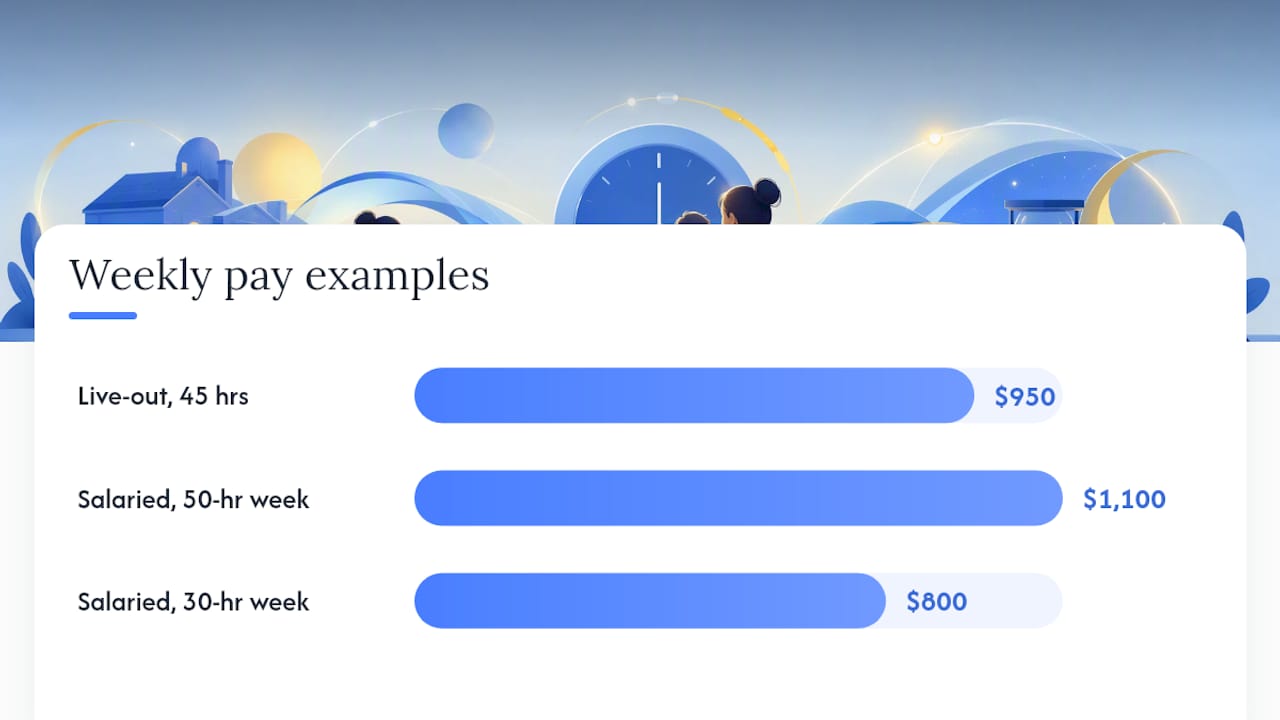
Take a live-out nanny earning $20 an hour who works 45 hours. She's owed 40 hours at $20 ($800) plus 5 hours at $30 ($150), for $950 total.
Now take a salaried nanny paid $800 a week for an expected 40 hours, but her schedule runs 50 hours one week and 30 the next. You cannot average those two weeks. The 50-hour week needs its own overtime calculation: the $800 salary divided by 40 hours gives a $20 regular rate, so she's owed $800 plus 10 overtime hours at $30, or $1,100 that week. The 30-hour week, meanwhile, still gets the full $800 despite fewer hours worked, unless your written agreement specifies otherwise. Overtime calculates per workweek, never averaged across pay periods.
Bonuses and different hourly rates for different tasks complicate the regular rate further. Non-discretionary bonuses typically get folded into the regular rate calculation before overtime is applied, which raises the effective overtime rate above what a flat hourly multiplier would suggest.
What Counts as "Hours Worked" for a Nanny?
Hours worked isn't limited to active childcare. The DOL's guidance draws a clear line between time a nanny is fully relieved of duty and time she's merely "engaged to wait," and that second category is compensable even if she's reading a book or resting.
- Standby time counts as hours worked when the nanny must stay available and cannot leave freely.
- Sleep time can be excluded only with a written agreement and at least five uninterrupted hours, per Fact Sheet #79D.
- An interruption during that sleep period, even a short one, makes the entire period paid time.
- Travel between job sites during a shift generally counts as work; a nanny's own commute to your home does not.
- Meal breaks count as work if the nanny remains on duty or on call during them.
Pro Tip: If your nanny works overnight shifts, log every wake-up call. A single unlogged 2 a.m. feeding can undo an entire week's sleep-time exclusion and turn eight "unpaid" hours into eight paid ones.
What Records Must You Keep, and What Are Your Tax Obligations?
The DOL expects household employers to keep records that would hold up under review. At minimum, that means daily hours worked, weekly totals, the regular pay rate, and the actual wages paid each period, based on Wage and Hour Division compliance guidance.
- Track clock-in and clock-out times daily, not estimated weekly totals.
- Withhold and remit FICA taxes once wages cross the federal household employer threshold.
- Pay your share of FUTA where applicable and issue a W-2 by January 31 each year.
- Keep payroll records for at least three years, and wage computation records for two.
A nanny timesheet template gives you a starting format if you're not ready for a full payroll system yet.
What Mistakes Trigger Wage Claims, and What Do They Cost?
Most overtime disputes trace back to the same handful of errors. Averaging hours across two weeks to avoid overtime is the most common. Assuming the live-in exemption applies without checking state law is close behind, and failing to document sleep-time exclusions properly turns an otherwise compliant arrangement into a liability.
- Averaging pay periods instead of calculating overtime per workweek.
- Treating a live-in nanny as automatically overtime-exempt regardless of state law.
- Excluding sleep time without a written agreement or without five uninterrupted hours.
- Paying a flat salary without ever converting it to an hourly regular rate.
The consequences scale with the state. California, for instance, can add waiting-time penalties on top of back pay when wages aren't paid on time at termination, a pattern outlined in current state overtime research. Liquidated damages, doubling the unpaid overtime owed, are also possible under federal law.
If you discover you've underpaid, an internal audit and voluntary back payment tend to reduce exposure far more than waiting for a complaint. Contacting your state labor office or an employment attorney early is almost always cheaper than litigating later.
Which States Change the Rules Most for Household Employers?
State law is where most employers get tripped up, because the federal floor is often not the actual floor. California applies both daily and weekly overtime thresholds and treats "personal attendants" under a distinct test that can pull nannies into overtime coverage even in live-in arrangements, detailed further in California-specific nanny overtime guidance.
New York requires overtime after a specific threshold of hours for live-in workers, along with a mandated weekly day of rest. Massachusetts extends overtime protection to live-in domestic workers outright, closing the federal exemption entirely.
- California: daily and weekly overtime thresholds plus a personal attendant test.
- New York: 44-hour live-in threshold and a required weekly rest day.
- Massachusetts, Hawaii, Maryland, New Jersey, Oregon, Minnesota, Nevada: overtime protections that extend to live-in workers under state Domestic Worker Bills of Rights.
If your state isn't listed here, check your state labor office directly. A deeper breakdown of live-in nanny overtime by federal and state law covers additional states and sleep-agreement documentation in more depth.
How Does Time Tracking Protect You From Back Pay Claims?
Wage claims are won and lost on documentation. A household employer with precise, timestamped logs of hours worked, sleep exclusions, and interruptions has a real defense. One relying on memory or a paper calendar usually doesn't.
- Digital clock-in and clock-out records that timestamp each shift automatically.
- Sleep and interruption flags that document when the five-hour uninterrupted rule was or wasn't met.
- Exportable weekly and monthly reports formatted for payroll processing and W-2 preparation.
- A shared schedule both the family and nanny can reference, reducing disputes before they start.
A nanny payroll setup guide pairs well with accurate time logs once you're ready to formalize withholding and tax filing.
Who Qualifies for Overtime Under FLSA Exemption Rules?
The FLSA doesn't exempt nannies as a category. It exempts specific work arrangements, and most nannies don't meet the bar for any of them. The two exemptions that come up most often are the live-in exemption and, historically, the companionship exemption, and both are narrower than many families assume.
A nanny caring primarily for children, rather than an elderly or disabled adult, generally does not qualify for the companionship exemption at all. That exemption was designed for companionship services to people who need help with daily living, not for childcare. Confusing the two is one of the more expensive misconceptions in this space, because it leads families to withhold overtime from a nanny who was never exempt in the first place.
The live-in exemption is real but conditional. It requires actual residence at the employer's home for at least five consecutive days weekly, a written record of hours worked, and compliance with state law wherever state law is stricter. Meeting the federal definition of live-in does not automatically mean overtime is off the table. It means the federal floor allows for an exemption, and your state's floor may not.
Thresholds also matter for minimum wage coverage, which applies regardless of exemption status. Every domestic worker, live-in or not, exempt or not, is entitled to at least the federal minimum wage for every hour worked. Overtime exemption never means wage exemption.
How Did the Companionship and Live-In Exemption Updates Change Coverage?
The companionship exemption once excluded a broad swath of home care workers, including some caring for children in mixed-care households, from both minimum wage and overtime protection. Regulatory changes narrowed that exemption considerably, tightening the definition of companionship services and shifting many workers who provide any meaningful amount of childcare, housekeeping, or personal care back into overtime coverage.
The practical effect for most nanny employers: if the job is childcare, the companionship exemption almost never applies, and it hasn't for some time. Families who assumed otherwise, often because a relative or friend told them "nannies are exempt," are the ones most likely to face back-pay exposure today.
The live-in exemption escaped these changes structurally, but state-level erosion has done what federal reform didn't. States including California, New York, and Massachusetts have layered their own protections on top of, or directly over, the federal live-in exemption. The result is a patchwork where the federal exemption still exists on paper but functions as the exception rather than the rule in several of the country's largest employment markets.
The safest posture for any household employer is to assume overtime applies unless you can point to the specific exemption, and the specific state law, that says otherwise in writing.
How Do You Handle Overtime for Split Shifts and Partial Weeks?
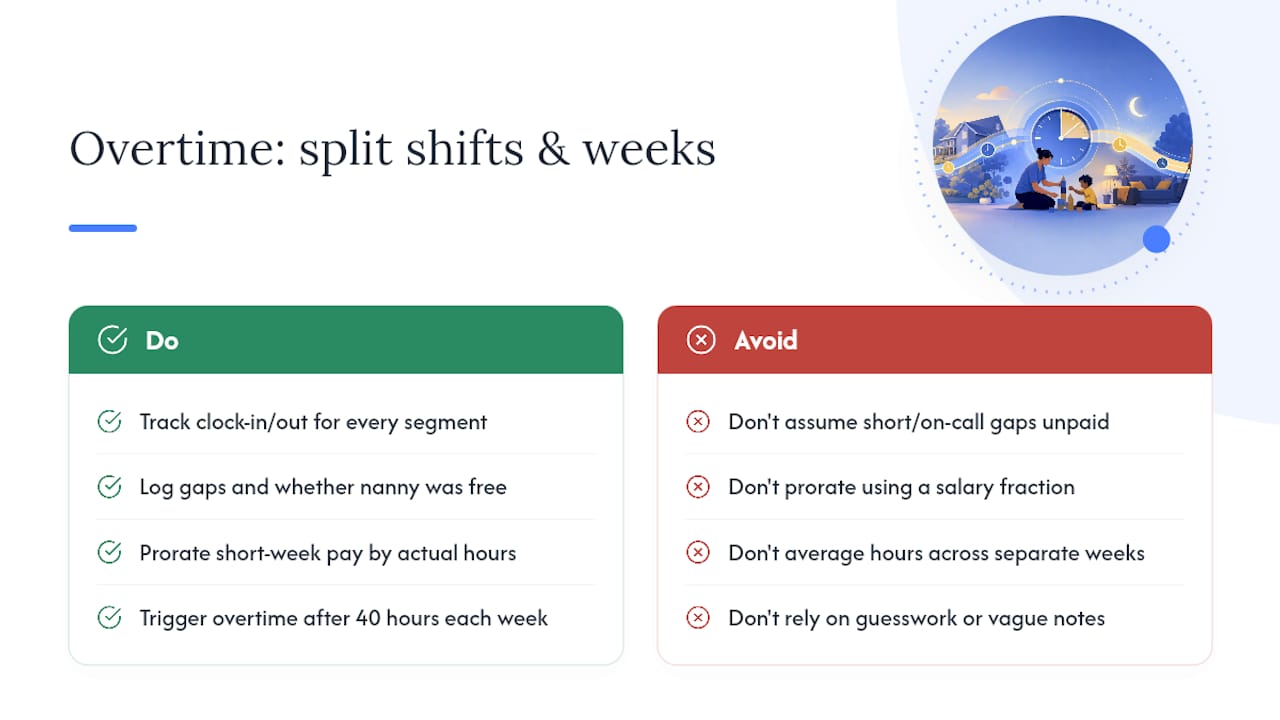
Split shifts, a morning block and an evening block with a gap in between, don't change the fundamental 40-hour rule, but they do change how carefully you need to track hours. Only the actual hours worked count toward the 40-hour threshold. The gap between shifts, if the nanny is fully relieved of duty and free to leave, does not count as hours worked and does not get paid.
The complication comes when the gap is short enough, or the on-call expectation vague enough, that the nanny isn't genuinely free during that window. A two-hour gap where she's expected to stay nearby in case a school pickup runs late is not a clean break. That time likely counts as hours worked under the same "engaged to wait" standard that applies to standby time generally.
Partial workweeks, when employment starts or ends mid-week, or a nanny takes unpaid leave for part of a week, get prorated based on actual hours worked, not a fraction of the salary. If a salaried nanny normally covers 40 hours but only works 25 hours during a short week, you still owe at least the proportional value of hours actually worked at no less than minimum wage, and any hours over 40 in a full week she does work still trigger overtime regardless of how the previous week looked.
The core principle carries through every version of this scenario: each workweek is evaluated independently, split shifts and partial weeks included. Track the actual clock times for every shift segment, log the gaps, and note whether the nanny was free to leave during the break. Guesswork here is exactly what creates disputes later.
Do Meal and Rest Breaks Affect Nanny Overtime Pay?
Meal and rest breaks are compensable or not based on one question: is the nanny relieved of duty? A genuine, uninterrupted meal break where the nanny is off the clock and free to step away doesn't count toward hours worked, and doesn't factor into the 40-hour overtime threshold.
But household employment rarely produces a clean break. A nanny eating lunch while a toddler naps nearby, expected to respond if the child wakes, is still on duty in every practical sense. That time counts as hours worked, whether or not you labeled it a break on the schedule.
Short rest breaks, five to twenty minutes, are treated as compensable work time under general FLSA principles because they primarily benefit the employer by keeping the employee available and productive. These add to the weekly total and factor into overtime the same way active caregiving hours do.
The practical risk here is understatement, not overstatement. Families often assume a 30 minute lunch break automatically comes off the clock, log 40 hours as 39.5, and never notice they've shorted a nanny's overtime threshold by exactly the amount needed to avoid triggering it. Multiply that pattern across months of employment, and a seemingly small habit becomes a real back-pay claim. Log breaks accurately, note whether the nanny was truly off duty, and let the actual pattern of relief from duty, not the label on the calendar, determine whether that time is paid.
What Can a Nanny Do if Overtime Goes Unpaid?
A nanny who believes she's owed unpaid overtime has real legal options, and household employers should understand them before a dispute reaches that stage. The most direct path is a wage complaint filed with the Department of Labor's Wage and Hour Division, which can investigate and, when warranted, order back pay directly.
State labor departments offer a parallel, often faster route, particularly in states with dedicated domestic worker protections like California, New York, and Massachusetts. Many nannies pursue state-level claims first because state agencies tend to move faster on smaller dollar amounts than federal channels.
Private legal action is also available, and this is where liquidated damages become relevant: a nanny who successfully sues for unpaid overtime can potentially recover double the unpaid amount under federal law, plus attorney's fees in many cases. That exposure is exactly why voluntary correction, paying what's owed once you discover an error, is nearly always cheaper than waiting for a claim to escalate.
For employers facing a dispute already in motion, the first move is an honest internal audit: pull every timesheet, recalculate the regular rate for each affected week, and identify the actual gap between what was paid and what was owed. Bringing a corrected, documented number to the conversation, rather than disputing the claim outright, resolves most disputes before they reach a labor office or a courtroom.
What Household Employers Consistently Get Wrong About Overtime
Most guidance on this topic treats nanny overtime as a math problem. It isn't, not primarily. It's a documentation problem wearing a math problem's clothes.
Where they lose money, and expose themselves to real liability, is in the judgment calls: was that 45 minutes of "quiet time" actually hours worked, did the sleep interruption at 2 a.m. reset the whole overnight exclusion, was last Tuesday's short day enough to offset last Friday's long one. The FLSA and state Domestic Worker Bills of Rights answer those questions clearly. Most families never check, because the honest answer usually means owing more than they assumed.
The conventional advice, "just pay time and a half after 40 hours," isn't wrong, but it's incomplete in a way that matters. It skips the harder, more consequential work: defining hours worked correctly in the first place, documenting sleep exclusions with an actual written agreement, and checking whether your state already overrode the federal live-in exemption years ago.
If there's one place to start, it's not the overtime formula. It's the log. A family that tracks actual hours worked, every shift, every interruption, every break, from day one rarely ends up owing back pay, because the number is never in dispute. The families who end up in front of a labor office are almost always the ones who never wrote anything down.
— mercedes
Track Nanny Hours Accurately With Thecaretracker
A nanny time tracking tool gives you the one thing that actually prevents overtime disputes: a timestamped, exportable record of every hour worked, every sleep exclusion, and every interruption, instead of a guess reconstructed from memory after a claim is already filed, complementing insights from a baby milestone tracker benefits for first-time parents that support detailed caregiving documentation. Some apps offer features like clocking in and out, flagging overnight interruptions, and submitting hours for approval directly from a phone, sometimes free for nannies and caregivers.
For the household side, Thecaretracker's employer app services support schedule approvals and payroll setup, so the hours your nanny logs turn into payroll-ready records without a manual spreadsheet in between. If overtime compliance has been a guessing game in your house, start logging hours with the nanny time tracking tool this week and get your first accurate weekly total before your next pay period closes.
This article is general information, not a substitute for advice from a qualified lawyer. Consult a qualified legal professional about your own circumstances before acting on anything here.
Sources
- Fact Sheet # 79D: Hours Worked Applicable to Domestic Service Employment Under the Fair Labor Standards Act (FLSA)
- 29 CFR § 552.102 — Live-in domestic service employees
- Beverly