
Under federal law, live-in nannies are generally exempt from overtime pay requirements, but that exemption does not apply in many states. If your nanny lives in your home permanently or for extended periods, the Fair Labor Standards Act allows you to skip overtime, but California, New York, Massachusetts, and several other states require it regardless. The safest first step is to confirm whether you are a household employer or a third-party agency placement, check your state's rules, and start logging hours now if you are not already doing so.
Key Takeaways
Live-in nannies are exempt from federal overtime under the FLSA, but state law in California, New York, Massachusetts, and several other states requires overtime regardless of that federal exemption.
| Point | Details |
|---|---|
| Federal exemption has limits | The FLSA live-in overtime exemption does not apply to third-party agency placements, and minimum wage always applies. |
| State law often controls | California, New York, Massachusetts, and other states require overtime for live-in workers; always check your state's threshold. |
| Sleep time rules are strict | Up to eight hours may be excluded only with adequate facilities and five uninterrupted hours; each interruption converts to compensable time. |
| Written agreements protect both parties | Document sleep-period exclusions, room-and-board credits, and on-call expectations in a signed agreement before work begins. |
| Thecaretracker supports compliance | Use Thecaretracker to log daily hours, record sleep and off-duty periods, and export reports for payroll and back-pay calculations. |
Table of Contents
- 1. What the federal FLSA says about live-in nanny overtime
- 2. How state laws differ and which states require overtime for live-in nannies
- 3. How to calculate regular rate and overtime pay for live-in nannies
- 4. Common exemptions and edge cases that change overtime obligations
- 5. What household employers must track and do now to avoid disputes
- 6. How to track live-in nanny hours reliably
- 7. Frequent errors employers and nannies make that trigger wage claims
- 8. What I've seen work for families navigating this
- Thecaretracker makes hour logging simple for live-in nannies and families
- Sources
1. What the federal FLSA says about live-in nanny overtime
The Department of Labor's Fact Sheet #79B is the controlling federal document for this topic. It defines a "live-in" domestic service worker as someone who resides on the employer's premises permanently or for extended periods, and it grants those workers an exemption from the FLSA's overtime requirement. That exemption does not mean you can pay whatever you like. Every live-in nanny must still receive at least the federal minimum wage for all hours worked, and you must keep accurate time records even when overtime is not owed.
Key points the fact sheet establishes:
- Who qualifies as live-in: The worker must reside on the premises permanently or for extended periods, not just stay overnight occasionally.
- Overtime exemption scope: Live-in domestic employees may be exempt from the time-and-a-half overtime premium under federal law, but minimum wage protection always applies.
- Third-party employer rule: If a staffing agency or home-care agency is the employer of record, that agency generally cannot claim the live-in exemption. The exemption is available only to the household employer directly.
- Sleep time: Up to eight hours of a sleep period may be excluded from compensable time, but only when the employer provides adequate sleeping facilities and the nanny can usually get at least five uninterrupted hours. Any interruption that requires the nanny to perform work converts that interrupted time to hours worked.
- Meal periods: Bona fide meal breaks during which the nanny is completely relieved of duties are not compensable. If the nanny must remain on call or attend to a child during a meal, that time counts as hours worked.
- Recordkeeping: The FLSA requires you to keep records of daily and weekly hours, wages paid, and employee identity information regardless of whether the overtime exemption applies.
DOL Fact Sheet #79D adds useful detail on what counts as "hours worked" for domestic employees, including on-call time and interrupted sleep examples that directly affect overtime liability calculations.
2. How state laws differ and which states require overtime for live-in nannies
Federal law sets the floor. When state law is more protective, state law controls, and you must follow whichever standard benefits the employee more. Several states have eliminated or significantly narrowed the live-in overtime exemption, so relying only on the FLSA is a real compliance risk.
According to a state-by-state roundup of nanny overtime laws, states including California, New York, Massachusetts, New Jersey, Nevada, Maryland, Hawaii, Oregon, and Minnesota all impose overtime obligations or different thresholds for live-in domestic workers. The table below captures the most common patterns.
As a practical rule, many states provide stronger protections than the federal baseline, and the list above is not exhaustive. Always confirm current rules directly with your state's labor department, since thresholds and exemption rules do change.
Pro Tip: If you employ a live-in nanny in California, the daily overtime trigger at nine hours is easy to miss on long care days. A California-specific overview of nanny overtime rules walks through those thresholds in detail.
3. How to calculate regular rate and overtime pay for live-in nannies
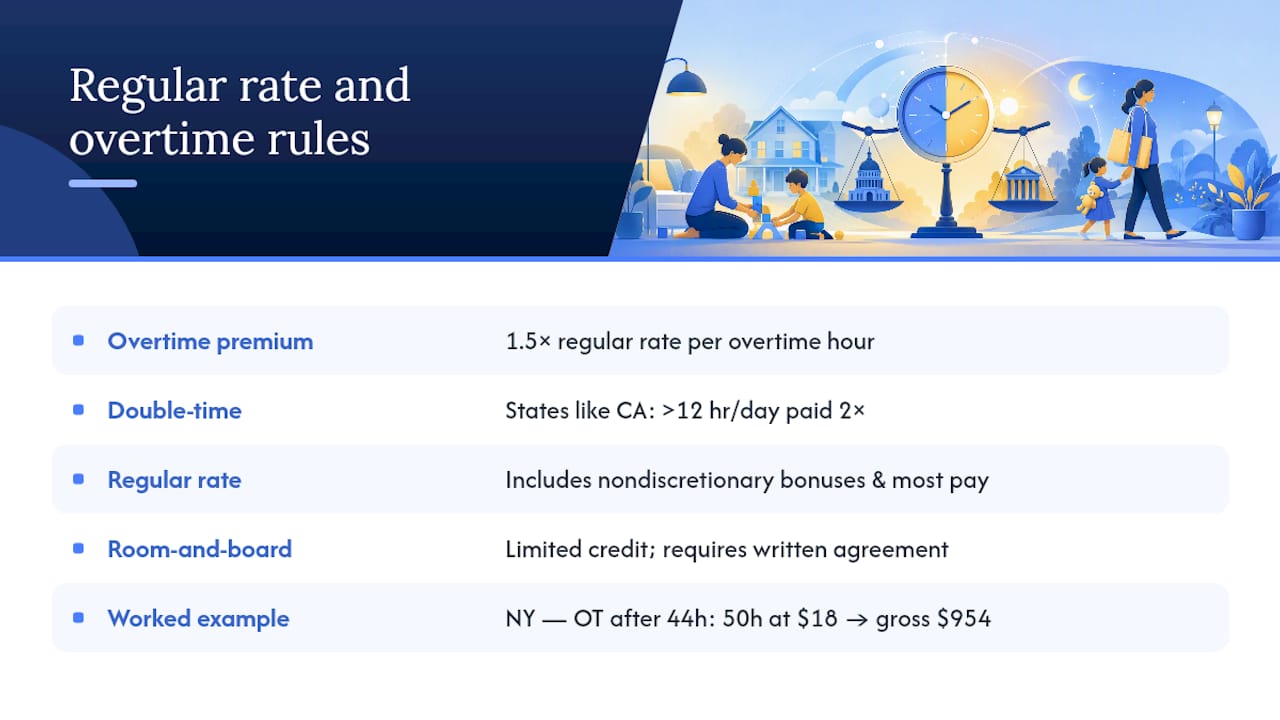
The overtime premium is 1.5 times the employee's regular rate of pay for each hour over the applicable threshold. In states with double-time rules, such as California, hours beyond 12 in a single day are paid at twice the regular rate.
The regular rate is not simply the hourly wage you agreed on. It includes nondiscretionary bonuses and most other compensation, divided by total hours worked in the workweek. Room-and-board credits can reduce the cash wage you pay, but only up to the limits set by federal and state law, and only when there is a clear written agreement. Room-and-board rules and their effect on pay calculations are a common source of errors, particularly when families assume the credit offsets more than it legally can.
Worked example: Your live-in nanny works in New York, where overtime applies after 44 hours per week. She works 50 hours in one week at an agreed hourly rate of $18. Her regular-rate pay for the first 44 hours is $792 (44 × $18). The remaining 6 hours are overtime hours, paid at $27 each (1.5 × $18), totaling $162. Her gross pay for the week is $954. If you also provide room and board, you may apply a documented credit against the cash wage, but the total compensation must still meet or exceed the applicable minimum wage for every hour worked.
DOL Fact Sheet #79D provides additional guidance on allocating hours across multiple pay rates and on how on-call and interrupted sleep periods factor into the total hours count.
4. Common exemptions and edge cases that change overtime obligations
Not every live-in caregiver fits the standard nanny classification, and the differences matter for overtime.
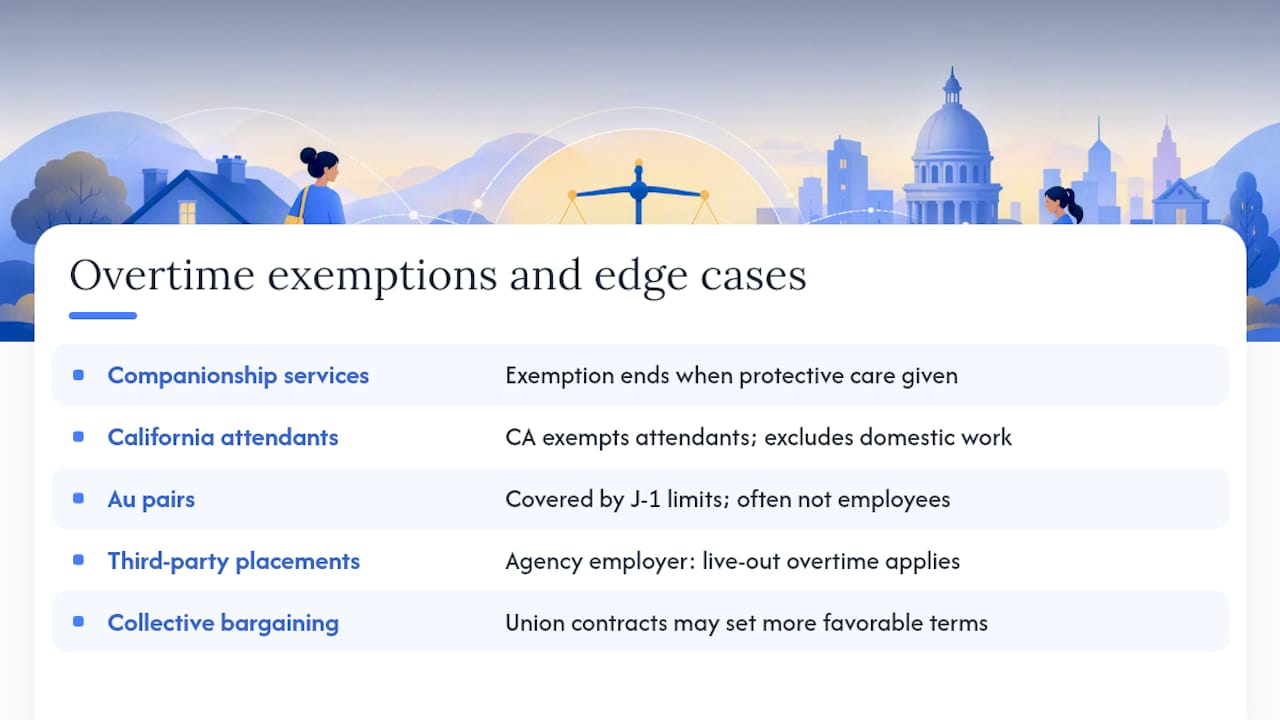
Companionship services cover workers who provide fellowship and protection to elderly or disabled individuals. Once that threshold is crossed, the companionship exemption no longer applies.
California personal attendants face a distinct rule. California defines a personal attendant as someone who supervises, feeds, or dresses a person who needs assistance due to age or disability. Personal attendants in California are exempt from overtime under state law, but that exemption is narrow and does not cover workers who also perform domestic duties like cooking or cleaning beyond incidental tasks.
Au pairs operate under a U.S. Department of State cultural exchange visa program. Because the J-1 visa program sets specific weekly hour limits and a fixed stipend, au pairs are generally not classified as standard household employees for FLSA purposes. However, the arrangement must genuinely meet the program's cultural-exchange requirements. Families who use an au pair outside the formal program structure risk having the worker reclassified as an employee with full wage protections.
Third-party placements through staffing or home-health agencies create a different employer-of-record situation. As noted in the federal rules section, agencies generally cannot claim the live-in overtime exemption. If the agency is the employer of record, overtime rules that apply to live-out workers typically govern the arrangement.
Collective bargaining agreements in states with strong domestic worker union activity, such as California and New York, can set overtime thresholds, rest periods, and pay rates that differ from both federal and state statutory defaults. If your nanny is covered by a union contract, that contract's terms control where they are more favorable to the worker.
5. What household employers must track and do now to avoid disputes
Accurate records are your first line of defense in any wage dispute. The FLSA requires you to keep specific information, and state laws often require more.
Mandatory records to maintain:
- Employee's full name, address, and Social Security number
- Daily start and end times for each shift
- Total hours worked each workweek
- Regular rate of pay and total wages paid each pay period
- Any documented sleep-time or meal-period exclusions, with written agreements supporting them
- Records of room-and-board credits applied, including the agreed value and basis
Written agreements matter beyond recordkeeping. A signed document that specifies the sleep period, the agreed exclusion amount, and what constitutes an interruption protects both you and your nanny. Without it, a dispute over whether a 2 AM feeding counts as compensable time has no paper trail to resolve it.
Household employers also carry federal payroll tax obligations. IRS Publication 926 explains when you become a household employer and what FICA, FUTA, and Schedule H filings are required. These obligations apply regardless of whether your nanny is live-in or live-out, and they are separate from overtime compliance.
A nanny timesheet template gives you a ready-made structure for logging daily hours, sleep exclusions, and interruptions without building one from scratch.
Pro Tip: Keep signed copies of all sleep-time and meal-period exclusion agreements in a dedicated employment file. If a wage claim is ever filed, those documents are the first thing a labor investigator will ask for.
6. How to track live-in nanny hours reliably
A reliable time-tracking workflow does not need to be complicated. The goal is a complete, timestamped record of every hour worked, every sleep period excluded, and every interruption logged.
A simple daily workflow looks like this:
- Clock in and out at the start and end of each shift, including overnight shifts.
- Log sleep periods separately, noting the agreed exclusion window and any interruptions.
- Record interruptions immediately with a timestamp and a brief note on what care was provided.
- Review weekly totals before each pay period to catch any hours that push past the applicable threshold.
Overnight and on-call shifts are where records most often break down. A nanny who is required to stay available throughout the night, even if she sleeps most of it, may have compensable hours depending on the frequency and duration of interruptions. Logging those interruptions in real time, rather than reconstructing them at the end of the week, produces far more defensible records.
Thecaretracker's time-tracking features support this workflow directly. Nannies can log hours, record off-duty and sleep periods, and flag interruptions from their phone. Employers receive accurate weekly totals and can export reports to support payroll calculations. For families who also want to integrate care information like medications, allergies, and daily schedules, the app keeps everything in one place.
When you discover a past underpayment, a payroll cleanup is worth doing properly. Thecaretracker's payroll consultation service helps employers calculate back pay, correct prior filings, and establish a compliant process going forward.
Integrating family health tracking practices alongside hours logging can also help caregivers maintain a complete picture of their daily responsibilities, which supports accurate time records when care tasks are varied.
7. Frequent errors employers and nannies make that trigger wage claims
Most wage claims involving live-in nannies trace back to a small set of recurring mistakes. Recognizing them early is far cheaper than resolving them after a complaint is filed.
- Not logging overnight interruptions. Assuming that a sleep period is fully excludable without tracking actual interruptions is the most common error. A night with three feeding or comfort calls may convert the entire sleep period to compensable time.
- Treating a weekly salary as an overtime bypass. Paying a flat weekly salary does not eliminate overtime obligations. If the nanny's hours exceed the applicable threshold, overtime is still owed, calculated from the regular rate derived from that salary.
- Applying room-and-board credits without documentation. A credit applied without a written agreement and a clear dollar value is legally vulnerable. The credit also cannot reduce cash wages below the applicable minimum wage.
- Assuming the federal live-in exemption applies in every state. As the state-by-state guidance makes clear, many states do not recognize the federal exemption. Employers in California, New York, and Massachusetts who rely on the FLSA exemption alone are exposed to back-pay liability.
- Mishandling third-party placements. Families who hire through an agency but treat the worker as a direct household employee for payroll purposes often get the overtime rules wrong. Confirm who the employer of record is before applying any exemption.
Practical guides consistently note that failing to track hours or misapplying the live-in exemption is a leading cause of wage claims, and that written agreements and accurate logs are the most effective way to reduce that risk.
8. What I've seen work for families navigating this
The families who handle live-in nanny overtime well share one habit: they treat the employment relationship like a real business arrangement from day one. That means a written work agreement that spells out expected hours, the sleep-period exclusion, and what counts as an interruption, signed before the nanny moves in.
When families come to me after a problem has already surfaced, the fix usually follows the same path. First, pull together every available record, even incomplete ones. Second, calculate what was actually owed using the correct regular rate and the applicable state threshold. Third, pay the difference and correct any prior payroll tax filings with the IRS and state tax authority. It is uncomfortable, but it is far less costly than a formal wage claim.
For nannies reading this: you have the right to a written agreement and to copies of your own time records. Keep your own log, even if your employer keeps one too. If your hours are not being tracked, that is worth raising directly. A simple daily log on your phone takes less than a minute and gives you a complete record if a dispute ever arises.
Thecaretracker makes hour logging simple for live-in nannies and families
Accurate time records are the foundation of overtime compliance, and Thecaretracker gives both nannies and household employers a free, straightforward way to build that foundation. Nannies log hours, record sleep and off-duty periods, and flag overnight interruptions directly from their phone. Employers see weekly totals in real time and can export clean reports for payroll calculations, back-pay audits, or tax filings.
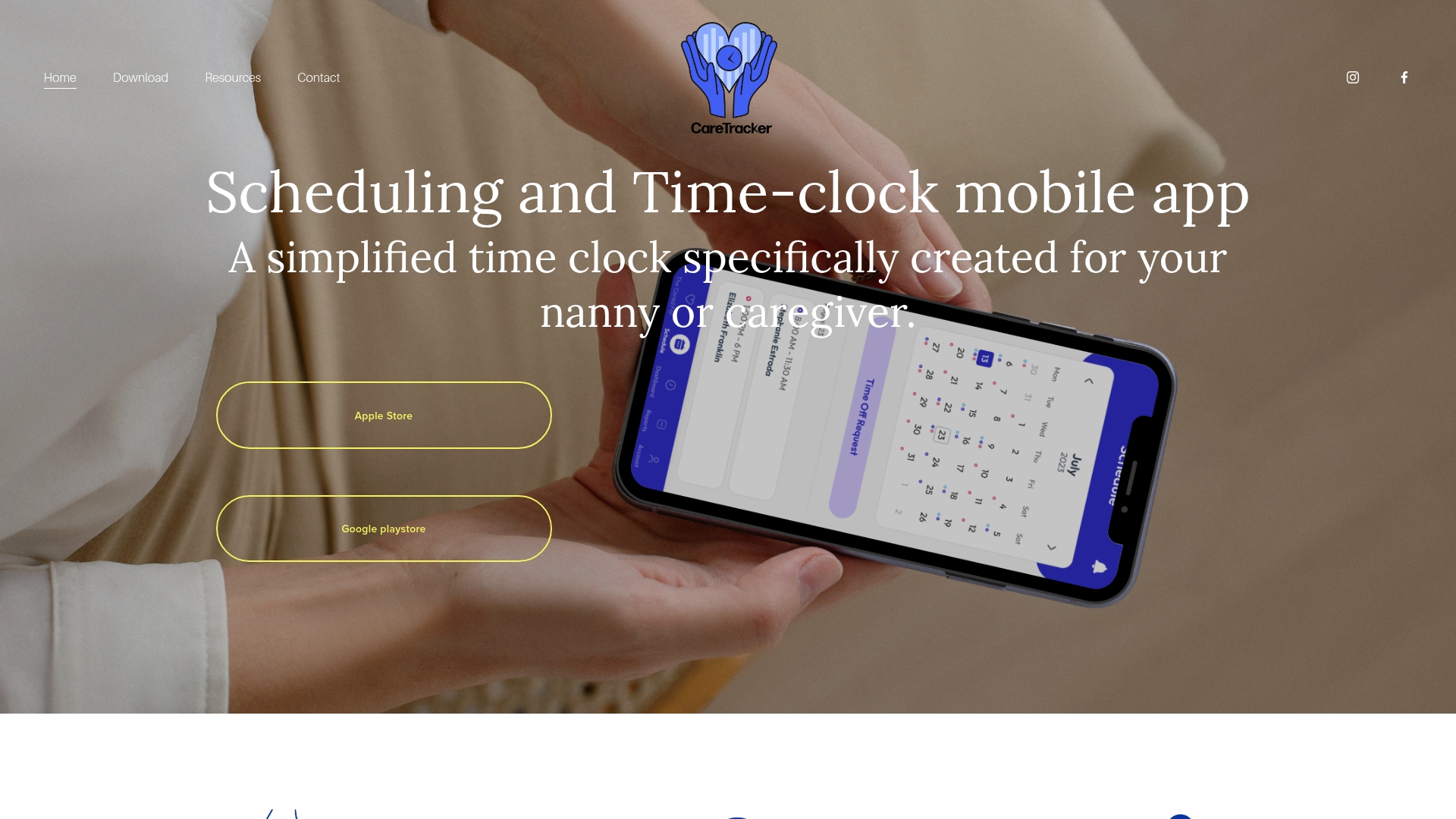
The app also stores care information, schedules, and reimbursement records in one place, so compliance and daily coordination happen together rather than separately. This article is general information, not legal advice. For disputes involving back pay or misclassification, consult a wage-and-hour attorney or a licensed payroll professional.
Start tracking hours with Thecaretracker today, or explore the time-tracking feature page to see how the workflow fits your household.
Sources
The sources below are the primary references for the rules covered in this article. Confirm current thresholds directly with your state labor department, since rates and exemption rules change.
- Live-In Caregiver Overtime Rules: What Families Must Pay
- Beverly
- About Publication 926, Household Employer's Tax Guide
This article is general information, not a substitute for advice from a qualified lawyer. Consult a qualified legal professional about your own circumstances before acting on anything here.