
Reimburse your nanny for work-related driving at the IRS standard mileage rate and document each trip to keep those payments completely nontaxable. The IRS business mileage rate can change during the year; employers should use the applicable IRS rate for each reimbursement period. Your immediate next steps are simple:
- Log every reimbursable trip with the date, miles driven, destination, and purpose.
- Pay reimbursements separately from wages, at the current IRS rate, on your regular payroll schedule.
- Store those logs with your payroll records and update your rate on July 1 if you haven't already.
Getting this right protects both you and your nanny. Properly documented reimbursements don't show up on her W-2, don't trigger payroll taxes, and don't complicate your household tax filing. Skip the documentation, and the IRS can reclassify those payments as taxable wages.
Table of Contents
- How mileage reimbursements are taxed — and how to keep them nontaxable
- Which reimbursement method works best for your household?
- Which states require you to reimburse your nanny's mileage?
- What your mileage log needs to include
- How to add mileage reimbursements to your household payroll
- Sample mileage reimbursement policy and worked examples
- How to talk to your nanny about mileage reimbursement
- IRS rate vs. actual expenses vs. gas cards: which fits your situation?
- The bottom-line recommendation for household employers
- Key Takeaways
- What most employers get wrong about mileage reimbursement
- Thecaretracker makes mileage tracking straightforward
- Useful sources to verify rates and rules
How mileage reimbursements are taxed — and how to keep them nontaxable
The IRS uses what's called an accountable plan to determine whether a reimbursement is tax-free. Under an accountable plan, three conditions must be met: the expense must have a genuine business purpose, the employee must document it adequately, and any excess reimbursement must be returned. When all three apply, the payment stays off your nanny's W-2 and out of your payroll tax calculation.
Adequate documentation means a dated trip log that captures the destination, the business purpose, and the miles driven for each trip. A note that says "Tuesday, 14 miles, school pickup and pharmacy run" satisfies the requirement. A lump-sum monthly payment with no log does not.
The distinction between reimbursement and wages matters more than most employers realize. Rolling mileage payments into base pay makes them taxable income, subject to FICA withholding on both sides. That costs your nanny money on her paycheck and costs you the employer's share of Social Security and Medicare taxes. Keeping reimbursements on a separate line preserves the tax-free status for everyone.
Families who pay household employment taxes correctly can still access the Child and Dependent Care Credit or a Dependent Care FSA, but only when they pay on the books. Mileage reimbursements handled under an accountable plan don't interfere with those benefits.
Pro Tip: Set up a simple reimbursement request process from day one. If your nanny submits a weekly trip log and you pay it as a separate line item, you've satisfied the accountable-plan rules without any extra effort at tax time.
Which reimbursement method works best for your household?
There are five practical ways to handle nanny driving expenses. Each has different tax implications and a different administrative load.
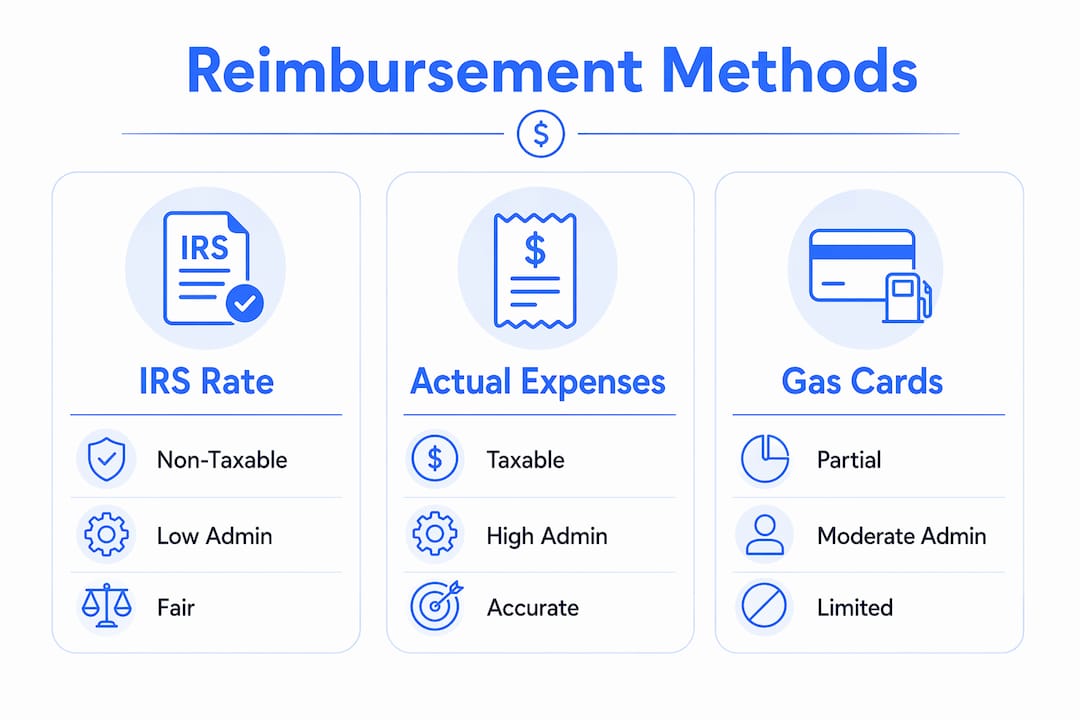
| Method | Taxable? | Admin effort | Fairness to nanny |
|---|---|---|---|
| IRS standard mileage rate | No (with log) | Low | High — covers fuel, wear, insurance |
| Actual expense reimbursement | No (with receipts) | High | High — but complex to track |
| Gas card or fuel payment | Possibly | Medium | Partial — fuel only |
| Flat per-trip stipend | Possibly | Low | Moderate — may over/under-pay |
| Rolled into hourly pay | Yes | Low | Low — loses tax-free status |
The IRS standard mileage rate is the most practical choice for most households. It covers depreciation, insurance, maintenance, and fuel in a single per-mile figure, so your nanny is compensated without needing to track receipts. The log requirement is minimal, and the tax treatment is clear.

Actual expense reimbursement is technically accurate but administratively demanding. You'd need fuel receipts, oil change records, and insurance cost allocations. Few household employers have the bandwidth for that.
Gas cards cover fuel but nothing else. If your nanny drives a high-mileage vehicle or one that requires frequent maintenance, a gas card alone undercompensates her for the real cost of using her car for your family's errands.
Pro Tip: If your nanny works for multiple families, she may already be tracking mileage for another employer. Ask during onboarding. That conversation often reveals whether she has a preferred log format you can adopt.
Which states require you to reimburse your nanny's mileage?
Federal law doesn't require employers to reimburse mileage. But several states and Washington, D.C. have their own rules that can legally require you to cover necessary work-related vehicle expenses for household employees.
California, Illinois, Massachusetts, and Washington, D.C. are among the jurisdictions that require employers to reimburse employees for necessary work-related expenses, which includes mileage driven on the job. California's Labor Code Section 2802 is particularly broad — it requires full reimbursement for all necessary expenditures, and courts have interpreted that to include vehicle use at or above the IRS rate.
State law can override federal practice. Even if you've set up a perfectly compliant federal accountable plan, your state may require reimbursement regardless of whether you've documented it. That means the obligation exists even if your nanny never submits a log.
To verify your state's rules:
- Search "[your state] labor code employee expense reimbursement" on your state's official labor department website.
- Look specifically for language about "necessary expenditures" or "business expenses" for employees.
- Check whether the rule applies to household employees or only to commercial employers.
- If your state requires reimbursement, confirm whether the IRS rate satisfies the obligation or whether actual expenses must be covered.
When in doubt, contact your state's Department of Labor directly or consult a payroll professional who handles household employment.
What your mileage log needs to include
A proper mileage log is the foundation of a compliant nanny mileage reimbursement program. The IRS requires that each reimbursed trip be documented with enough detail to verify the business purpose.
| Field | What to record | Example |
|---|---|---|
| Date | Full date of the trip | June 3, 2026 |
| Driver name | Nanny's full name | Jane Smith |
| Start location | Where the trip began | [employer's home] |
| Destination | Where the nanny drove | Lincoln Elementary School |
| Purpose | Why the trip was work-related | School pickup for Emma |
| Miles driven | Total trip miles | — |
| Odometer (optional) | Start and end readings | 42,310 → 42,314 |
Your nanny can keep this log in a notebook, a spreadsheet, or a dedicated app. What matters is that the record exists before you pay the reimbursement, not after. Reconstructed logs created at tax time carry much less weight with the IRS.
Retain mileage logs for at least three years alongside your other payroll records. Digital backups are worth the few seconds they take. If you use a payroll system, attach the log or a summary to the corresponding pay period.
Pro Tip: Odometer readings aren't strictly required by the IRS, but they add a layer of verification that makes any audit conversation much shorter. Encourage your nanny to note start and end readings for longer trips.
How to add mileage reimbursements to your household payroll
Reimbursements that meet accountable-plan rules stay completely outside payroll taxes. But you still need to handle them correctly in your payroll records to keep that status intact.
Here's a step-by-step process that keeps everything clean:
- Collect the log. Your nanny submits her trip log at the end of each pay period (weekly or biweekly works well).
- Calculate the reimbursement. Multiply total miles by the applicable IRS rate. For trips before July 1, 2026, use 72.5 cents. For trips on or after July 1, 2026, use 76 cents.
- Enter it as a separate line. In your payroll records, label it "mileage reimbursement" or "expense reimbursement," never as wages or a bonus.
- Pay it with the paycheck. You can include it in the same payment, but it must appear as a distinct line item on the paystub.
- Split records at the rate-change date. If a pay period straddles July 1, calculate pre-July miles and post-July miles separately and apply the correct rate to each.
The mid-year rate change from 72.5 to 76 cents is exactly the kind of detail that creates reconciliation problems if you don't split records at the effective date. A single combined calculation for a pay period that crosses July 1 will either over- or underpay your nanny and may flag an inconsistency if you're ever audited.
Sample mileage reimbursement policy and worked examples
Sample policy clause
"[Nanny's name] will be reimbursed for all work-related driving performed on behalf of [Family name] at the current IRS standard business mileage rate. Reimbursable trips include school pickups and drop-offs, errands, medical appointments, and other tasks assigned by the employer. Commuting from [Nanny's home] to the employer's home is not reimbursable. [Nanny's name] will submit a completed mileage log within two business days of the end of each pay period. Reimbursements will be paid with the following regular paycheck. This rate will be updated whenever the IRS announces a change, effective the date the IRS specifies."
Worked example A: weekly school-run schedule (mid-year split)
Your nanny drives a consistent number of miles per week for work-related trips, which may span across different IRS mileage rate periods.
| Period | Miles | Rate | Reimbursement |
|---|---|---|---|
| Jan 1 – Jun 30 | [number of miles] | $0.725 | [miles] × $0.725 = [amount] |
| Jul 1 – Dec 31 | [number of miles] | $0.76 | [miles] × $0.76 = [amount] |
| Total for that week | 30 miles | — |
A typical full week before or after a mid-year IRS mileage rate change would involve using the IRS business mileage rate effective for that period: 72.5 cents per mile (January 1 – June 30, 2026) and 76 cents per mile (July 1 – December 31, 2026).
Worked example B: monthly variable trips
Your nanny logs 87 miles in June and 94 miles in July.
- June reimbursement: 87 × $0.725 = $63.08
- July reimbursement: 94 × $0.760 = $71.44
Key points to remember when calculating:
- Always use the rate in effect on the date of the trip, not the date of payment.
- Round to the nearest cent.
- Keep the log that supports each monthly total on file.
How to talk to your nanny about mileage reimbursement
The best time to set expectations is before the first day of work. Discussing reimbursement during hiring and putting the terms in writing prevents the kind of ambiguity that leads to disputes months later.
A short onboarding checklist for mileage reimbursement:
- Confirm the reimbursement rate and reference the IRS standard mileage rate in the offer letter.
- List specific reimbursable tasks (school runs, errands, medical appointments, activity drop-offs).
- State explicitly that commuting from the nanny's home to your home is not reimbursable.
- Agree on the log format and submission deadline (end of each pay period works well).
- Confirm the payment timing (with the next regular paycheck).
A simple opening for the conversation: "We want to make sure you're fairly compensated for any driving you do for us. Here's how we handle it — let me walk you through the policy and answer any questions."
If job duties change and new driving tasks are added, update the written policy and note the effective date. A one-paragraph amendment to the original agreement is enough.
Pro Tip: Give your nanny a printed or digital copy of the mileage log template on her first day. When the format is already set up, she's far more likely to fill it in consistently.
IRS rate vs. actual expenses vs. gas cards: which fits your situation?
The IRS standard mileage rate is usually the right choice for fairness and tax clarity, but a few household scenarios call for a different approach.
Use the IRS standard mileage rate when:
- Your nanny drives her own vehicle for work-related trips.
- Driving is regular but not the primary job function (a few trips per week).
- You want the clearest tax treatment with the least paperwork.
- Your state requires reimbursement and you want a defensible rate.
Consider actual expense reimbursement when:
- Your nanny drives an unusually expensive vehicle to maintain.
- You want to reimburse only documented out-of-pocket costs.
- You have the administrative capacity to collect and verify receipts.
A gas card may make sense when:
- You provide the vehicle your nanny drives (in which case fuel is a legitimate employer-provided benefit).
- Driving is infrequent and the trips are short.
- Note: a gas card for a nanny using her own vehicle typically undercompensates her for depreciation and wear.
A flat per-trip stipend works when:
- Trips are highly predictable in distance (e.g., always the same school route).
- You've calculated the stipend to equal or exceed the IRS rate for that trip.
- You document the basis for the stipend in writing.
Avoid rolling mileage into hourly pay. It converts a nontaxable reimbursement into taxable wages, costs both parties more in taxes, and obscures the actual compensation structure.
For households where the nanny works for multiple families, the IRS rate is especially clean. Each employer reimburses only the miles driven for their family, and the nanny's log separates each employer's trips clearly.
The bottom-line recommendation for household employers
Use the IRS standard mileage rate, put your policy in writing, and log every trip. That combination gives your nanny fair compensation, keeps the payments off her W-2, and protects you from payroll tax exposure.
Your single most important next step: adopt the sample policy clause above, give your nanny the mileage log template, and start tracking trips this week. If you've been paying mileage informally or rolling it into wages, correct the records going forward and consult a payroll professional about any prior periods.
The IRS mileage rate can change midyear, so it's important to stay updated with current rates for accurate reimbursement. Build a habit of checking the IRS standard mileage rates page each January and whenever a mid-year announcement is made.
Pro Tip: Set a calendar reminder for January 1 each year to check the IRS mileage rate. A five-minute check at the start of the year keeps your reimbursements accurate and your records clean.
Key Takeaways
The most compliant and fair approach to nanny mileage reimbursement is the IRS standard mileage rate, documented per trip, paid separately from wages, and updated whenever the IRS announces a rate change.
| Point | Details |
|---|---|
| Use the IRS standard rate | Use the IRS business mileage rate in effect for the period: 72.5 cents per mile (January 1 – June 30, 2026), and 76 cents per mile (July 1 – December 31, 2026); always check the IRS page for updates. |
| Document every trip | Log date, destination, purpose, and miles for each trip to satisfy accountable-plan rules. |
| Keep reimbursements off wages | Pay mileage as a separate line item; rolling it into pay makes it taxable for both parties. |
| Check your state's rules | CA, IL, MA, and D.C. may legally require reimbursement regardless of your federal setup. |
| Thecaretracker simplifies tracking | Use Thecaretracker's time tracking tools to log trips, store records, and tie reimbursements to payroll periods. |
What most employers get wrong about mileage reimbursement
The conventional wisdom treats mileage reimbursement as a nice-to-have perk. That framing is wrong, and it leads to real problems.
In states like California, reimbursement isn't optional. It's a legal obligation, and failing to meet it exposes you to back-pay claims. Even in states without a mandate, underpaying a nanny for vehicle use is a quiet source of resentment that erodes the working relationship over time. The nanny who drives 40 miles a week for your family and receives nothing for it is absorbing roughly $30 in vehicle costs every week out of her own pocket.
The mid-year rate change in 2026 is a useful illustration of a broader point: mileage reimbursement requires active management, not a set-it-and-forget-it policy. Employers who set a rate in January and never revisit it will underpay their nanny in the second half of the year. Splitting records at July 1 takes about five minutes; fixing a year's worth of underpayments takes much longer.
Communication is the other piece most employers underestimate. Nannies who don't know which trips are reimbursable often stop submitting logs entirely, either because they feel awkward asking or because the process seems unclear. A written policy handed over on day one removes that friction completely. The families who handle this best treat mileage reimbursement the same way they treat payroll: consistent, transparent, and documented.
Thecaretracker makes mileage tracking straightforward
Keeping accurate mileage logs by hand is manageable when driving is occasional. When your nanny drives multiple times a week across school runs, errands, and appointments, a paper log becomes easy to forget and hard to reconcile at pay time.

Thecaretracker gives nannies and household employers a single place to track hours, submit expense requests, and store the records that support compliant reimbursements. Your nanny can log trips as they happen, and you can review and approve them before the next payroll run. No more chasing down logs at the end of the month or reconstructing trips from memory.
Key features that support mileage reimbursement compliance:
- Accurate hour and trip logging tied to specific pay periods
- Expense submission and approval workflow between caregiver and family
- Payroll-ready reports that separate reimbursements from wages
- Accessible care records and schedules in one place, free for caregivers
If you need help setting up a compliant household payroll structure that includes mileage reimbursements, the standard payroll consultation walks you through the full setup. Or start with the Thecaretracker app today and give your nanny a tool that makes accurate recordkeeping easy from day one.
Useful sources to verify rates and rules
Rates and state laws change. Always confirm current figures directly from the primary source before paying.
- IRS standard mileage rates (current and historical): irs.gov/tax-professionals/standard-mileage-rates — check here every January and after any mid-year IRS announcement.
- IRS Publication 15-B (employer's tax guide to fringe benefits): covers accountable-plan rules and what qualifies as a nontaxable reimbursement.
- IRS Publication 503 (Child and Dependent Care Expenses): explains how household employment taxes interact with dependent care credits.
- IRS Topic 756 (employment taxes for household employees): covers FICA thresholds and Schedule H filing requirements.
- Your state's Department of Labor website: search "[state name] employee expense reimbursement" to find any mandate that applies to household employers.
- California Labor Code Section 2802: the most expansive state reimbursement law; relevant if you employ a nanny in California.
For complex situations — prior-year corrections, multi-employer arrangements, or state-specific compliance questions — consult a payroll professional or tax advisor who specializes in household employment. General information in any article, including this one, is not a substitute for advice tailored to your specific situation.