
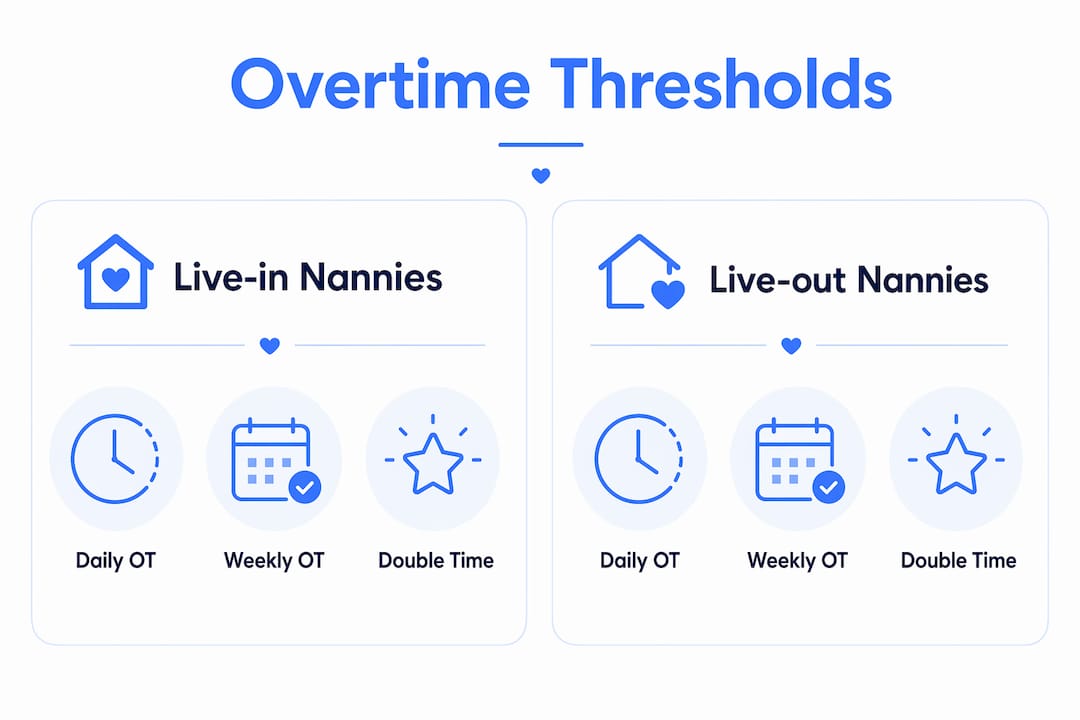
California nanny overtime law sets clear, mandatory pay thresholds that every household employer must follow. Under the California Domestic Worker Bill of Rights (AB 241), the rules differ based on how your nanny's time is spent. If your nanny qualifies as a personal attendant, meaning she spends at least 80% of her time supervising, feeding, or dressing a child, overtime kicks in after 9 hours per day or 45 hours per week at 1.5 times her regular rate. If she does not meet that threshold and falls under general domestic worker rules governed by Wage Order No. 15, overtime starts after 8 hours per day or 40 hours per week, with double time available in certain situations.
Quick-reference overtime thresholds:
- Personal attendant (private household): overtime after 9 hours/day or 45 hours/week at 1.5x pay; no double time
- Non-live-in domestic worker (not a personal attendant): overtime after 8 hours/day or 40 hours/week at 1.5x; double time after 12 hours/day or after 8 hours on the 7th consecutive workday
- Live-in domestic worker (not a personal attendant): overtime after 9 hours/day and for the first 9 hours on the 6th and 7th consecutive day; double time after 9 hours on the 6th or 7th day
| Worker Type | Daily OT Threshold | Weekly OT Threshold | Double Time |
|---|---|---|---|
| Personal attendant (live-out) | Over 9 hours | Over 45 hours | Not applicable |
| Non-live-in domestic worker | Over 8 hours | Over 40 hours | Over 12 hrs/day or 8+ hrs on 7th day |
| Live-in domestic worker | Over 9 hours | Over 45 hours | Over 9 hrs on 6th or 7th day |

How to calculate overtime pay for your California nanny
The overtime pay rate is always 1.5 times the worker's regular hourly rate. Getting that base rate right is the first step.
For hourly workers: The regular rate is simply the agreed hourly wage. If your nanny earns a certain hourly rate, her overtime rate is 1.5 times that regular rate.
For salaried workers: Under Wage Order No. 15, you divide the weekly salary by 40 for a non-personal attendant. For a personal attendant, the weekly salary is divided by 45 to find the regular hourly rate, with overtime pay at 1.5 times that rate.
Example: personal attendant working 50 hours in a week
- She works five long days each exceeding the daily regular hours; any time beyond regular daily hours triggers overtime.
- That produces several hours of daily overtime across the week.
- Her weekly total exceeds the weekly threshold, but those extra hours are already counted as daily overtime. You do not pay overtime twice for the same hours.
- Result: 45 hours at $22 ($990) plus 5 hours at $33 ($165) = $1,155 total.
Live-in vs. live-out distinctions matter here. Live-in nannies follow slightly different daily and weekly thresholds under Wage Order No. 15's special provisions, particularly around the 6th and 7th consecutive workday. Always track daily and weekly hours separately in your payroll records so you can apply the correct multiplier to each bucket of hours.
Exceptions and exclusions from nanny overtime rules
Not every domestic worker in California is covered by AB 241's overtime protections. Knowing who is excluded helps you classify workers correctly and avoid costly errors.
Workers excluded from the Domestic Worker Bill of Rights:
- Family members of the employer (parent, grandparent, spouse, sibling, or child)
- Babysitters under 18 years old
- Casual babysitters who work on an irregular or intermittent basis and do not babysit as a regular occupation
- Regional center providers serving individuals with developmental disabilities through a state or regional center voucher program
- Workers providing services under California's Child Care and Development Services Act or the CalWORKs program
Classification matters more than most employers realize. A nanny who spends more than 20% of her time on duties beyond supervising, feeding, or dressing a child is not a personal attendant. That means standard overtime rules apply, with the lower 8-hour daily threshold. Misclassifying a general domestic worker as a personal attendant to delay overtime can result in significant back pay liability.
One rule applies universally: overtime rights cannot be waived by contract or flat-rate agreement. Even a written agreement specifying a flat weekly salary does not eliminate your obligation to pay overtime if the nanny works beyond the applicable thresholds. California law treats these rights as absolute.
How to file an overtime wage claim in California
If overtime goes unpaid, both workers and employers need to understand the formal process for resolving it. The California Labor Commissioner's Office handles wage claims for domestic workers, including nannies.
Steps to file a wage claim:
- Document everything. Gather time records, pay stubs, work schedules, and any written agreements. The stronger your documentation, the clearer the claim.
- Calculate the unpaid amount. Identify each pay period where overtime thresholds were exceeded and compute the difference between what was paid and what was owed.
- Contact the Labor Commissioner's Office. You can file online, by mail, or in person at a local office. The Division of Labor Standards Enforcement (DLSE) processes claims and can schedule a settlement conference.
- Submit a formal wage claim (Form DLSE 1). Include all supporting records with your submission.
- Attend the conference or hearing. A deputy labor commissioner will review the evidence and issue a decision.
Deadlines apply. Wage claims for unpaid overtime generally must be filed within three years of the violation under California law. Missing that window can forfeit your right to recover.
For direct help, visit the Labor Commissioner's Office at dir.ca.gov or call the DLSE at 1-844-522-6734. The California Domestic Workers Coalition at cadomesticworkers.org also provides guidance specifically for nannies and caregivers navigating wage disputes.
Employers who misclassify workers or fail to pay overtime face back pay claims and enforcement actions from the Labor Commissioner. Proactive compliance is always less expensive than a formal claim.
Summary of California domestic worker overtime rules
| Worker Classification | Daily OT Trigger | Weekly OT Trigger | OT Rate | Double Time | Governing Law |
|---|---|---|---|---|---|
| Personal attendant (live-out) | Over 9 hrs | Over 45 hrs | 1.5x | None | AB 241 |
| Non-live-in domestic worker | Over 8 hrs | Over 40 hrs | 1.5x | Over 12 hrs/day; over 8 hrs on 7th day | Wage Order No. 15 |
| Live-in domestic worker | Over 9 hrs | Over 45 hrs | 1.5x | Over 9 hrs on 6th or 7th day | Wage Order No. 15 |
| Personal attendant (nonprofit, Wage Order No. 5) | Not applicable | Over 40 hrs or 7th day | 1.5x | None | Wage Order No. 5 |
Official resources for California nanny overtime compliance
These are the primary sources to consult when verifying rules, filing claims, or reviewing legal text.
- AB 241 FAQ (California DIR): The official state FAQ covering personal attendant definitions, overtime thresholds, and exclusions under the Domestic Worker Bill of Rights.
- Wage Order No. 15 (California DIR): The full regulatory text governing wages, hours, and working conditions for household occupations, including overtime provisions for live-in and live-out workers.
- California EDD Household Employer Guide: Covers payroll tax registration, SDI withholding, and quarterly reporting requirements for household employers.
- California Labor Commissioner's Office (DLSE): File wage claims, request compliance guidance, or access local office locations at dir.ca.gov/dlse.
- California Domestic Workers Coalition: Advocacy and plain-language resources for nannies and caregivers at cadomesticworkers.org.
- Registered payroll services: Using a payroll provider familiar with California household employment rules reduces the risk of calculation errors and missed filings.
How Thecaretracker helps you stay on top of overtime hours
Accurate hour logs are your first line of defense against wage disputes. Without a reliable record of daily and weekly hours, it is nearly impossible to verify whether overtime thresholds were crossed, let alone calculate the correct pay.
Thecaretracker is a free app built specifically for nannies and caregiving families. It gives both caregivers and employers a shared, transparent view of hours worked, schedules approved, and care details logged.
Key features that support overtime compliance:
- Track weekly hours accurately with a built-in time tracker that separates regular and overtime hours
- Receive and approve schedule requests digitally, creating a clear paper trail
- View all jobs in one unified calendar so nothing gets missed
- Access care information (allergies, medications, emergency contacts, nap schedules) instantly
- Submit and approve time-off and reimbursement requests within the app
For employers who want additional support, Thecaretracker also offers payroll consultation services to help you review past pay periods and correct any overtime errors before they become formal claims.
Pro Tip: Set a weekly reminder to review your nanny's logged hours before processing payroll. Catching an overtime threshold crossed mid-week is far easier to address than correcting three months of underpayment after a wage claim is filed.
For workforce scheduling insights that apply beyond the household, the Heyhive blog covers attendance and scheduling strategies relevant to employers managing flexible or part-time workers.
Thecaretracker is completely free for caregivers. Get started today and give your family and your nanny a clear, shared record of every hour worked.
Key Takeaways
California nanny overtime law requires time-and-a-half pay once daily or weekly hour thresholds are crossed, with the specific trigger depending on whether your nanny qualifies as a personal attendant.
| Point | Details |
|---|---|
| Personal attendant threshold | Overtime applies after 9 hours/day or 45 hours/week at 1.5x pay under AB 241. |
| General domestic worker threshold | Overtime starts after 8 hours/day or 40 hours/week, with double time after 12 hours/day. |
| Overtime rights cannot be waived | Flat-rate contracts do not eliminate overtime obligations under California law. |
| Classification determines the rule | A nanny spending more than 20% of time on non-attendant duties follows the lower 8-hour daily threshold. |
| Accurate records prevent disputes | Daily and weekly hour logs are required to calculate and verify correct overtime pay. |