
In almost every U.S. household, a nanny should be paid as a W-2 employee, not a 1099 contractor. The IRS and the Department of Labor both treat in-home childcare as household employment, because you set the schedule and control the work. Rare exceptions exist, mostly when care happens outside your home through the caregiver's own business, and we cover those next.
TL;DR:
- Payment as a household employee with W-2 wages is required unless the caregiver works outside your home for their own business and serves multiple unrelated families.
- Controlling the schedule, providing supplies, and working exclusively for one family indicate employee status, not contractor classification.
- Families must file W-2 forms and Schedule H each year, start with an EIN, and register for state unemployment insurance before paying their nanny.
- Misclassifying a nanny leads to significant back taxes, penalties, and lost worker protections such as unemployment and workers' compensation.
- Accurate, consistent time tracking is essential for compliance and simplifies tax filing, ideally supported by apps or payroll services to ensure proper recordkeeping.
Table of Contents
- Nanny W2 vs 1099: How Federal Law Actually Decides
- Which Tax Forms Apply, and When Do You File Them?
- What Payroll Taxes You Actually Owe as an Employer
- What Happens If You Misclassify Your Nanny
- When a 1099 Actually Fits
- Setting Up Payroll Without the Headaches
- W-2 vs. 1099: What Each Path Actually Costs You
- Why Your Nanny's Classification Matters to Her, Not Just You
- Reclassifying a Nanny from 1099 to W-2
- Does Your State Add Extra Rules?
- Why Families Get This Wrong, and What Actually Fixes It
- Free Time Tracking That Keeps Your Payroll Records Straight
- Sources
Nanny W2 vs 1099: How Federal Law Actually Decides
The IRS doesn't ask what you called your nanny in a signed agreement. It asks who controls the work. That's the heart of the common-law test the agency uses, and it breaks into three factors.
Behavioral control looks at whether you direct how the job gets done. If you set the hours, decide the daily routine, tell the nanny which activities to run, and provide the car seat or supplies, that's an employee relationship. A true independent contractor sets their own methods.
Financial control examines who bears the business risk. Nannies almost never invest in their own equipment, advertise services to multiple unrelated families on a rotating basis, or risk a profit-or-loss outcome the way a landscaping contractor might. They get paid a set hourly rate for time worked, which points to employment.
Type of relationship considers permanency and the nature of the work itself. A nanny who works ongoing, indefinite hours in your home, performing a role central to your household, looks like an employee, not a vendor providing a discrete project.
The DOL's Fact Sheet 13 applies a related "economic realities" test under the Fair Labor Standards Act. It asks whether the worker is economically dependent on you for their livelihood. A nanny who works for one family, full time, using your home and your supplies, is economically dependent on that family. Labels and payment method don't change that.
An actual IRS Form SS-8 case decision makes this concrete. A family and their in-home caregiver had a signed contractor agreement. The IRS reviewed the facts anyway and determined the worker was a household employee, because the family controlled the schedule and the work itself. The paperwork didn't matter. The facts did.
- Sets nanny's hours and daily schedule: employee indicator
- Nanny works for multiple families on her own terms: contractor indicator
- Family provides supplies, car seat, activities: employee indicator
- Nanny invests capital and risks profit/loss: contractor indicator
Pro Tip: A written contract calling your nanny a "contractor" carries zero legal weight if your actual working relationship looks like employment. Courts and the IRS look past the label every time.
Which Tax Forms Apply, and When Do You File Them?
Once you've established employee status, the paperwork follows a defined path. IRS Publication 926 sets the rules for household employers, and it's the single most useful document you'll reference all year.
You issue a Form W-2 once you've withheld federal income tax or once you've paid Social Security and Medicare wages that cross the threshold Pub. 926 defines for the tax year. You file Schedule H with your personal Form 1040 to reconcile the household employment taxes you owe. The Social Security Administration recommends filing W-2s electronically, and generally expects employee copies out by January 31 and SSA copies filed around the same window.
Form 1099 almost never applies here. The IRS reserves 1099-MISC or 1099-NEC for payments made in the course of a trade or business to independent contractors, not for household wages you pay out of personal funds. The narrow exception involves a caregiver who genuinely runs her own care business, which we'll cover in the exceptions section.
- Apply for an EIN before your first payroll (required for W-2 and Schedule H filing)
- File Schedule H with your 1040, even if you use a payroll service
- Give the nanny her W-2 copy by January 31
For thresholds specific to this tax year, the 2026 nanny W-2 rules breakdown walks through the exact dollar triggers and overtime box entries.
What Payroll Taxes You Actually Owe as an Employer
Household employment tax has two separate tracks: what you owe as the employer, and what you withhold from the nanny's pay. Confusing the two is where most families get into trouble.
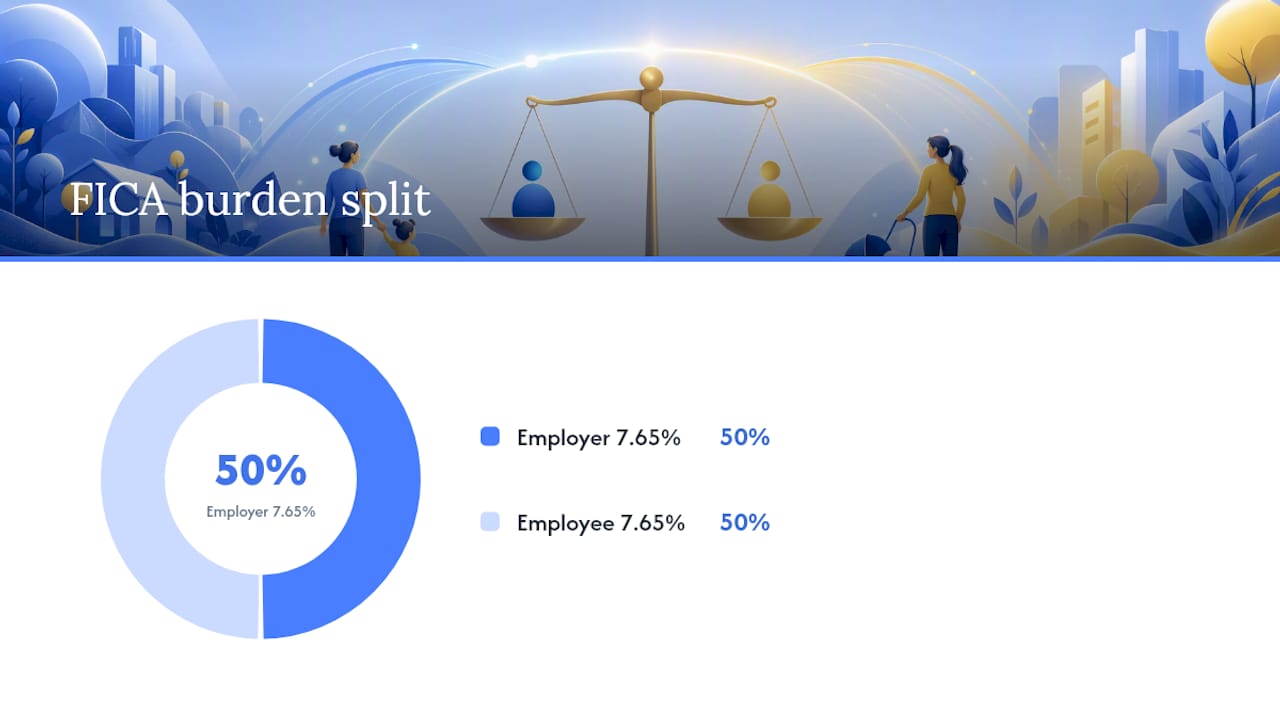
FICA (Social Security and Medicare) splits 15.3% between you and your nanny once wages cross the Pub. 926 threshold, roughly half paid by you and half withheld from her check. If you misclassify her as a 1099 contractor, she'd be stuck covering the full self-employment tax burden herself, nearly double what she'd owe as an employee. That's a real cost you'd be shifting onto her paycheck, not just a paperwork shortcut.
FUTA (federal unemployment tax) applies once you cross a separate wage threshold in a calendar quarter, and most states layer on their own unemployment insurance contribution on top. You'll typically register with your state's labor department for a UI account once you have a household employee on payroll.
Income tax withholding is optional for household employees, but many nannies request it so they don't owe a lump sum at filing time. If you don't withhold, she pays quarterly estimated taxes instead.
- Calculate FICA using current-year wage figures with a nanny tax calculator
- Register for state unemployment insurance before your nanny's first paycheck
- Deposit federal employment taxes according to the schedule Pub. 926 assigns your household
Many families outsource this entirely to a household payroll service rather than track deposit schedules themselves, and that's often the right call if tax administration isn't your thing.
What Happens If You Misclassify Your Nanny
Treating an employee as a 1099 contractor doesn't just risk an audit. It creates a specific, calculable bill. If the IRS reclassifies your nanny after the fact, you owe both the employer and employee shares of unpaid FICA, unpaid FUTA, back state unemployment contributions, interest on all of it, and penalties layered on top.
The IRS cross-references W-2 and 1099 filings against Social Security wage records, and gaps surface through routine data matching, not just targeted audits. Willful, repeated misclassification can escalate to criminal penalties in extreme cases, though most household situations resolve through civil penalties and back taxes.
Your nanny loses real protections too: no unemployment eligibility if the relationship ends, no workers' compensation coverage if she's hurt on the job, and gaps in her Social Security earnings record.
- Back FICA (both shares) plus interest and penalties
- Back FUTA and state unemployment contributions
- Nanny's lost unemployment and workers' comp eligibility
The IRS also offers the Voluntary Classification Settlement Program, which lets you correct past misclassification with reduced penalties if you come forward before an audit finds you first.
When a 1099 Actually Fits
A handful of arrangements genuinely qualify for contractor treatment. A caregiver who runs her own licensed care business, advertises to multiple unrelated families, sets her own rates, and provides care at her own location, not yours, may legitimately be a 1099 contractor. Document those business-like factors carefully if you're relying on them.
Nanny shares complicate things further. Each family in a share remains an employer for the hours they use the nanny; you can't split employer duties onto the other household.
- Care performed at the caregiver's own licensed business location
- Nanny advertises to and serves multiple unrelated families
- Nanny sets her own rates and schedule independently
Pro Tip: Unsure which side of the line you're on? File Form SS-8 and let the IRS make an official determination. It's free, and it protects you if you've made a good-faith error.
Setting Up Payroll Without the Headaches
Compliance isn't complicated once you break it into steps; understanding your payroll tax obligations is a key part of setting up your nanny's employment correctly. Here's the order that actually works.
- Apply for an EIN. You'll need one for W-2 and Schedule H filing; the IRS household employer page walks through the application.
- Collect an SSN and complete Form I-9. Verify work eligibility before the first day on the job.
- Sign a written employment agreement. Spell out hours, pay rate, overtime terms, and paid time off, even though the agreement alone won't determine tax classification.
- Track hours weekly. Accurate timesheets are your best defense in any dispute or audit, and they're the foundation for correct FICA and overtime calculations.
- Set up withholding or a payroll service. Decide whether you'll handle deposits yourself or hand it to a household payroll provider.
- File W-2 and Schedule H at year-end. Give your nanny her copy by January 31, file Schedule H with your 1040.
Keep timesheets, I-9 forms, and W-2 copies for at least four years; the IRS can request records that far back.
Pro Tip: A DIY spreadsheet works fine if you're consistent about it. Where families slip up is inconsistency, missing weeks, rounded hours, no signature trail. That's what turns an honest mistake into a documentation problem during an audit.
For a full walkthrough of getting payroll running from scratch, the nanny payroll setup guide for U.S. households covers each step in more depth.
W-2 vs. 1099: What Each Path Actually Costs You
W-2 status costs more up front. You're paying half of FICA, likely funding state unemployment insurance, and handling quarterly or year-end filings. Families sometimes look at that bill and wonder whether 1099 is the simpler, cheaper route.
It isn't, for two reasons. First, it's usually not legal, given how the IRS and DOL tests apply to a controlled, in-home caregiving role. Second, even where it were legal, you'd be shifting the full 15.3% self-employment tax burden onto your nanny's shoulders instead of splitting it, which tends to strain the relationship with someone caring for your kids.
The advantage of W-2 status runs the other direction. It gives your nanny access to unemployment benefits if the job ends, builds her Social Security earnings record, and lets you claim the Dependent Care FSA or the Child and Dependent Care Credit, which are benefits unavailable for payments to a 1099 contractor in most household situations.
The disadvantage most families actually feel is administrative: registering for state unemployment insurance, running withholding calculations, and filing Schedule H every spring. That's real friction, but it's friction you can hand to a payroll service for a modest monthly fee rather than something that should push you toward misclassification.
Why Your Nanny's Classification Matters to Her, Not Just You
Classification isn't just a tax-filing question. It determines what safety net exists if something goes wrong for the person caring for your children.
A W-2 nanny qualifies for unemployment insurance if you end the job, provided your state UI contributions were made on time. A 1099 worker generally doesn't, since unemployment programs are funded through employer contributions tied to W-2 wages.
Workers' compensation coverage, required in many states for household employees working a minimum number of hours, protects your nanny if she's injured on the job, say a fall while carrying a child down stairs. Contractor status typically leaves her without that coverage, and without it, a workplace injury becomes her financial problem, not a covered claim.
Social Security contributions build her long-term retirement and disability record. Every quarter of W-2 wages reported adds to that record. Wages paid off the books, or improperly routed through a 1099, either don't count toward her benefits or force her to cover the full self-employment tax herself to get partial credit.
These aren't abstract protections. They're the difference between a nanny who has recourse after a layoff or injury and one who doesn't, and the DOL's own framing makes clear that worker protections follow directly from correct classification, not from what either party prefers to call the arrangement.
Reclassifying a Nanny from 1099 to W-2
If you've been paying your nanny as a 1099 contractor and you're realizing that's the wrong classification, correcting it now is far better than waiting for an IRS letter. The process is straightforward even if it feels daunting the first time.
Start by applying for an EIN if you don't already have one, then register with your state's unemployment insurance program. Going forward, calculate her wages as W-2 pay, withholding her share of FICA and any income tax she requests.
For the current year, you'll issue a corrected W-2 reflecting wages paid, and you may need to file an amended Schedule H if you already filed your return under the wrong assumption. If prior years were also misclassified, the IRS Voluntary Classification Settlement Program offers a path to fix past filings with reduced penalty exposure, a far better outcome than waiting for a data-matching flag to trigger an audit.
Talk with your nanny before you make the switch. She may have budgeted around 1099 pay without withholding, so walk her through what changes in her take-home amount and what she gains in return, particularly Social Security credit and unemployment eligibility. Most nannies, once they understand the trade-off, prefer W-2 status.
Does Your State Add Extra Rules?
Federal law sets the floor, but plenty of states build additional requirements on top. Several states mandate written employment agreements or specific pay-frequency rules for domestic workers that go beyond federal minimums. A growing number extend workers' compensation requirements to household employers once a nanny works a minimum number of hours weekly, sometimes as few as one.
Overtime rules vary meaningfully too. Federal law generally requires overtime pay for hours worked past 40 in a week, but some states apply daily overtime thresholds or different live-in caregiver exemptions than federal law allows. State unemployment insurance registration thresholds and contribution rates also differ, sometimes significantly, from one state to the next.
Because these variations affect real dollar amounts and legal exposure, check your specific state's department of labor and unemployment insurance agency before finalizing your payroll setup, rather than assuming federal rules are the whole picture.
Why Families Get This Wrong, and What Actually Fixes It
Most families who misclassify a nanny aren't trying to cut corners. They're following advice from a friend, a nanny agency, or a nanny herself who requested 1099 status thinking it simplified her taxes. That advice is almost always wrong, and it usually reflects a misunderstanding of what "contractor" legally means rather than bad intent.
The gap I see most often isn't ignorance of the rules. It's underestimating how mechanically the IRS applies them. Families assume a signed agreement or a nanny's preference carries legal weight. The SS-8 case proves otherwise: facts on the ground override paperwork every time.
If I had to name the single highest-leverage fix, it's not the tax withholding calculation or the EIN application, both are mechanical once you start. It's building a habit of documenting hours and duties from day one, before any dispute or audit ever forces the question. Families who track this consistently rarely face reclassification fights, because the facts already support their W-2 decision. Families who wing it on memory and verbal agreements are the ones who get caught flat when a nanny files for unemployment and the state asks who her employer was.
Prioritize the paper trail over the paperwork panic. The forms follow easily once the facts are clean.
— mercedes
Free Time Tracking That Keeps Your Payroll Records Straight
Everything in this guide points to one habit that makes W-2 compliance manageable: accurate, consistent hour tracking. There are apps that help you log hours, submit timesheets, and request schedule changes, and those records become the backbone of your Schedule H filing and FICA calculations at year-end.
Thecaretracker isn't a payroll processor or a tax preparer, and it won't file your Schedule H or remit deposits for you. For that side of compliance, pair it with a household payroll service or a tax professional, or book a premium consultation with Thecaretracker if you want hands-on help sorting out a misclassification or setting up payroll for the first time. Start by tracking your nanny's hours this week. Clean records now save you a much harder conversation with the IRS later.
This article is general information, not a substitute for advice from a qualified financial advisor. Consult a qualified financial professional about your own circumstances before acting on anything here.
Sources
Every claim in this guide traces back to a specific government source, not a blog's interpretation of one. IRS Publication 926 is the master reference for household employer tax rules. The DOL's Fact Sheet 13 governs worker-protection questions under the FLSA. SSA's W-2 filing guidance covers the mechanics of getting wages reported correctly.
- Publication 926, Household Employer's Tax Guide (2024)
- Fact Sheet 13: Employment Relationship Under the FLSA
Accurate hour logs feed directly into all three. A tool like Thecaretracker's time-tracking feature generates the weekly records that make W-2 wage totals and overtime calculations defensible if a state agency ever asks questions.