
Pick a consistent schedule that fits your state's pay-frequency rules, and for most hourly nannies, weekly or bi-weekly pay works best because it lines up cleanly with overtime tracking. Confirm your state's requirements through the Department of Labor's state payday guidance before locking anything in. Keep the $3,000 household-employer tax threshold in view too, since crossing it mid-year changes your withholding obligations.
TL;DR:
- Most households should pay weekly or bi-weekly to align with overtime calculations based on the workweek, especially with variable schedules.
- Paying in arrears, one week after work is completed, minimizes overpayment risk and aligns with common household payroll practices.
- State laws often mandate minimum pay frequencies and lag times, so checking the current rules annually is essential, especially near state borders.
- Using tools like detailed timesheets and payroll apps ensures accurate hour tracking, preventing errors that could lead to compliance issues.
- Once household wages reach $3,000 annually, FICA taxes apply to the full amount paid, making early planning crucial to avoid penalties.
Table of Contents
- Which Nanny Pay Frequency Should You Choose?
- Should You Pay in Arrears or Pay Current?
- What Are the State Rules on Pay Frequency and Lag?
- What Payroll Timing Checklist Should You Follow Each Pay Period?
- How Should You Handle Direct Deposit, Checks, and Payment Apps?
- When Do Taxes and Withholding Kick In for 2026?
- How Does TheCareTracker Keep Your Pay Periods Accurate?
- Why Compliance Should Drive Your Pay Schedule, Not Convenience
- Get Help Setting Up or Fixing Your Nanny Payroll
- Where to Verify These Rules Yourself
- Sources
- FAQ
Which Nanny Pay Frequency Should You Choose?
Four standard pay frequencies cover almost every household payroll setup, and each one produces a different number of pay periods per year. Weekly pay offers the most frequent pay periods, followed by bi-weekly, then semi-monthly, and monthly with the fewest. The DOL's payday guidance treats these as the baseline options, though your state may narrow the list.
The right choice depends on how your nanny's hours behave and how much payroll admin you want to handle.
- Weekly: Best for hourly nannies with variable schedules; overtime math stays simple since overtime is calculated per workweek anyway.
- Bi-weekly: A strong middle ground; fewer payroll runs than weekly, but still tracks overtime cleanly across two clear seven-day workweeks.
- Semi-monthly: Works better for salaried arrangements, though it can complicate overtime because the 15th and last day of the month rarely align with a workweek boundary.
- Monthly: Rare in household employment; it strains cashflow for the caregiver and makes overtime reconciliation harder to audit.
Families running hourly schedules with any week-to-week variation generally do best on weekly or bi-weekly pay, since overtime is measured by workweek, not by pay period. Salaried nannies with fixed weekly hours can handle semi-monthly or monthly pay without the same friction.
Should You Pay in Arrears or Pay Current?
Paying in arrears means payday compensates for a workweek that already ended, typically with a one-week lag. Paying current means you pay for hours worked during the same period that includes payday, which forces you to estimate hours you haven't seen yet.
- Set the lag deliberately. A one-week lag (workweek Monday through Sunday, payday the following Friday) is the most common arrangement in household payroll, and it gives payroll processors time to calculate withholding accurately.
- Favor arrears to avoid overpayment. Paying current requires guessing at hours that haven't happened, which creates overpayment risk whenever your nanny's schedule shifts. Paying in arrears removes that guesswork.
- Spell it out in the contract. Note the exact start date and lag structure in writing, and address the first and last paycheck explicitly. A common approach: the first paycheck covers a partial period and arrives on the next regular payday, and the final paycheck follows the same lag rather than an immediate lump payment on the last day worked.
What Are the State Rules on Pay Frequency and Lag?
States can mandate a minimum pay frequency, a maximum number of days between the end of a pay period and payday, or both, and these rules apply to household employers just as they apply to any other employer. Some states go further for domestic workers specifically. New York, for example, requires weekly pay for manual workers, a category that has been applied to domestic employees in guidance from the state's labor department.
Because these rules shift by state and change over time, don't rely on generic advice you find online.
- Check the DOL's state-by-state payday page first; it lists frequency minimums and lag maximums by state.
- Cross-reference with your state's labor department directly, since some domestic-worker provisions live outside the general payday statute.
- If you're near a state line or your nanny works across state boundaries, confirm which state's rules actually govern the employment relationship.
- Revisit the rules annually. State legislatures update wage and hour law often enough that last year's answer isn't guaranteed to still be correct.
What Payroll Timing Checklist Should You Follow Each Pay Period?
A reliable pay period routine comes down to five habits repeated consistently, not a one-time setup you configure and forget.
- Log hours against the workweek, not the pay period. Overtime calculations depend on a defined seven-day workweek, so your timesheet needs to map to that window even if your pay period spans two workweeks.
- Submit payroll ahead of bank cutoffs. ACH transfers and check processing both need lead time, and bank holidays push everything back further than most employers expect.
- Save every pay stub. Keep digital or paper copies documenting gross pay, withholding, and net pay for each period.
- Retain ACH confirmations or canceled checks. These records back up your pay stubs if a tax authority or your nanny ever questions a payment.
- File records toward year-end reporting. Everything you save each pay period becomes the source data for your W-2 and Schedule H preparation.
Pro Tip: Set a recurring calendar reminder two business days before each payday to confirm hours, submit payroll, and check for upcoming bank holidays. Missing that window by even a day can push a direct deposit past your nanny's expected payday.
How Should You Handle Direct Deposit, Checks, and Payment Apps?
Standard ACH transfers usually take one to three business days to land, and same-day ACH exists but comes with cutoff times your bank sets, not you. That timing matters most around the last pay period before a holiday.
- Roughly 19 states restrict employers from mandating direct deposit, which means your nanny has to volunteer for it in writing rather than being required to accept it.
- Payment apps like Venmo, Zelle, or Cash App can move money fast, but none of them withhold taxes or generate pay stubs, so you still need a separate payroll record even if you use one to deliver funds.
- If a transfer fails, pay through a backup method immediately rather than waiting for the original attempt to resolve, and log the failure along with how you fixed the authorization or account error.
Keeping a signed direct-deposit authorization on file protects you if a state ever asks how you documented consent.
When Do Taxes and Withholding Kick In for 2026?
In 2026, once you pay a single household employee $3,000 or more in cash wages during the year, you owe Social Security and Medicare tax (FICA) on the full amount paid, not just the portion above the threshold. That single number, set by IRS Publication 926, drives most of the timing decisions in this section.
- FICA totals 15.3% of wages, split as 7.65% from you as the employer and 7.65% withheld from your nanny's pay; some families choose to cover the employee's share themselves as a benefit, which is legal but increases your cost.
- Federal income tax withholding isn't required unless your nanny requests it in writing, though state income tax withholding rules vary.
- Quarterly estimated payments generally track calendar quarters, so build a reminder around each quarter's close to avoid an underpayment penalty.
- At year-end, issue a W-2 to your nanny and file Schedule H with your own federal tax return to report the household employment taxes you paid.
Every pay-period record you keep during the year, from timesheets to pay stubs, feeds directly into that Schedule H filing.
How Does TheCareTracker Keep Your Pay Periods Accurate?
Accuracy problems with nanny pay periods almost always trace back to inconsistent hour tracking, not bad math. The TheCareTracker app centralizes timesheets, schedule approvals, and care information in one place, so the hours you're paying against match what actually happened during each workweek.
- Nannies log hours in real time, which removes the guesswork that can lead to arrears disputes or overtime miscalculations.
- Approved schedules sync into one calendar, so you avoid reconciling a paper timesheet against messages.
- Our nanny payroll setup guide and pay-stub recordkeeping guide walk through the documentation you'll want on hand before quarterly payments or year-end filing.
- A consistent timesheet habit each week makes your quarterly estimated payments and year-end preparation a matter of pulling records, not reconstructing them from memory.
Why Compliance Should Drive Your Pay Schedule, Not Convenience
Most advice on nanny pay periods treats the decision like a scheduling preference. It isn't. The frequency you choose determines how cleanly you can calculate overtime, and overtime miscalculation is one of the most common, most expensive mistakes household employers make. A semi-monthly schedule that looks tidy on a calendar can quietly break your overtime math because it doesn't respect workweek boundaries.
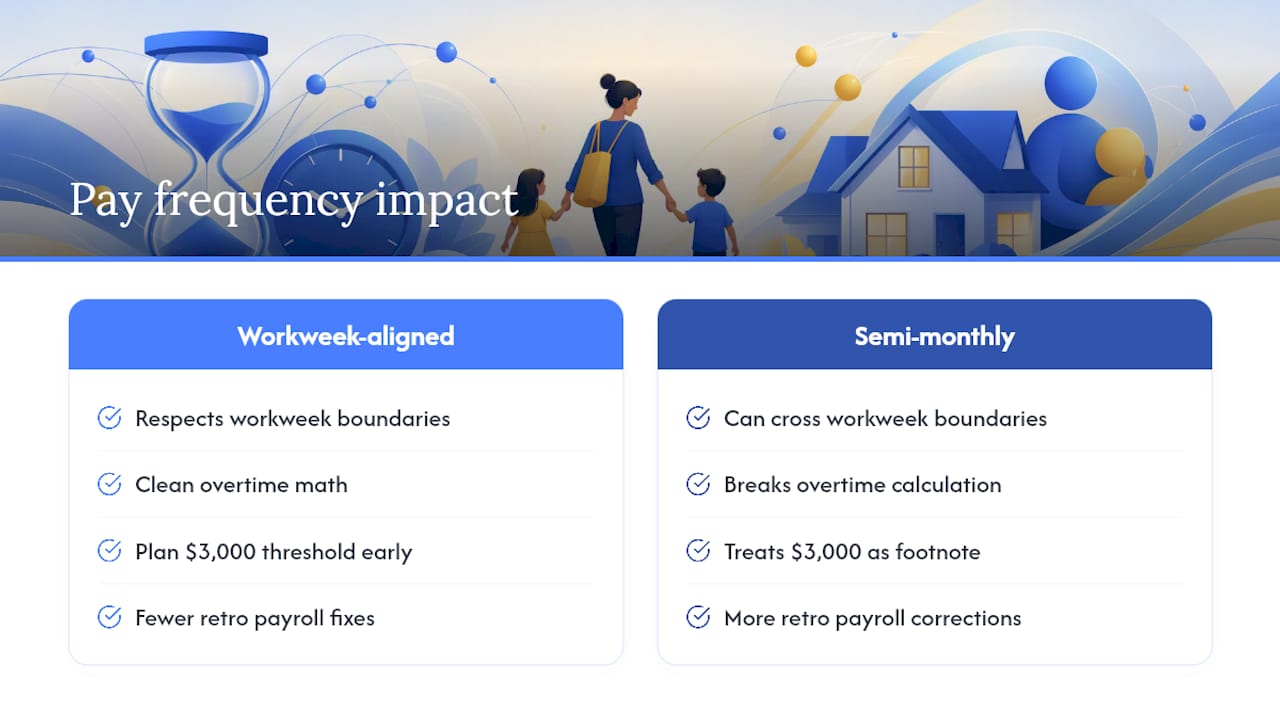
The $3,000 threshold gets treated as a footnote in a lot of guidance, when it should be a planning trigger. Families who wait until they've already crossed it to think about withholding end up scrambling to correct payroll retroactively, which is harder and more stressful than setting it up correctly from the first paycheck.
If you take one thing from this guide, let it be this: choose your pay frequency around your nanny's actual hour pattern first, confirm your state's rules second, and treat tax threshold planning as a day-one task, not a year-end surprise. Tools that log hours consistently—whether that's a dedicated app or a disciplined spreadsheet habit—matter more than which specific payday you pick.
**
Get Help Setting Up or Fixing Your Nanny Payroll
Getting pay periods right the first time saves you from untangling missed withholdings or inconsistent paychecks months later. TheCareTracker is the alternative to guessing your way through household payroll: our Premium consultation is a $150 one-time session built specifically around first and last paycheck timing, missed withholdings, and getting your schedule compliant with your state's rules.

If your payroll history needs correcting rather than just starting fresh, our Prior Wage Reporting & Household Payroll Cleanup Services address that directly, no published price required upfront since scope varies by household. And if timesheet accuracy is your real bottleneck, the free scheduling and time-clock app tracks hours, manages schedule approvals, and centralizes care information so your pay periods reflect what actually happened each week. Book a consultation or download the app to get your next pay period on solid ground.
Where to Verify These Rules Yourself
For pay-frequency and lag rules by state, check the DOL's state payday page. For tax thresholds and withholding, see IRS Publication 926.
This article is general information, not a substitute for advice from a qualified financial advisor. Consult a qualified financial professional about your own circumstances before acting on anything here.
Sources
- U.S. Department of Labor — State Payday Requirements
- IRS Publication 926, Household Employer's Tax Guide
- GTM — Paying in Arrears or Current? What’s the Best Way to Pay My Nanny?
- Care
FAQ
How much is a nanny paid per hour in the U.S.?
Nanny pay varies widely by region and experience, and no single national hourly figure applies evenly across every market. Check local nanny agency surveys or Care.com's household payroll guide for regional benchmarks before setting a rate.
What are the standard paid holidays for nannies?
There's no federal mandate requiring paid holidays for nannies, so paid holiday policy is a matter of your written work agreement. Many families offer major holidays like New Year's Day, Thanksgiving, and Christmas as paid days off, but this is a negotiated benefit, not a legal requirement.
Is it better to pay a nanny weekly or bi-weekly?
Both work well, but the right choice depends on your nanny's schedule consistency and your state's rules. Weekly pay simplifies overtime tracking for hourly nannies with variable hours, while bi-weekly cuts your payroll runs in half and still respects workweek-based overtime calculations as long as each workweek stays intact within the period.
Which state pays nannies the most?
Pay rates for nannies tend to run highest in metro areas with a high cost of living, particularly on the coasts, though exact figures shift with local demand and experience level. Rather than chasing a single "highest paying state" figure, compare local nanny agency data for your specific metro area.
What happens if I don't withhold FICA once I cross $3,000 in wages?
Once you pay a household employee $3,000 or more in a year, you're required to withhold and pay FICA taxes on the full wage amount, not just the excess over $3,000. Skipping this exposes you to back taxes and penalties, so tracking your year-to-date wages each pay period matters more than treating the threshold as a distant concern.