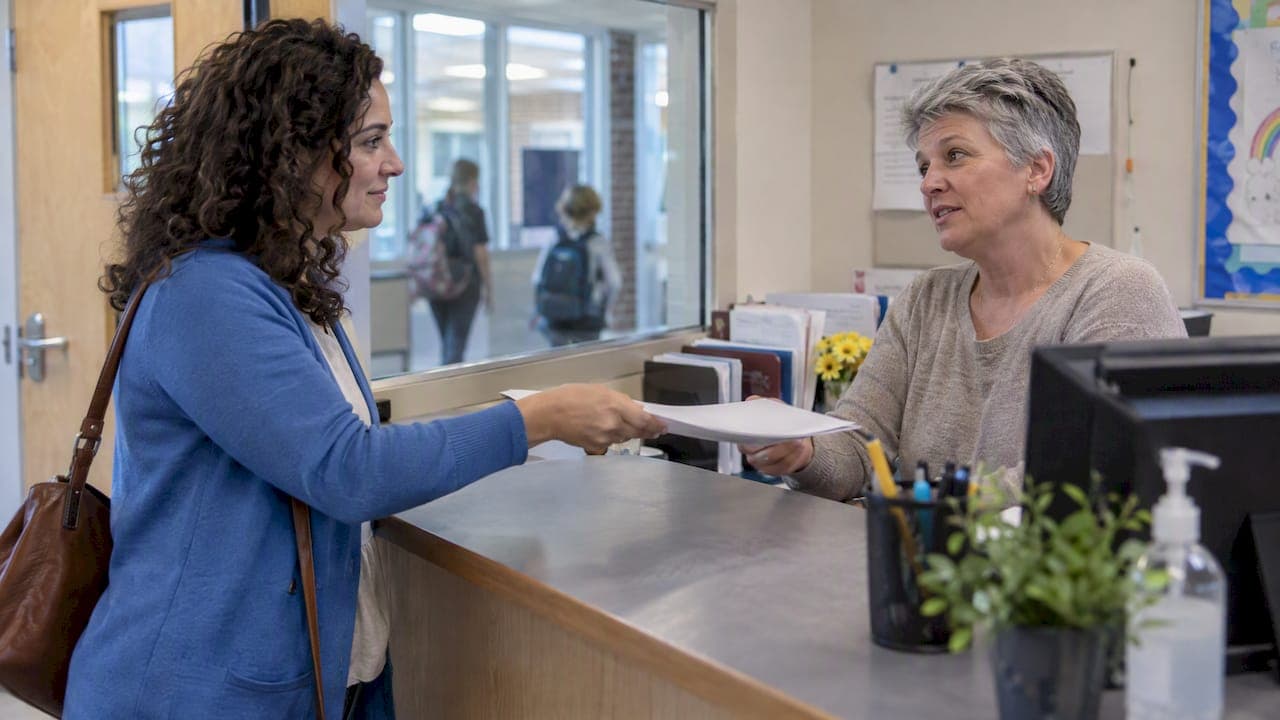
Yes, your nanny can pick your child up from school, but only after you authorize her with the school. Being the person you trust is not enough. The school releases children only to adults on its approved list, and staff will check a photo ID at the gate. This guide covers how to add your nanny, what a written authorization letter must say, how long it takes, and what to do when plans change at the last minute. It also covers how to keep the work records that go with a pickup job.
TL;DR
- A nanny or au pair can pick up your child once you add her to the school's authorized pickup list, in writing or through the school's parent portal.
- Plan for a delay. Many schools and programs need 24 to 48 hours to process a new name.
- "Emergency contact" and "authorized pickup" are different categories. Your nanny should be listed as both.
- She should carry a government-issued photo ID every time. Staff cannot make exceptions for a familiar face.
- Pickup hours are paid work hours. Track them, even if you pay in cash.
Table of Contents
- Who is allowed to pick up a child
- Two lists, two purposes
- How to add your nanny to the pickup list
- How long it takes
- Writing an authorization letter for a one-off pickup
- Photo ID: the rule that surprises regular caregivers
- "But they know her": why familiarity does not count
- Mistakes that cause pickup problems
- Pickup-only nannies and driving questions
- What to give your nanny on day one
- Our perspective: pickups are work hours, so record them
- Pickup hours, pay, and household taxes
- Help with household payroll
- A quick checklist before the first pickup
- FAQ
- Sources
Who is allowed to pick up a child
Schools protect children by releasing them only to known, recorded adults. The federal Caring for Our Children standards say caregivers and teachers should release a child only to an authorized adult, and that programs should establish and record the child's legal guardians at enrollment.
Within that rule, parents decide who else goes on the list. A school pickup guide lists the usual choices: parents or legal guardians, grandparents, babysitters or nannies, older siblings if the school allows it, family friends, and carpool parents. Each school sets its own details, and authorization generally has to be given in advance.
So the answer to "can my nanny pick up my kids?" is yes, if you have done the paperwork. The same applies to an au pair, a grandparent who helps out, or a neighbor who covers one afternoon.
Two lists, two purposes
Most schools keep an emergency contact list and an authorized pickup list. They are not the same thing.
- Emergency contacts are called when a child is sick or hurt.
- Authorized pickup designees are the only people permitted to sign a child out.
Your nanny should be on both. Digital portals make this easy to get wrong. One school's guide for adding pickup people in its portal walks families through entering the person and then marking them for pickup. If you only add a name to the family directory, the school may not treat that person as cleared to take your child.
After you submit the change, open the portal again and confirm the status says what you meant it to say. If you can, ask the front office to confirm it by phone or email.
How to add your nanny to the pickup list
The process differs by school, district, and program, but it usually looks like this.
- Read the school's policy. Check the handbook or the school website for the pickup section. Some schools use a paper form, some email, some a portal.
- Gather your nanny's details. You will need her full legal name, phone number, address, and relationship to your child. The relationship is usually "nanny" or "caregiver."
- Submit the change in the required format. Written or portal submission is the norm. Phone-only requests are often refused.
- Check both categories. Add her as an emergency contact and mark her as authorized for pickup.
- Allow processing time. Do not plan her first pickup for the same morning.
- Confirm and tell her. Send her a screenshot or a copy of the confirmation, and make sure she knows what the school will ask for.
- Repeat for every program. The after-school club, the bus company, a sports program, and the school itself may each keep their own list.
That last step catches many families. The school may have approved your nanny, but the after-school program in the same building may not know her.
How long it takes
Build in a buffer. A town school-age child care form requires any pickup list change to be submitted in writing, with at least 48 business hours of notice. Other programs ask for 24 hours or less, and some process changes the same day. The only reliable answer comes from your school's office.

An addition made on the morning of a pickup may not show up on the list staff are using that afternoon. If you have an emergency change, send the written update and then call the office to confirm it was received.
Writing an authorization letter for a one-off pickup
Sometimes the person picking up is not on the standard records. Maybe your nanny is out sick and a friend is stepping in, or a new sitter covers a single week. In that case, you write a letter or fill out the school's form.
A licensed child care program in Oregon, for example, must have documentation of parent permission.pdf) when a person who is not in the child's records picks the child up. A good letter includes:
- The child's full name (and grade, if the school asks)
- The full name of the person authorized
- Their phone number and relationship to your child
- The date or timeframe the permission covers
- Your signature and your own contact number
Some schools and after-school programs publish a template. One recreation department's after-school pickup letter is meant for individuals not listed on the child's emergency form. If your school has its own form, use it rather than a generic letter.
Here is a plain version you can adapt:
I, [parent's full name], give permission for [full name of person] to pick up my child, [child's full name], from [school or program] on [date or dates]. Their phone number is [number] and they are my child's [relationship]. I can be reached at [number]. Signed, [parent signature and date].
Send it as early as the school allows, and send a copy to your nanny so she can show it if asked.
Photo ID: the rule that surprises regular caregivers
The pickup-person check is not a formality. Staff compare the adult in front of them with the name on the list, and they usually check a photo ID for anyone who is not a parent or guardian. Oregon's licensing guidance says the same: staff verify photo ID at pickup.pdf), and the Caring for Our Children standards cover how programs should collect and verify identity.
This applies even if your nanny has done the pickup every day for a year. A government-issued photo ID, like a driver's license or state ID, should always be in her bag or wallet. Without it, the school may refuse to release your child, which is stressful for everyone.
"But they know her": why familiarity does not count
It feels odd when a teacher who sees your nanny daily asks for ID. The rule exists because staff cannot judge from appearance alone who is safe. Schools train staff to follow the list exactly, and a district preschool handbook, the Madison Elementary School District 38 handbook, shows how firm schools can be about professional boundaries between staff and families.
The practical lesson for you: do not ask the front desk for an exception, and do not be offended when your nanny is asked for ID. The system works because it treats everyone the same.
A change of caregiver is also a change for your child. If a new nanny or sitter is stepping in, tell your child ahead of time who will be at the gate and why. A parent guide to secure attachment explains why predictable handoffs matter to young children.
Mistakes that cause pickup problems
Assuming the list is permanent. Many schools require lists to be renewed each school year, and portals may need you to review and re-confirm contacts. Check the list at the start of each year and again after winter break or any change in your schedule.
Adding a name to the directory only. As noted above, a portal entry may need a separate pickup designation.
Forgetting secondary programs. Bus companies, aftercare, sports, and camps keep their own records.
Last-minute changes by text. A text to the teacher is rarely enough. Use the official channel.
Letting the ID slip. Remind your nanny to carry hers every day, not only on the first.
Skipping the name spelling. The name on the list should match the name on the ID. Nicknames can cause a mismatch.
Pickup-only nannies and driving questions
Many families hire a nanny just for the afternoon run. Listings for after-school help often include pickup, driving to activities, homework supervision, and snacks. If your nanny will drive, settle three things before the first day: whether she uses her own car or yours, who pays for gas and mileage, and whether your auto insurance covers her driving your child. Ask your insurer about the last one. If a school bus brings your child home, check whether the district allows a caregiver to ride with or meet the child at a stop, since some districts have their own bus rules.
Put the pickup rules in writing in your work agreement: which schools and programs she is cleared for, which days, what happens if she is running late, and who she calls first if the school will not release your child.
What to give your nanny on day one
A short pickup sheet saves frantic phone calls. Include:
- The school and program addresses and the exact pickup door or line
- Dismissal times, including early-release days
- Your phone numbers and a backup adult
- The child's allergies, medications, and any pickup restrictions
- A copy of the authorization confirmation
- A reminder to bring her photo ID
If you use our app, your nanny can see emergency contacts and care details like allergies and medications in one place on her phone, and our guide on accessing emergency contacts in two minutes shows the steps. That helps, though it does not replace the school's own list.
Our perspective: pickups are work hours, so record them
We build a free app for nannies and caregivers, and we talk to household employers every week about hours and pay. Here is what we see. Families put real effort into school safety paperwork and then leave the work records vague. The two belong together.
Pickup is paid time. A "quick pickup" that starts with a 2:45 dismissal, includes traffic, a stop at the pharmacy, and ends with a snack at home is not fifteen minutes. When the hours are not written down, nannies and parents end up disagreeing about what was agreed, and that hurts trust on both sides.

We suggest that you and your nanny agree on how time is recorded from the first day: the start and end of each shift, any extra stops, and who approves changes. A shared record gives you accuracy, and it gives her proof of income. It is the same idea as the school list: written down, checked, and the same for everyone.
If you pay by cash, the record matters more. Our guide on tracking hours and receipts when you pay a nanny in cash explains how to keep clean proof.
— mercedes
Pickup hours, pay, and household taxes
School pickup does not change your tax status as an employer, but the hours do count toward wages. A few facts to know, all for U.S. households:
- A nanny you direct and control is generally a household employee. The IRS Topic 756 lists babysitters among household employees.
- Paying in cash does not remove your obligations. According to IRS Publication 926 for 2026, you generally must withhold Social Security and Medicare taxes, or pay them yourself, once you pay a household employee cash wages of $3,000 or more in 2026.
- The same publication points out that federal unemployment (FUTA) tax can apply if you pay $1,000 or more in cash wages in any calendar quarter.
- The combined Social Security and Medicare rate is 15.3% of wages, split 7.65% for the employer and 7.65% for the employee, per the same IRS guidance.
These thresholds change, and state rules differ. For your own situation, check the current IRS publication or talk with a payroll professional or tax adviser. For a walk-through, see our guides on how to calculate nanny taxes and setting up nanny payroll. If you want a simple way to log pickup shifts, our nanny timesheet template is a good place to start.
Help with household payroll
If the pickup question made you realize your nanny's pay records are thin, we can help. We offer a Standard Payroll Consultation package for household employers at $150 one-off, and a premium consultation, also $150 one-off, plus Prior Wage Reporting and Household Payroll Cleanup Services for families who need to tidy up past records. You can see the Standard Payroll Consultation package here or learn about prior wage reporting and payroll cleanup. Your nanny can also use our free time-clock app to track her hours and view her jobs in one calendar.
A quick checklist before the first pickup
- I read the school's pickup policy
- My nanny is on the pickup list, not only the emergency list
- I checked the portal or received written confirmation
- Aftercare, bus, and activity programs are updated
- My nanny has her photo ID and the school's address and dismissal time
- We agreed on how pickup hours are recorded and paid
- A calendar reminder is set to review the list each school year
FAQ
Can a nanny pick up kids from school?
Yes, as long as you have authorized her with the school. Add her to the authorized pickup list, in writing or through the school's portal, and confirm that she is marked for pickup. She should carry a government-issued photo ID.
How do I write an authorization letter to pick up my child from school?
Include your child's full name, the full name of the person picking up, their phone number and relationship to your child, the dates the permission covers, and your signature. Use the school's own form if it has one. Some programs want it 48 hours ahead.
Can someone else pick up my child from school?
Yes, if you authorize them and the school's policy allows it. Grandparents, family friends, and carpool parents are common choices. Older siblings are allowed only where school policy permits it.
Can I pay my nanny cash in hand?
You can, but the tax rules still apply. If you pay $3,000 or more in cash wages in 2026, you generally must handle Social Security and Medicare taxes, according to the IRS. Keep a clear log of hours and payments.
Sources
- Caring for Our Children: 9.2.4.8 Authorized Persons to Pick Up Child
- Adding Authorized Individuals to Pick-up Students in Veracross (Pingry School)
- Authorized Pick-Up Form Letter (Town of Smithtown)
- Parent Authorization Forms (Oregon DELC).pdf)
- Pick-Up Authorization Letter Template (Chico Area Recreation)
- How to Add Someone to Your Child's School Pickup List
- 2026-2027 Preschool Handbook (Madison Elementary School District 38)
- IRS Publication 926 (2026), Household Employer's Tax Guide
- IRS Topic no. 756, Employment taxes for household employees