Run a multi-layer nanny background check that includes an identity and SSN trace, county criminal-court searches guided by address history, sex-offender and child-protection registries, and a motor vehicle record when driving is part of the role. These are the non-negotiable checks to run before any offer is extended. Start the process by getting written consent from your candidate today.
The essential checks at a glance:
- Identity and SSN trace — confirms the candidate is who they say they are and surfaces every address they have lived at, which guides where to search for criminal records
- County criminal-court searches — the most complete source of local felony and misdemeanor records; run searches in every county tied to the candidate's address history
- National criminal database search — a broad sweep across multiple jurisdictions, best used as a starting point rather than a standalone result
- Sex-offender registry check — cross-reference state and national registries, including the National Sex Offender Public Website
- Child-abuse and caregiver registries — state-maintained lists of individuals with substantiated abuse findings; availability varies by state
- Motor vehicle record (MVR) — required when the nanny will drive your children
- Employment and reference verification — confirms work history and surfaces behavioral patterns
- Certification check — CPR, First Aid, and any childcare credentials the candidate claims
Key Takeaways
A thorough nanny background check combines an SSN trace, county criminal searches, sex-offender and child-protection registry checks, and an MVR (when driving applies), all run with proper FCRA-compliant consent before any offer is extended.
| Point | Details |
|---|---|
| Start with written consent | Get a standalone disclosure and signed authorization before ordering any consumer report. |
| Layer your searches | Combine a national database search with direct county-court searches in every location the SSN trace returns. |
| Check state programs | Look up your state's caregiver registry or TrustLine-style program; fingerprint-based checks add reliability where available. |
| Follow adverse-action steps | If a report affects your hiring decision, send a pre-adverse notice, wait at least five business days, then send a final notice. |
| Thecaretracker centralizes records | After hiring, use Thecaretracker to store onboarding documents, track hours, and keep daily care logs organized and accessible. |
Table of Contents
- What does a thorough nanny background check include?
- How do you run a nanny background check legally and correctly?
- What state rules and programs should you check where you live?
- How do you bring up a background check with a nanny candidate?
- How do you read results and decide what to do next?
- How do ongoing records and a caregiver app complement a background check?
- Thecaretracker keeps your onboarding documents and daily records in one place
- What parents often get wrong about nanny screening
- Sources
What does a thorough nanny background check include?
A complete nanny background screening covers eight distinct layers. Each one catches something the others can miss.
Identity and SSN trace
An SSN trace is the foundation of the entire process. It confirms the candidate's identity, flags any aliases they have used, and returns a list of addresses associated with that Social Security number. Without this step, you risk running criminal searches in the wrong counties, especially for candidates with common names. Practical hiring experts note that skipping the SSN trace is the single most common mistake parents make when running checks themselves.
County criminal-court searches and national database searches
County courts hold the most complete and current criminal records. A national database search pulls from thousands of sources simultaneously, which makes it a useful first pass, but industry screening providers confirm that national databases often miss county-level records entirely. The right approach is to use the national search to identify jurisdictions of interest, then verify findings with direct county-court searches in every location the SSN trace returned.
Sex-offender registry checks
Megan's Law and related statutes created the public sex-offender registry system that parents can access today. Search both the national registry and your state's own database. State registries sometimes carry more current local entries than the national site. New York, for example, maintains its own searchable sex-offender registry that complements the federal database.
Child-abuse and caregiver registries
Several states maintain registries of individuals with substantiated child-abuse findings or caregiver misconduct. California's TrustLine program is the most well-known: it cross-references the California Department of Justice and FBI databases and is specifically designed for in-home caregivers. Not every state has an equivalent, but many have child-protective-services databases that employers can query. Check your state's child-welfare agency website to find out what is available where you live.
Motor vehicle records
If your nanny will drive your children to school, activities, or appointments, pull an MVR from your state's DMV. The record shows license status, suspensions, DUI convictions, and serious moving violations. New York's DMV, for instance, provides driving-record abstracts that you can request directly. A suspended license or a pattern of reckless driving is a clear disqualifier for a driving role.
Employment and reference verification
Call every reference personally. Ask specifically about reliability, how the candidate handled stressful situations with children, and whether the reference would hire them again without hesitation. A vague or overly brief reference from a former employer is worth probing further.
Certifications and optional drug testing
Verify CPR and First Aid certifications directly with the issuing organization when possible. If you require a drug test, use a certified collection site and be consistent: apply the same standard to every candidate you screen.
Social media and online search
A basic online search takes ten minutes and occasionally surfaces public posts, news mentions, or social media behavior that contradicts a candidate's self-presentation. Treat it as a supplementary check, not a primary one, and focus only on publicly available information.
Pro Tip: Use a multi-year lookback window as your baseline, guided by the address history the SSN trace returns. If the candidate lived in a county for only a few months, still run the search there. Extend the lookback beyond ten years only when a specific concern warrants it, since some state laws cap how far back certain records can be reported.
How do you run a nanny background check legally and correctly?
The ordering process has a legal structure you need to follow before you touch any third-party data. The Fair Credit Reporting Act (FCRA) governs any background check you run through a consumer reporting agency (CRA), and it sets two non-negotiable requirements upfront: a standalone written disclosure and the candidate's signed written authorization. The disclosure must be a separate document, not buried in an employment application.
If the report leads you to decline the candidate, the FCRA requires a two-step adverse-action process: first, a pre-adverse-action notice with a copy of the report and a summary of rights; then, after a reasonable waiting period (typically five business days), a final adverse-action notice. Skipping either step exposes you to legal liability.
DIY vs. using a professional vendor
You can run some checks yourself. Public sex-offender registries, state caregiver registries, and some county court portals are free and accessible. The limits are real, though: manual court searches are time-consuming, easy to miss if you do not know every county in the candidate's history, and you still need to handle consent documentation carefully.
A professional CRA handles the search workflow, county verification, and FCRA-compliant documentation for you. When choosing a vendor, ask whether they verify records at the county-court level (not just database pulls), whether they use human reviewers for ambiguous results, and whether they hold PBSA accreditation (the Professional Background Screening Association's quality standard). Avoid vendors that offer only instant national database results and call it a complete check.
The step-by-step ordering workflow
Follow these steps in order and keep a copy of every document in the candidate's hiring folder:
- Prepare the disclosure form. Draft a standalone written disclosure explaining that you will request a consumer report. Do not combine it with any other document.
- Get signed authorization. Have the candidate sign a separate written authorization before you order anything.
- Order the SSN trace and address history. This is the first search to run; everything else flows from the addresses it returns.
- Order county criminal-court searches in every county tied to the address history, plus a national database search as a supplementary sweep.
- Run the sex-offender registry check at both the national and state level.
- Check child-abuse and caregiver registries for your state and any state where the candidate previously worked in childcare.
- Pull the MVR if driving is part of the role.
- Verify employment history and references by phone.
- Verify certifications directly with issuing organizations.
- Review results and follow the FCRA adverse-action steps if needed.
Typical timeline and cost: A basic package from a reputable CRA (SSN trace, national database, county searches, sex-offender check) generally takes two to five business days. More thorough packages that include manual county verification and MVR can take up to seven business days. Costs vary by vendor and the number of counties searched; basic packages typically start at a modest fee, while comprehensive packages with county-level verification run higher.
Hiring a nanny also triggers household-employer obligations. The U.S. Department of Labor publishes guidance on pay, overtime, and classification rules that apply once wages cross statutory thresholds, so review those requirements alongside your screening process.
What state rules and programs should you check where you live?
State rules vary more than most parents expect. Some states require fingerprint-based background checks for in-home caregivers in licensed settings; others have voluntary programs that parents can use for private hires. NCSL tracks state-level variations in caregiver-registry and background-check rules, making it a reliable first stop when you want to know what your state offers.
Key state-level resources to check:
- Your state's child-welfare or child-care licensing agency — search "[your state] child-care background check requirements" to find the relevant agency and what databases it queries
- California TrustLine — the most established state program for private in-home caregivers; it cross-references DOJ and FBI fingerprint records and is available to any California family hiring a nanny or babysitter
- New York OCFS — the New York Office of Children and Family Services publishes guidance on background-check requirements for child-care settings and can point private employers toward available resources
- State sex-offender registry — always search your state's own registry, in addition to the national database
- State DMV portal — for MVR requests; most states allow employers to request a driving record with the candidate's written consent
- County court portals — many counties now offer online case-search tools; your SSN trace results will tell you which counties to search
Fingerprint-based checks, where available, are more reliable than name-based searches because they cannot be defeated by a name change or alias. If your state's program offers fingerprinting for private household employers, it is worth the extra step. California parents hiring through TrustLine get fingerprint-based FBI and DOJ checks as part of the process.
Lookback periods also vary by state. Some states prohibit reporting convictions older than seven years for positions below a certain salary threshold. A reputable CRA will apply the correct lookback rules automatically, but if you are running checks yourself, confirm your state's rules before drawing conclusions from older records.
For California parents, state-specific payroll rules add another layer of complexity. California nanny overtime rules differ from federal standards, so review those alongside your screening obligations.
How do you bring up a background check with a nanny candidate?
Timing and tone matter. Raise the background check during the first substantive interview so candidates know it is part of your standard process, not a personal accusation. Most professional nannies expect it and will not be put off by the request.
Three short scripts you can use:
Initial hiring conversation: "We run a background check on every candidate we consider seriously. It's a standard part of our process, and we'll walk you through exactly what we're checking and share the results with you."
Pre-offer consent request: "Before we move forward, I need you to sign a disclosure and authorization form. This gives us permission to request a consumer report. You'll receive a copy of the report and a summary of your rights under federal law."
Pre-adverse-action conversation (if a concerning result comes back): "We received your background report and there's an item we'd like to give you a chance to review and respond to before we make a final decision. Here is a copy of the report and your summary of rights."
Best practices for the consent step:
- Raise the check after a promising first interview, before any conditional offer
- Provide the standalone disclosure and authorization as separate documents, never embedded in an application
- Give the candidate a copy of the completed authorization for their own records
- Store the signed authorization in the candidate's hiring folder immediately
- Apply the same process to every candidate you screen; inconsistency creates legal exposure and is addressed in EEOC guidance on fair-hiring practices
How do you read results and decide what to do next?
Not every finding on a background report is a disqualifier. The goal is to distinguish between findings that genuinely put your children at risk and findings that deserve a conversation.
Clear red flags that typically warrant declining:
- Recent violent felony convictions
- Any conviction involving a child (abuse, exploitation, endangerment)
- Active restraining orders or protective orders
- A pattern of theft or fraud convictions
- Serious DUI convictions within the past several years when driving duties apply
- A confirmed listing on a sex-offender registry
Contextual findings that deserve a conversation:
- A single older conviction for a non-violent offense
- A dismissed charge or arrest without conviction (arrests alone are not proof of guilt)
- An expunged record that appears due to a database error (the candidate can provide court documentation)
- A minor driving violation from several years ago when driving is not a primary duty
When a concerning item appears, follow the FCRA two-step adverse-action process:
- Send a pre-adverse-action notice that includes a copy of the background report and the candidate's written summary of FCRA rights. Allow at least five business days for the candidate to respond or dispute inaccurate information.
- If you proceed with the decision after the waiting period, send a final adverse-action notice stating that the report contributed to your decision, the name and contact information of the CRA, and a reminder of the candidate's right to dispute the report.
Recordkeeping after the hire or the decline:
- Keep the signed disclosure and authorization indefinitely
- Retain the background report and any adverse-action notices for at least five years
- Store copies of certifications, ID documents, and reference notes in the same folder
- Document your reasoning in writing if you declined a candidate based on a specific finding; consistent documentation protects you if a decision is ever questioned
How do ongoing records and a caregiver app complement a background check?
A background check tells you who someone was before they walked through your door. What happens after the hire requires a different kind of documentation.
Onboarding documents to collect and store on day one:
- Signed disclosure and authorization form
- Copy of government-issued ID
- CPR and First Aid certification copies
- Emergency contact information
- Any driving record or MVR obtained
- Signed employment agreement
Once the nanny starts, ongoing records become your evidence layer. A nanny daily log captures what happened each day: activities, incidents, meals, nap times, and any concerns. Time logs confirm hours worked, which matters for payroll accuracy and overtime compliance. Incident notes, even brief ones, create a contemporaneous record that is far more credible than memory if a dispute arises later.
A caregiver app that centralizes schedules, time tracking, and care information makes this documentation consistent without adding friction. Thecaretracker, for example, lets caregivers log hours, share care details like allergies and medications, and coordinate schedules in one place, so the records you need are always current and accessible.
Pro Tip: Store all sensitive documents (background reports, ID copies, authorization forms) in a password-protected folder or a secure app with role-based access. Never leave printed copies in an unsecured location, and confirm that any app you use does not share data with third parties without your consent.
For payroll and tax compliance after the hire, a nanny timesheet template gives you an accurate record of hours that feeds directly into Schedule H calculations.
Thecaretracker keeps your onboarding documents and daily records in one place
Once your background check is complete and your nanny is hired, the paperwork does not stop. Signed authorizations, certification copies, emergency contacts, daily logs, and time records all need a home that is organized, secure, and easy to share with your caregiver.
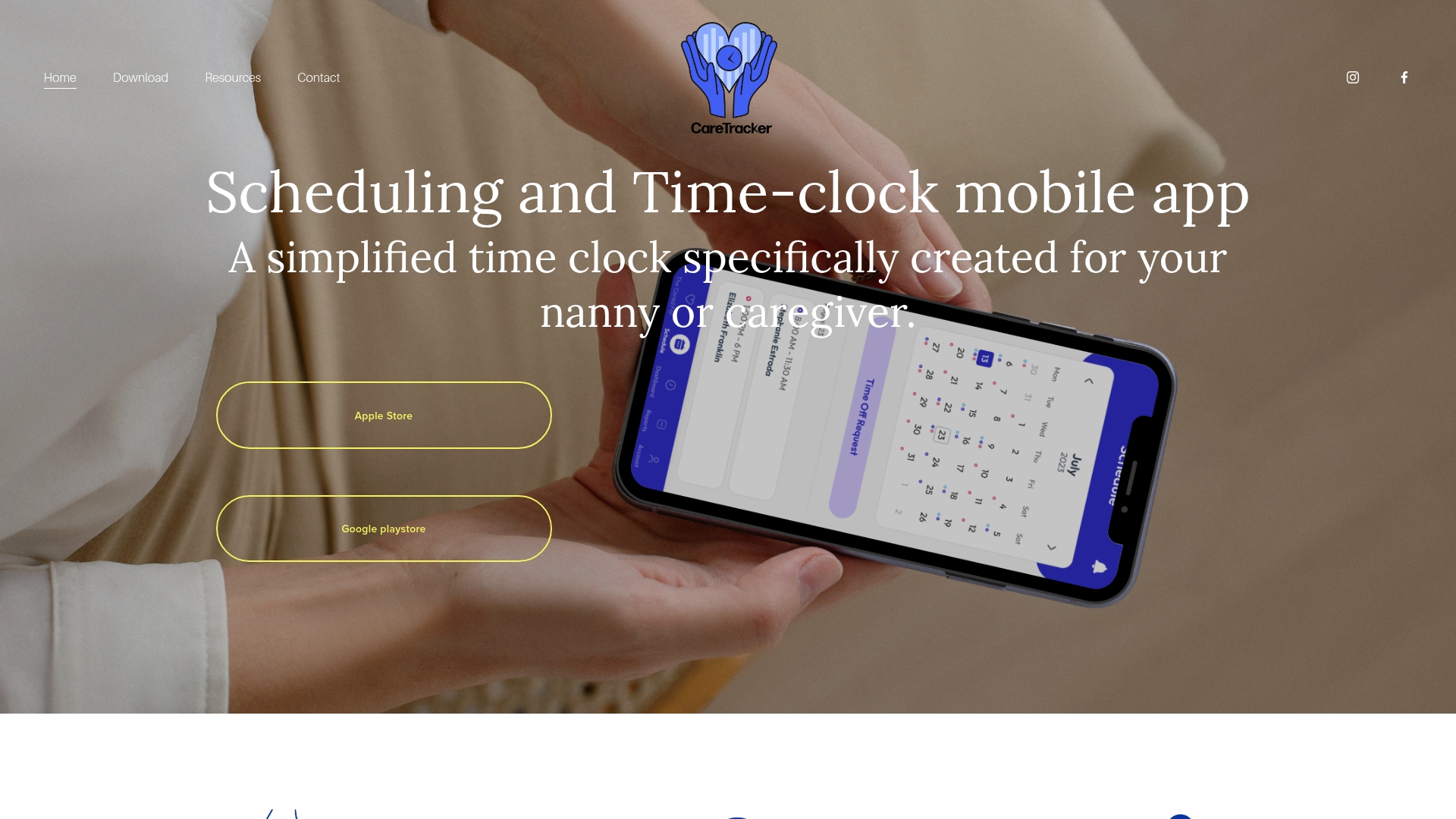
Thecaretracker gives families exactly that, and it is completely free for caregivers. Parents can store key care information (allergies, medications, emergency contacts, nap and nursing schedules), coordinate schedules, and track hours accurately, all in one place. Caregivers receive and approve schedule requests, view all jobs in a unified calendar, and access the care details they need instantly. There is no paperwork pile, no missed shift, and no scramble to find a certification copy when you need it.
After the background check clears and the hire is made, visit Thecaretracker to set up your caregiver's profile, upload onboarding documents, and start tracking hours from day one.
What parents often get wrong about nanny screening
Most parents who run a background check do the right thing in the wrong order. They find a candidate they like, extend an informal offer, and then ask about a background check as an afterthought. That sequence creates two problems: it signals to the candidate that the check is optional, and it puts you in an awkward position if the results require a difficult conversation.
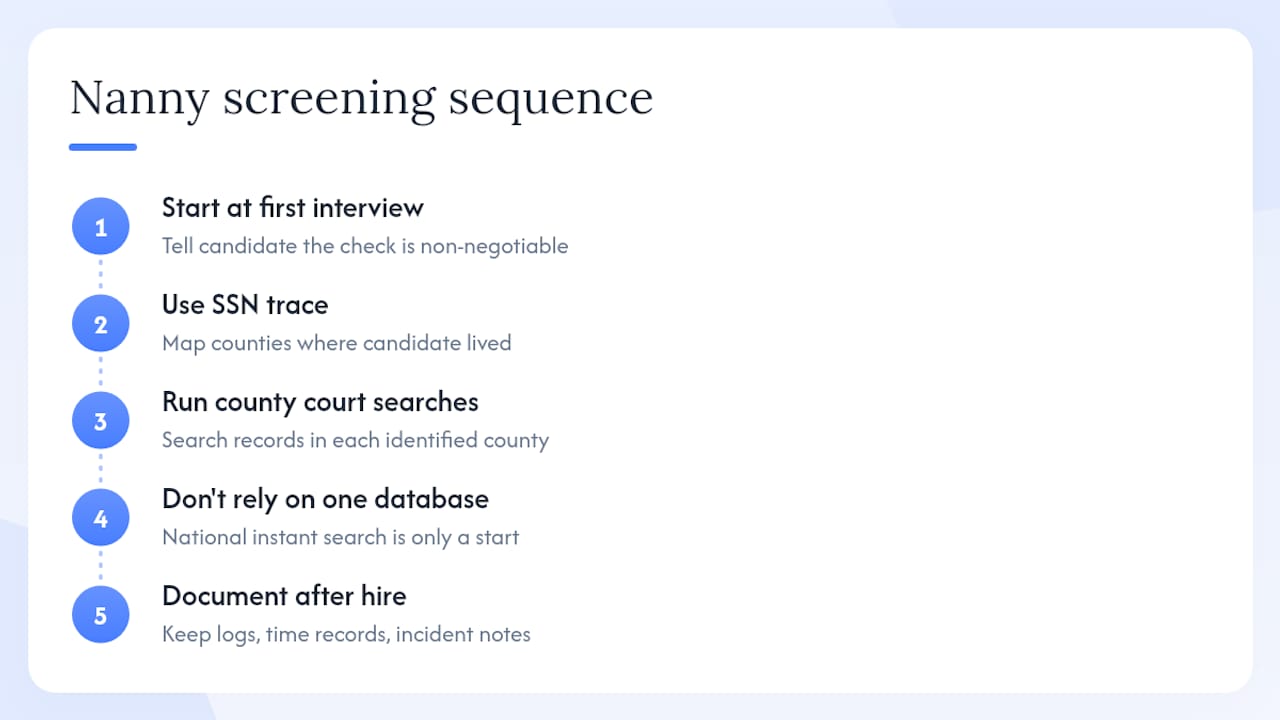
The smarter approach is to treat the background check as a standard, non-negotiable step that you announce at the first interview. Candidates who are serious about the role will not flinch. The ones who push back or go quiet when you mention it are telling you something worth knowing before you hand them your house keys.
There is also a tendency to over-rely on a single database search and call it done. A national instant search is a starting point, not a conclusion. County courts hold the most complete records, and a candidate who has lived in four states over ten years needs county-level searches in each of those locations. That is what the SSN trace is for: it gives you the map. The county searches fill it in.
Finally, documentation after the hire matters as much as the check itself. A background report is a snapshot of one moment in time. Daily logs, time records, and incident notes build the ongoing picture that protects your family and your caregiver if anything is ever disputed. The nanny performance review process is a natural extension of this: scheduled, documented check-ins that keep the relationship transparent and accountable on both sides.
This article is general information, not a substitute for advice from a qualified lawyer. Consult a qualified legal professional about your own circumstances before acting on anything here.
Sources
Use these official resources to verify current rules in your state and federally.
Federal resources:
State-level resources:
Screening vendor guidance: