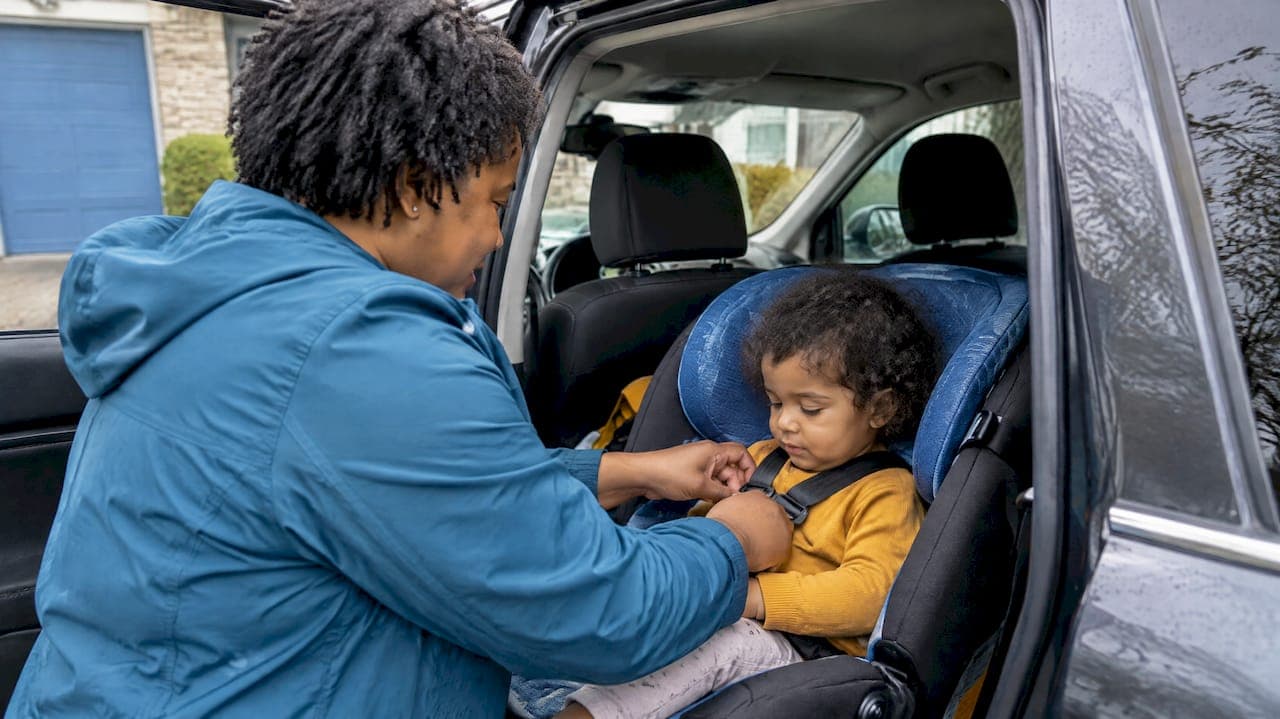
There is no separate set of car seat laws for nannies. Every state has child passenger safety laws, and they apply to whoever is driving the child, whether that is a parent, a babysitter or a nanny. The details (age, weight, height, seat type, fines) differ from state to state, so the safest approach is to follow your state's law as the minimum and the national safety guidance as the goal.
This guide explains how the rules work for household employers and caregivers, what safety experts recommend beyond the legal minimum, and what to put in writing before a nanny drives your child anywhere.
TL;DR
- Car seat laws are state laws, and they cover anyone who drives a child, nannies included. Check your own state and any state you travel through.
- Legal minimums are often lower than best practice. The CDC recommends rear-facing as long as possible, a harness seat until it is outgrown, and a booster until the belt fits.
- Fines range widely by state, and the driver can be the one held responsible. Agree in advance on who provides and installs the seat.
- Put your car seat expectations, vehicle rules and mileage terms in the nanny contract, and track driving time so it is paid correctly.
Table of Contents
- Do car seat laws apply to nannies?
- How the laws differ by state
- What the law does not tell you: expert recommendations
- Infants and toddlers: the highest-stakes rides
- Penalties: who pays and what it costs
- Before your nanny drives: a checklist for parents
- Put it in the nanny contract
- Perspective: why we treat driving as part of the job
- Keeping driving time accurate and legal
- How Thecaretracker helps
- FAQ
- Sources
Do car seat laws apply to nannies?
Yes. Child passenger laws are written around the act of transporting a child, not around the relationship to the child. The Governors Highway Safety Association (GHSA) says a strong law should make the driver responsible for restraint use by children under 16, regardless of their relationship to the child. In practice, if your nanny is behind the wheel, your nanny is the person a police officer will talk to.
That applies in the family car, in the nanny's own car and in rideshares. Virginia's health department, for example, states that rideshare services like Uber and Lyft are not exempt from child restraint laws and are treated differently from traditional taxicabs. Other states handle this differently, so never assume a rideshare or taxi trip is exempt in your state.
For families, this means two things:
- The law is not a reason to assume "the nanny knows what she is doing." Confirm it.
- You, as the parent, decide the rules for your child. The seat you choose, the trips you allow and the training you ask for are all part of your job as the household employer.
How the laws differ by state
All states and territories have child passenger safety laws, although requirements vary by age, weight and height. The Insurance Institute for Highway Safety (IIHS) keeps a table showing that state laws vary widely on the thresholds for moving between rear-facing, forward-facing, booster and seat-belt restraints.
What typically differs:
- The age or size at which a child can face forward. Some states set a minimum age, others set weight or height triggers.
- Booster requirements. The age or height at which a child may use a booster, and when a child may use the adult seat belt alone.
- Seating position. Some states require children under a certain age to ride in the back seat.
- Penalties. Amounts, points on a license and whether a court can waive the fine after proof of a seat purchase.
Because the details change when legislatures amend them, we do not list every state here. The GHSA page linked above is the place to start, and your State Highway Safety Office can answer questions about your state directly.
Driving across state lines
If your nanny takes the children to a grandparent's house, a ball game or a weekend trip in the next state, the law of the state where the car is driven applies. A seat that is legal at home may not meet the rule across the border, especially for booster age or front-seat limits. The simplest fix is to follow the stricter of the two states, and the CDC guidance below will usually be stricter than either.
What the law does not tell you: expert recommendations
The legal minimum is not the same as the safest choice. The Child Passenger Safety Board notes that state laws are often less rigorous than best-practice recommendations. The CDC's child passenger safety guidance is the benchmark most families use:
| Stage | CDC guidance |
|---|---|
| Infants and toddlers | Rear-facing until the child reaches the maximum weight or height limit of the seat, ideally until about age 2 to 4 |
| Preschool and older toddlers | Forward-facing harness seat until at least age 5, and until the seat is outgrown |
| School-age children | Booster seat until the seat belt fits properly, usually between ages 9 and 12 |
| All children | Back seat until age 13 |
Always read the car seat manual for the exact weight and height limits of your seat. The manual and the seat's labels override any rule of thumb.
Why a booster matters
A seat belt is built for an adult body. A child who is too small can end up with the lap belt across the stomach and the shoulder belt across the neck. This is why the CDC points to fit, not just age, as the test. If your child is in the 8 to 12 range, ask your pediatrician or a certified child passenger safety technician to check the fit rather than guessing.
Infants and toddlers: the highest-stakes rides
For the youngest children, the instruction is simple: keep them rear-facing as long as the seat allows. The CDC says infants and toddlers should ride rear-facing until they reach the seat's limits. A nanny may feel pressure from a fussy toddler or from a relative who says the child is "big enough" to turn around. Give your nanny explicit permission to say no, and tell them you will back them up.
Two installation points are worth sharing with any caregiver who moves a seat between cars:
- Use LATCH or the seat belt, not both. The LATCH system is an alternative to seat belt installation. The Child Passenger Safety Board says manufacturers and safety experts generally advise against using both at the same time unless the manual specifically permits it.
- Use the top tether on forward-facing seats. A tether anchor can reduce head movement by 4 to 6 inches in a crash.
If a nanny uses their own car, the seat has to be installed correctly in that vehicle every time it is moved. Many fire stations and hospitals offer free seat checks by certified technicians, and it is worth booking one together.
Penalties: who pays and what it costs
First-offense fines for violating child passenger laws range from $10 to $500, and some states add demerit points to the driver's license. Those numbers are the legal cost. The real cost of a crash with an improperly restrained child is far higher.
A few practical points:
- The driver is typically the person cited. If your nanny is driving, a ticket and any points land on their license, which can affect their own insurance. That is a good reason to make seat rules clear and to provide the correct seat.
- Medical exemptions exist but need paperwork. In Virginia, for example, a child may be exempt for medical reasons with a written statement, and it must be carried or a $20 civil fine may be received. If your child has a medical condition affecting seating, get the documentation from the doctor and give your nanny a copy.
- A fine does not settle your own risk. Insurance and liability questions are separate. For household employers, our guide to nanny workers' comp rules by state covers what happens if your nanny is hurt on the job, and your auto insurer can tell you how a nanny driving your car or their own with your child is treated under your policy.
Before your nanny drives: a checklist for parents
The smartest time to deal with car seat rules is before the first drive, not after a near miss. Sit down with your nanny and cover these points.
- Whose car, whose seat. Decide whether the nanny drives the family car (with seats already installed) or their own. If it is their own, decide who buys and installs the seat.
- Seat type and stage. Write down the child's current seat, its weight and height limits, and when you will review it. Children outgrow seats faster than most families expect.
- Installation training. Show your nanny how you install and adjust the harness. Ask them to demonstrate it back to you. A certified technician can run both of you through it.
- Trips allowed and not allowed. Be specific: school runs, activities, medical visits, out-of-state travel. Our guide to school pickup authorization for your nanny covers the permission side of these trips.
- Rideshare and taxi rules. Decide whether the nanny may use them with your child. If yes, who supplies a portable seat?
- Emergency information. Make sure allergies, medications and emergency contacts are within reach on every drive. A babysitter information sheet is a good starting format.
- Phone and driving rules. No handheld phone use, no driving when tired, and a clear path to call you if a child is upset in the back seat.
- Driver checks. Verify a valid license and review the driving record as part of your hiring process. See our nanny background check guide for how to do this legally.
The final decisions on a child's restraint belong to the parent or legal caregiver, as the CPS Board also stresses in its guidance. That is why the instructions need to come from you in writing.
A new baby is also a good moment to plan the whole gear list, not only the seat. This checklist of essentials for new parents is a handy starting point for what to have ready before the first ride.
Put it in the nanny contract
Car seat expectations belong in the written agreement, next to hours, pay and duties. A short driving clause should say:
- Whether the nanny is permitted to drive the child, and in which vehicles.
- That the nanny will always use the designated seat or booster, correctly installed, on every trip.
- Who supplies and maintains the seat.
- That the nanny will not exceed the agreed trips or distances without permission.
- How driving time and mileage are paid.
Our nanny contract essentials article shows where a driving clause fits. If the nanny uses their own car, see our nanny mileage reimbursement guide, because driving a child to an activity during work hours is work time, not a favor.
Perspective: why we treat driving as part of the job
We built Thecaretracker for households where a caregiver's day involves more than one location. School pickups, appointments and activities all happen in a car, and they all count as work. Our view is that driving a child should be handled with the same clarity as hours, pay and schedule changes: written down, agreed in advance and tracked.

What we see in household employment is that problems come from assumptions. A parent assumes the nanny knows the seat rules. A nanny assumes the family wants a quick trip made. Nobody has said what is allowed. The fix costs nothing: put the rules in writing, give the caregiver the information they need in one place, and keep a record of hours so that drive time is paid accurately.
In our app, caregivers can see the care information that matters on any outing, such as allergies, medications and emergency contacts, and they can track their hours and mileage-related time in one place. That does not replace a car seat check or your state's law. It does make it easier to keep everyone on the same page, with transparency on both sides and peace of mind for the family.
— mercedes
Keeping driving time accurate and legal
When a nanny drives your child, those hours are working hours. Include them in the weekly total, and watch overtime. Rules differ by state, and our guide to nanny overtime by state explains how 40-hour weeks and back pay work for household employers. If a car trip changes the schedule, the rules in our nanny schedule changes guide apply too.
Accurate records protect both sides. The family has a clear picture of what it owes, and the nanny has proof of the time worked.
How Thecaretracker helps
The Thecaretracker mobile app is free for nannies and caregivers. They can view all their jobs in one calendar, receive and approve schedule requests, track weekly hours and access care details like allergies, medications and emergency contacts instantly. You can try the Scheduling and Time-clock mobile app for your household.
If you are also unsure about payroll, back wages or tax setup for your nanny, we offer a Standard Payroll Consultation package for $150 one-off, available in our store. Our team can help you set up correct, compliant household payroll so that driving time, mileage and overtime are handled the right way from day one.
FAQ
Can a nanny be ticketed for a child's car seat violation?
Yes. Child restraint laws generally apply to the driver, and the GHSA says a strong law makes the driver responsible for children under 16 regardless of their relationship. If your nanny is driving, a citation would typically go to them. Check your state's specific penalty on the GHSA page.
Who should buy the car seat if the nanny uses their own car?
There is no legal rule on this, so agree on it in writing. Many families buy and own the seat or a second seat for the nanny's car, because it is their child's safety equipment. Have a certified technician check the installation in that car.
When can a child move from a car seat to a booster?
The law depends on your state, but the CDC says a child should use a forward-facing harness seat until at least age 5 and until they outgrow it. After that, a booster is used until the seat belt fits properly, usually between ages 9 and 12. Always follow the seat's manual limits.
Do car seat laws apply in Uber or Lyft?
It depends on the state. Virginia's health department says rideshares are not exempt from child restraint laws. Other states treat taxis and rideshares differently, so check your state before you allow your nanny to use one, and decide who provides the seat.
Sources
- Child Passengers, Governors Highway Safety Association
- Seat belt and child seat laws, Insurance Institute for Highway Safety
- Child Passenger Safety, CDC
- First Ride, Safe Ride, Virginia Department of Health
- Lower Anchors & Tethers for Children, CPS Board
- Checklist for Hospital Discharge Recommendations, CPS Board