
Most household employers need workers' compensation coverage for a nanny, though the requirement depends entirely on your state's rules and how many hours your caregiver works. Some states mandate it from the first hour of work. Others exempt domestic employees entirely. There is no federal answer here. The Department of Labor confirms there is no single federal workers' compensation law for private household workers, so your state is the only authority that matters.
Coverage isn't just a compliance checkbox. It protects your family financially if your nanny gets hurt on the job, and it protects her too.
- Medical costs stay covered. A workers' comp policy pays for treatment after a workplace injury, so you're not covering an ER bill out of pocket.
- You're shielded from a lawsuit. Without coverage, an injured nanny can sue you directly for medical bills and lost wages.
Here's what to do today:
- Look up your state's workers' compensation agency and confirm the rule for domestic employees.
- Contact your insurer or a household payroll service in writing and ask directly whether you're covered.
- Start logging your nanny's hours and payroll now. Both IRS Publication 926 and your future insurance audit will ask for these numbers.
Key Takeaways
Whether you're legally required to carry nanny workers' comp depends on your state, but confirming coverage in writing protects your family from lawsuits and unpaid medical claims either way.
| Point | Details |
|---|---|
| Check state rules first | Confirm your state's exact trigger, hours, earnings, or blanket rule, before assuming you're exempt. |
| Get written confirmation | Ask your insurer directly whether homeowners coverage or a standalone policy applies, and get it in writing. |
| Budget realistically | Expect roughly $200 to $1,000 annually for a full-time nanny, depending on state and duties. |
| Track hours accurately | Use consistent time logs so payroll audits and workers' comp claims match your actual records. |
| Handle payroll correctly | File Schedule H, issue a W-2, and avoid misclassifying your nanny as a contractor. |
Table of Contents
- Which States Require Nanny Workers Comp?
- How Do You Get a Nanny Workers Comp Policy?
- What Does Nanny Workers Comp Actually Cover?
- How Much Does Nanny Workers Comp Cost?
- Will Homeowners Insurance Cover a Nanny's Injury?
- What Payroll and Tax Steps Come With Hiring a Nanny?
- What Should You Ask Your Insurance Agent?
- Why Coverage Is Worth It Even When It's Optional
- Frequently Asked Questions
- Sources
Which States Require Nanny Workers Comp?
The rules vary so much state to state that a family in New Jersey and a family in Texas can have completely opposite obligations for the same job. Broadly, states use one of three triggers: an hours threshold, an earnings threshold, or a blanket requirement that covers domestic employees regardless of hours worked, according to LegalClarity's breakdown of household employer rules.
States like New York, California, Hawaii, and New Jersey tend to require coverage for domestic workers with little to no minimum hours, treating a nanny the same as any other employee from day one. Other states set a specific weekly hours cutoff (often somewhere around 40 hours) before coverage becomes mandatory. A smaller group excludes household employees from workers' comp requirements altogether, though even in those states, carrying voluntary coverage is worth serious consideration.
Live-in nannies deserve a special note. Several states treat live-in domestic staff identically to any other household employee for workers' comp purposes, while a few carve out separate rules or route them through disability insurance systems instead. This is exactly the kind of detail that changes year to year, so treat any list, including this one, as a starting point rather than the final word.
- Bookmark your state's official workers' compensation agency page and check it before you sign an offer letter.
- Ask specifically about domestic or household employee rules. General small-business FAQs often don't apply to your situation.
- If your nanny works across state lines (say, you have homes in two states), confirm which state's law governs the employment.
New York enforces some of the steepest penalties for noncompliance, with fines that can reach $2,000 for every 10-day period a household employer goes without required coverage. That's not a number to gamble on.
How Do You Get a Nanny Workers Comp Policy?
You generally have three paths, and the right one depends on your state and your existing insurance setup.
- State fund purchase. Some states, including Ohio through its Bureau of Workers' Compensation, let you buy domestic coverage directly from a state-run fund, which is often the simplest and cheapest route when it's available.
- Private carrier or endorsement. A private insurer can write a standalone household employer policy, or in limited cases add an endorsement to an existing policy.
- Bundled payroll service. Companies like Beverly, GTM Payroll & Household Services, and Capitol Benefits fold workers' comp into their household payroll packages, so the premium gets handled alongside tax withholding and wage reporting.
Before you commit, gather your EIN, your nanny's job duties, her estimated annual wages, and her start date. Then ask your agent pointed questions:
- What is the policy's effective date, and is there a gap before it starts?
- Does coverage extend to travel with the family, including out-of-state trips?
- Is this a standalone policy or an endorsement, and does my state accept either?
- How does the year-end payroll audit work?
Pro Tip: Never assume your homeowners policy has you covered. Get the answer in an email or letter, not just a phone call, before your nanny's first day.
What Does Nanny Workers Comp Actually Cover?
A standard policy covers four main categories: medical care for the injury, temporary disability wage replacement (typically around two-thirds of lost wages), vocational rehabilitation if she can't return to the same duties, and death benefits with burial costs in the rare worst-case scenario.
If your nanny gets hurt on the job, here's the sequence that protects everyone:
- Get her medical attention immediately.
- Document exactly what happened, when, and where.
- Notify your insurer within the timeframe your state requires (often as short as a few days).
- File any state-mandated injury report forms.
Coverage gets murkier around gray areas. An injury during a personal errand she was running for herself, rather than for your family, may fall outside coverage. Same with injuries tied to intoxication or activities clearly outside her job description. States vary on how strictly these exclusions get interpreted, so when in doubt, ask your insurer directly rather than assuming.
How Much Does Nanny Workers Comp Cost?
For a single full-time nanny, annual premiums typically land somewhere between $200 and $1,000, depending heavily on your state and her wages. A part-time sitter working 12 hours a week will cost a fraction of that; a full-time live-in nanny with driving duties sits at the higher end.

Insurers calculate premiums as a rate per $100 of payroll, using your estimated annual wages upfront and reconciling the actual figure at a year-end audit. If you underestimate payroll, expect a bill; if you overestimate, expect a refund.
A few variables move the needle more than others:
- State rate tables. Every state sets its own base rates for household employment classifications.
- Job duties. A nanny who drives the kids to school and activities sits in a higher risk class than one who stays home all day.
- Payroll size. More hours and higher wages mean a higher premium, proportionally.
- Claims history. A prior claim can push your renewal rate up.
- Live-in status. Some insurers price live-in arrangements differently than daily commuters.
A part-time sitter working three afternoons a week might pay well under $200 annually. A full-time nanny who drives, cooks, and works 50 hours a week could push past $1,000, especially in a state with higher base rates.
Will Homeowners Insurance Cover a Nanny's Injury?
Usually not, and this is one of the most common and costly assumptions families make. Homeowners policies are built around liability for guests and property damage, not employment injuries, and many explicitly exclude domestic staff. Liberty Mutual and other insurers that specialize in household coverage both confirm that homeowners policies frequently exclude domestic employees, and some states outright prohibit using a homeowners endorsement to satisfy a mandatory workers' comp requirement.
- Don't assume any endorsement on your homeowners policy counts as compliance.
- Do ask your carrier directly: "Does my policy provide workers' compensation coverage for a household employee, or do I need a standalone policy?"
- Do check whether your state permits an endorsement at all before you rely on one.
Pro Tip: Ask your agent for that answer in writing. A verbal "you're probably fine" from a call center rep won't help you if a claim gets denied.
What Payroll and Tax Steps Come With Hiring a Nanny?
Workers' comp is only one piece of household employment compliance. The IRS treats your nanny as a W-2 employee, not a contractor, once you control her hours and duties, according to IRS Publication 926. That classification triggers a full checklist:
- Confirm employee status (not independent contractor).
- Apply for an EIN if you don't already have one.
- Collect Form I-9 for employment eligibility.
- Set up payroll withholding for Social Security and Medicare.
- Report the new hire to your state's new-hire registry.
- Withhold and remit FICA and FUTA taxes as required.
- File Schedule H with your personal tax return and issue a W-2 at year-end.
Common mistakes that trigger audits or penalties include misclassifying a nanny as a 1099 contractor, running her wages through a business payroll system instead of household payroll, and failing to track overtime correctly under your state's rules. Accurate hour tracking, through a tool like CareTracker's time tracking feature, makes both your tax filings and your workers' comp audit far less stressful when the numbers need to match up.
What Should You Ask Your Insurance Agent?
Walk into the conversation prepared, and you'll avoid the vague answers that leave families exposed. Bring your EIN, your nanny's Social Security or ITIN number, a written job description, her typical weekly hours, and recent payroll totals, especially if driving is part of her role.
Ask these questions directly:
- Does my state require workers' comp for a household employee?
- Can my homeowners policy be used, or do I need a standalone policy?
- What is the effective date of coverage?
- How does the year-end audit work, and what documentation will you need?
Pro Tip: If the agent says "yes, you're covered" on the phone, ask them to email or mail that confirmation. Verbal assurances don't hold up if a claim gets disputed later.
Why Coverage Is Worth It Even When It's Optional
Even in states where workers' comp isn't mandatory for household employees, carrying it anyway protects your family's finances and gives your nanny real security if something goes wrong. Check your state's page today, then call your insurer before the week is out.
Frequently Asked Questions
Is workers' compensation legally required for a nanny? It depends entirely on your state. Some states, including New York, California, and New Jersey, require it as a blanket rule. Others set an hours or earnings threshold, and a few leave it optional. Check your state's workers' compensation agency directly to confirm.
What happens if I don't carry required coverage? Penalties vary by state but can include steep fines, stop-work orders, and personal liability for your nanny's medical bills and lost wages if she's injured. New York, for example, can fine noncompliant employers $2,000 per 10-day period without coverage.
Can I just use my homeowners insurance instead of a separate policy? Usually not. Most homeowners policies exclude domestic employees from coverage, and some states won't accept a homeowners endorsement as a substitute for a required standalone policy. Confirm with your carrier in writing before relying on it.
How much does nanny workers comp typically cost? Annual premiums for a full-time nanny generally fall in the $200 to $1,000 range, calculated as a rate per $100 of payroll and reconciled at a year-end audit.
Does a part-time babysitter need workers' comp coverage too? It depends on your state's threshold. Some states apply the requirement to any domestic worker regardless of hours; others only trigger it once weekly hours or annual earnings cross a set line. A tool like CareTracker can help you track exact hours so you know where you stand.
What records should I keep for an insurance audit? Keep accurate weekly time logs, payroll totals, your EIN, and your nanny's job description on file. If your records are incomplete or disorganized, a payroll consultation service can help you clean things up before an audit catches you off guard. Families working with a PEO for broader HR support can also find helpful first-time selection guidance through resources like Inclusive PEO.
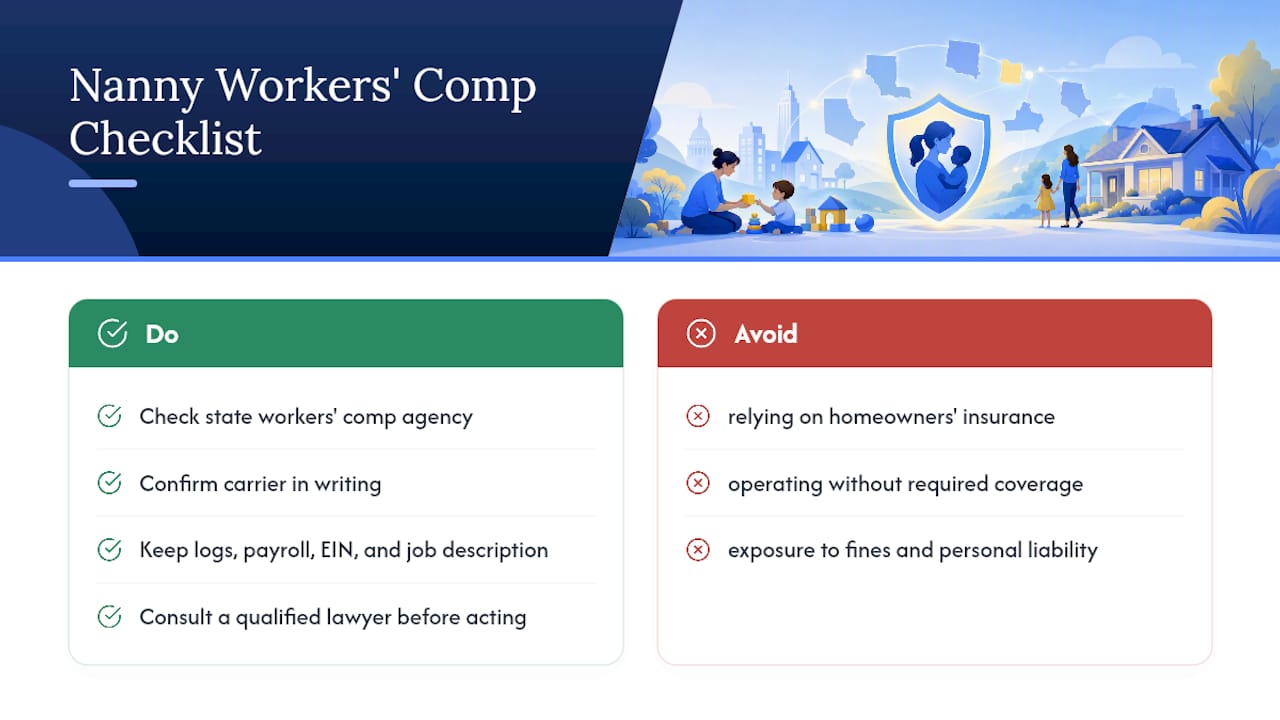
This article is general information, not a substitute for advice from a qualified lawyer. Consult a qualified legal professional about your own circumstances before acting on anything here.
Sources
- IRS Publication 926
- Workers' compensation | U.S. Department of Labor
- Workers’ Comp for a Nanny: Requirements and Costs - LegalClarity
- Workers' Comp for Nanny Employers | NannyKeeper Blog