As of 2026, domestic workers have secured Bill of Rights legislation in 12 states, the District of Columbia, and 2 major cities, guaranteeing baseline protections like minimum wage, overtime pay, and anti-harassment safeguards. The domestic worker bill of rights is a category of state and local laws that extends fundamental labor protections to nannies, housecleaners, personal attendants, and caregivers for elderly or disabled individuals — workers who were historically excluded from federal labor law.
These laws typically cover:
- Minimum wage at or above the applicable state rate
- Overtime pay at time-and-a-half after a set weekly hours threshold
- Paid rest days and mandatory rest breaks
- Protection from harassment, discrimination, and retaliation
- Paid sick leave and family leave where state statutes apply
- Written employment contracts in the worker's preferred language
The goal is straightforward: correct a decades-long gap in labor law and give domestic workers the same dignity and legal standing that most other workers take for granted.
What rights does the domestic worker bill of rights guarantee?
The core protections across most state laws follow a consistent pattern, though the specific thresholds vary by jurisdiction.
- Minimum wage: Workers must receive at least the applicable state minimum wage, which in many states exceeds the federal floor of $7.25 per hour.
- Overtime: Most laws require time-and-a-half pay after 40 hours per week, with some states setting a higher threshold for live-in workers.
- Rest breaks: Employers must provide paid rest breaks, typically 10 minutes every four hours.
- Weekly day off: Workers are entitled to at least 24 consecutive hours of rest every seven days, or overtime pay if they agree to work on that day.
- Paid rest days annually: After one year with the same employer, workers generally earn paid days off.
- Paid sick and family leave: Multiple state bills include access to paid sick leave, paid family leave, vacation, and disability-related leave.
- Anti-harassment and anti-discrimination protections: Workers are covered under state human rights and anti-discrimination laws.
- Protection from retaliation: Employers cannot retaliate against a worker for exercising any right under these laws.
All of these protections apply regardless of a worker's immigration status. That point is explicit in New Jersey's law and consistent with guidance from the National Domestic Workers Alliance.
How do state laws compare across major jurisdictions?
The laws differ in meaningful ways. Here is a summary of the major state and city provisions in effect as of 2026.

| Jurisdiction | Effective Date | Key Overtime Rule | Written Contract | Notable Provision |
|---|---|---|---|---|
| New York | 2010 | After 40 hrs (44 for live-in) | Not mandated statewide | 3 paid rest days after 1 year; collective bargaining study |
| California (AB 241) | 2014 | After 9 hrs/day or 45 hrs/week | Not mandated statewide | Extends overtime to personal attendants previously excluded |
| New Jersey | July 1, 2024 | State minimum wage rules apply | Required (5+ hrs/month) | Employer registration if $1,000+ paid; Workers' Comp required |
| Illinois | January 1, 2017 | State wage and hour rules apply | Not mandated statewide | Explicit legislative findings on historical exclusion |
| Washington State | 2026 | State wage rules apply | Written agreement required | Signed into law March 2026 |
| Philadelphia | Active | State wage rules apply | Written agreement required | City-level protections for wage and breaks |
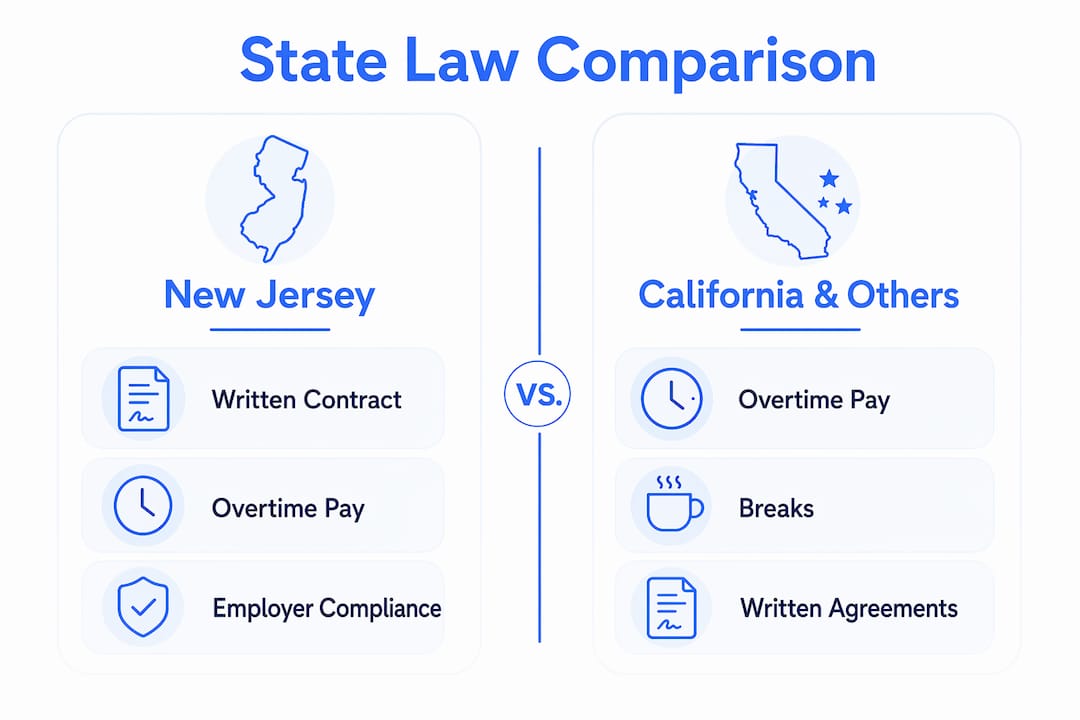
New York was one of the earliest states to act. The New York Domestic Workers' Bill of Rights requires overtime after 40 hours per week (44 for live-in workers), a mandatory 24-hour rest period every seven days, and 3 paid rest days annually after one year of employment. The New York Department of Labor also completed a feasibility report on extending collective bargaining rights to domestic workers, signaling continued legislative interest.
California's AB 241 extended overtime pay to personal attendants who were previously excluded under Wage Order No. 15. Under AB 241, covered personal attendants are entitled to overtime at 1.5 times their regular rate for hours beyond 9 in a day or 45 in a week.
New Jersey went the furthest on employer compliance requirements. Effective July 1, 2024, the New Jersey law requires a written employment contract in the worker's preferred language for anyone working more than 5 hours per month. Employers who paid above a specified amount in the previous calendar year must register with the state, file quarterly wage records, and make payroll tax contributions.
Washington State and Philadelphia both require written agreements and provide wage and break protections, with Washington's law signed in march 2026 as one of the most recent additions to this growing body of legislation.
One important exclusion: casual workers, such as occasional babysitters or dog walkers, are often exempt from coverage. Employers should verify how their state classifies the specific work arrangement before assuming coverage applies.
What are your obligations as an employer of a domestic worker?
If you employ a nanny, housekeeper, or personal attendant, you carry specific legal responsibilities that go beyond simply paying a wage.
- Written contracts: In New Jersey, a written contract in the worker's preferred language is required for anyone working more than 5 hours per month. Massachusetts requires a written agreement for workers logging 16 or more hours per week. Contracts must cover job duties, wages, schedules, and leave.
- Employer registration: In New Jersey, if you paid a domestic worker $1,000 or more in the prior calendar year, you must register as an employer with the state and make contributions to unemployment and disability funds.
- Payroll tax obligations: Domestic workers are employees, not independent contractors. You cannot issue a 1099 form to a nanny or housekeeper. You are responsible for withholding and remitting payroll taxes.
- Record keeping: Employers must maintain accurate records of hours worked, pay rates, meal and rest breaks, and leave time for at least three years.
- Workers' Compensation insurance: New Jersey law makes employers personally liable for failing to carry Workers' Comp coverage. You must also provide written notice of the policy to your employee.
- No retaliation: Employers may not discipline or terminate a worker for filing a complaint or discussing their rights. In New Jersey, if adverse action occurs within 90 days of a worker reporting a violation, the employer must prove the action was not retaliatory.
- Notify workers of their rights: You must inform employees of their rights under the applicable law and how to file a complaint, even if they work fewer than 5 hours per month.
Key government resources for compliance include the New York State Department of Labor (dol.ny.gov), the New Jersey Department of Labor and Workforce Development (nj.gov/labor), the California Department of Industrial Relations (dir.ca.gov), and the U.S. Department of Labor's Wage and Hour Division (dol.gov/agencies/whd).
How did the domestic worker bill of rights come to exist?
Domestic workers were deliberately excluded from the National Labor Relations Act of 1935 and the Fair Labor Standards Act of 1938. Those exclusions were not accidental. They reflected the political compromises of the New Deal era, which left out industries dominated by Black and immigrant women to secure Southern congressional support. The result was that nannies, housecleaners, and caregivers spent decades without the overtime protections, minimum wage guarantees, or collective bargaining rights that factory and office workers received as a matter of course.
The modern movement for domestic worker rights gained momentum in the early 2000s, led by organizations like the National Domestic Workers Alliance. New York became the first state to pass a Domestic Workers' Bill of Rights in 2010, followed by Hawaii in 2013 and California in 2014. Illinois enacted its law effective january 1, 2017. The pace accelerated through the 2020s, reaching 12 states, D.C., and 2 cities by 2026. A federal version, H.R. 4826, was introduced in the 117th Congress but has not yet been enacted into law.
The legislative history reflects a consistent theme: these laws represent minimum standards, not a ceiling. Employers and workers are encouraged to negotiate agreements that go beyond what the law requires.
How does the bill of rights differ from general labor law?
Most workers in the United States are covered by the Fair Labor Standards Act, which sets the federal minimum wage and requires overtime after 40 hours per week. Domestic workers, however, were largely carved out of those protections for most of the 20th century. State domestic worker bills of rights fill that gap by applying equivalent or stronger standards specifically to household employment.
The practical differences are real. A factory worker who is misclassified as an independent contractor can typically file a federal wage claim under the FLSA. A domestic worker in a state without a bill of rights has far fewer options. State laws also add protections that the FLSA does not include at all, such as mandatory written contracts, paid rest days, and explicit anti-harassment coverage under state human rights statutes. New Jersey's law, for example, brings domestic workers under the New Jersey Law Against Discrimination, a protection that did not previously apply to household workers.
One area where general labor law still applies: payroll tax obligations. Regardless of which state a worker is in, the IRS treats domestic workers as employees. Misclassifying a nanny as an independent contractor is a federal tax issue, not just a state labor issue.
Landmark cases that shaped domestic worker protections
Court cases involving domestic worker rights have largely focused on wage theft, misclassification, and retaliation rather than constitutional challenges to the bills of rights themselves.
In Coke v. Long Island Care at Home, Ltd. (2007), the U.S. Supreme Court upheld a Department of Labor regulation that exempted companionship workers from FLSA overtime protections. That ruling left a large category of home care workers without federal overtime rights for years. The DOL revised its regulations in 2015 to narrow that exemption, extending FLSA coverage to most home care workers employed by third-party agencies. Workers employed directly by private households remained in a more complicated position, which is precisely why state-level bills of rights matter.
State courts have also addressed retaliation claims. New Jersey's rebuttable presumption rule, which places the burden on the employer to disprove retaliation when adverse action follows a complaint within 90 days, reflects lessons learned from cases where workers faced termination shortly after raising wage concerns. That provision gives workers a meaningful procedural advantage that general employment law often does not provide.
How Thecaretracker helps you stay compliant and organized
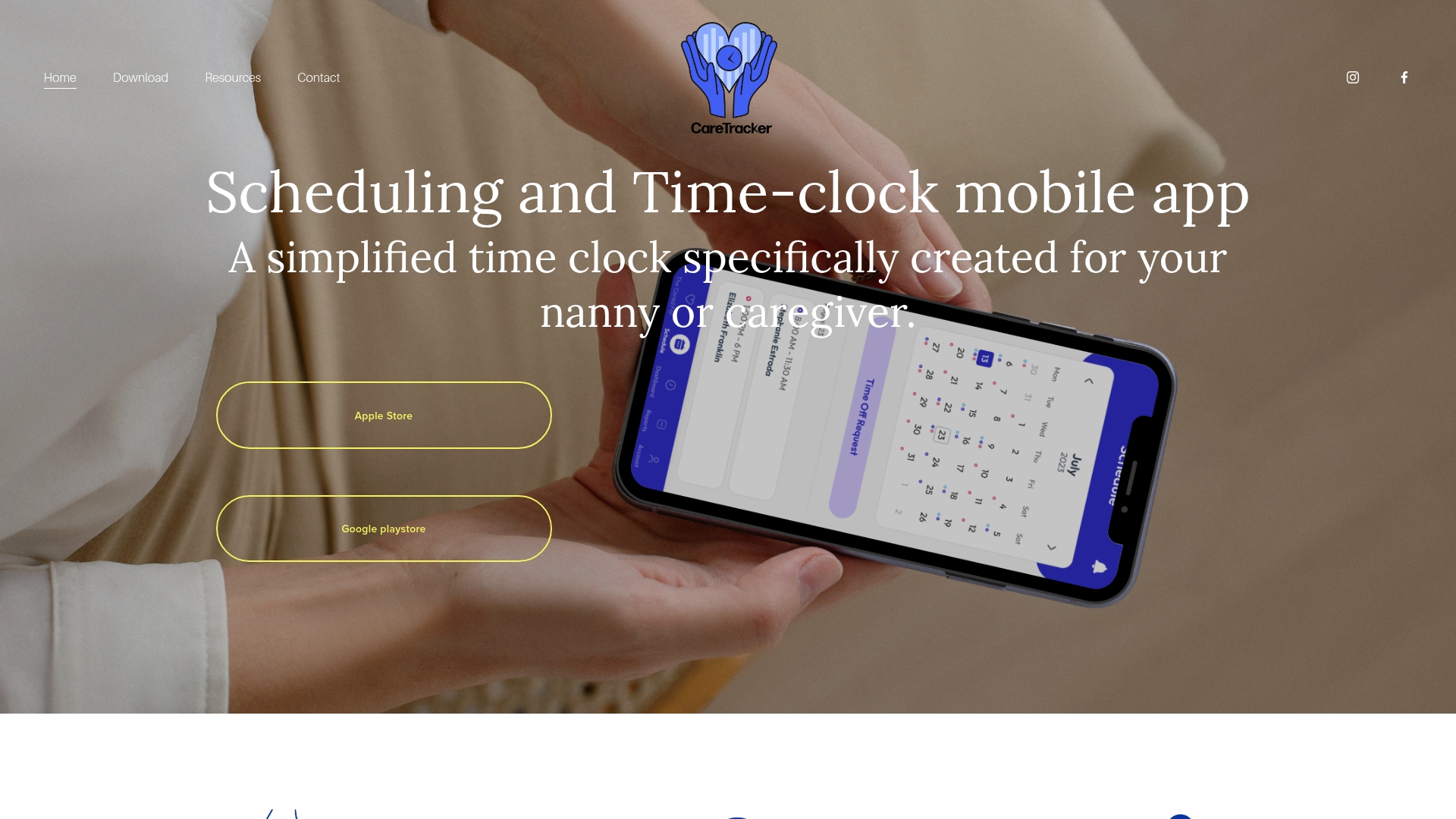
Knowing the law is one thing. Documenting compliance is another. Thecaretracker is a free app for caregivers and nannies that makes the documentation side straightforward.
- Accurate hour tracking: Log daily hours, breaks, and overtime in real time, creating the kind of records that state laws require employers to maintain for at least three years.
- Schedule management: Receive and approve schedule requests, view all jobs in a unified calendar, and avoid the confusion that leads to unpaid overtime disputes.
- Care information access: Store allergies, medications, emergency contacts, nap schedules, and daily activities in one place, so nothing falls through the cracks during a shift.
- Payroll support: Thecaretracker offers a standard payroll consultation package and a premium payroll consultation for employers who need help aligning their payroll practices with state domestic worker laws.
Pro Tip: Accurate digital time records are your strongest evidence in a wage dispute. If a worker claims unpaid overtime and you have timestamped logs showing every shift, break, and total weekly hours, the conversation is much shorter and cleaner for everyone involved.
For employers managing attendance and scheduling across multiple caregivers, resources like the employee attendance tracking guide from Heyhive offer practical frameworks for building compliant tracking systems.
Thecaretracker is completely free for caregivers. Download it, set up your profile, and start tracking hours today so your records are ready if you ever need them.
Key Takeaways
Domestic worker bill of rights laws in 12 states, D.C., and 2 cities now guarantee minimum wage, overtime, paid rest, and anti-harassment protections that federal law historically denied to household workers.
| Point | Details |
|---|---|
| Broad state adoption | As of 2026, 12 states, D.C., and 2 cities have enacted domestic worker bill of rights laws. |
| Core rights guaranteed | Minimum wage, overtime pay, paid rest days, anti-harassment, and retaliation protections are standard provisions. |
| New Jersey employer duties | Written contracts, employer registration, and Workers' Comp are required if $1,000+ was paid in the prior year. |
| New York overtime rule | Overtime kicks in after 40 weekly hours (44 for live-in workers), with 3 paid rest days after one year. |
| Record keeping requirement | Employers must keep payroll and hours records for at least three years under most state laws. |