
Federal law does not require you to give your nanny a meal break, but your state or city may, and the rule that decides whether the break is paid is the same everywhere: is your nanny completely relieved of duty? If she is still watching your child, answering your texts or listening for a baby monitor, the break is working time and has to be paid. This guide explains the federal rule, shows how several states and cities go further, and gives you a simple routine for scheduling and recording breaks so that your hours and pay match.
TL;DR
- The Fair Labor Standards Act (FLSA), the federal wage law, does not require meal or rest breaks. Where your state has no break law, breaks are a matter of agreement between you and your nanny.
- A meal period of 30 minutes or more is unpaid only when your nanny is completely relieved of duty. Short breaks of about 5 to 20 minutes are paid.
- New Jersey, Seattle, Massachusetts and Nevada have domestic worker rules that add to the federal baseline, and the details differ. The law of the place where the work happens applies.
- An interrupted meal break counts as hours worked. Write your break agreement down and keep a daily record of start and end times.
Table of Contents
- What federal law says about nanny meal breaks
- Live-in nannies and au pairs
- When state and city law goes further
- The rule of thumb: follow the stricter standard
- A worked example
- How to arrange meal break coverage and record time
- Common mistakes
- When a consultation makes sense
- Our perspective
- FAQ
- Sources
What federal law says about nanny meal breaks
The U.S. Department of Labor (DOL) says plainly that federal law does not require lunch or coffee breaks. What federal law does do is define what counts as paid time when a break is given:
- Short breaks, usually about 5 to 20 minutes, are work time and must be paid.
- Meal periods, typically at least 30 minutes, are not work time and need not be paid, as long as the worker is completely relieved of duty.
The DOL's guidance for direct-care workers adds that people who are completely relieved from duty and free to use the time for their own purposes, including live-in employees, do not have to be paid for that time. Its example is a live-in care provider who works 3 hours in the morning and 2 in the evening: only those 5 hours are compensable.
The key words are "completely relieved." For a nanny, that is a higher bar than it sounds.
On duty versus off duty
The DOL's fact sheet on hours worked for domestic workers explains that a nanny who must watch over her charge even while the child sleeps is on duty and must be paid for that time. A live-in worker who is free to go to class or run errands is not working during that time.
Here is what that looks like in a normal day:
| Situation | Paid or unpaid? |
|---|---|
| Nanny eats lunch at the table while the toddler eats beside her | Paid. She is still supervising. |
| Nanny eats lunch while the baby naps and she must stay in the house and listen for crying | Paid. She is still responsible for the child. |
| Nanny leaves the house for 45 minutes, free to do as she likes, and nobody calls her | Can be unpaid, if your state allows it and you have agreed in advance. |
| Nanny's lunch is cut short because the child wakes up and she has to respond | The interrupted time is hours worked. |
Most nannies who work alone with young children are on duty for most of the day. That is why "she can sit down and eat" is rarely a reason to deduct 30 minutes from her pay.
Live-in nannies and au pairs
Live-in arrangements have more flexibility on paper. The DOL's fact sheet for live-in domestic workers says you and your worker may agree to exclude bona fide meal periods, sleep periods and off-duty time from hours worked. It also sets the federal minimum wage of $7.25 an hour for all hours that do count. Three conditions matter:
- The exclusion has to be by agreement, so put it in writing.
- If a meal, sleep or off-duty period is interrupted by a call to duty, the interruption counts as hours worked.
- You must keep a copy of the agreement and accurate records of the hours.
The DOL also treats an employee as live-in when she works and sleeps at your home seven days a week, or five days a week for 120 hours or more. For sleep specifically, see our guide to sleep time rules for live-in nannies. For overtime on live-in schedules, see live-in nanny overtime.
An au pair or live-in caregiver is not exempt from the idea that unpaid time must be genuinely free time. A written schedule that names the meal window, and a habit of not calling the person during it, is what makes it real.
When state and city law goes further
Because federal law is silent, states and cities have filled the gap. The law of the place where the work is performed is the one that applies, so check your own address first. Several examples show how much the rules vary.
New Jersey
New Jersey's Domestic Workers' Bill of Rights, N.J.S.A. 34:11-72, requires:
- An uninterrupted, paid 10-minute rest period for each four consecutive hours worked.
- An uninterrupted 30-minute meal break after more than five consecutive hours.
If the worker is not relieved of all duties and free to leave, the meal period is an "on-duty" meal period and is paid at the regular rate. It is allowed only under a written agreement, which the worker can revoke in writing at any time. The statute sets a penalty of one hour of pay, up to two hours, per workday for violations.
The state labor department adds that on-duty meal breaks may be required only when the worker cares for someone who cannot be left alone. If the worker opts out in writing, you must provide an uninterrupted paid 30-minute break every five hours. Live-in workers cannot be required to work more than six days in a row without a 24-hour rest period, which may be unpaid. The law took effect on July 1, 2024.
Seattle
Seattle's Domestic Workers Ordinance gives domestic workers a 30-minute meal period for every five hours worked and a 10-minute paid rest break for every four hours. A meal period may be unpaid only when the worker is completely relieved of duty. If a break is interrupted, it starts over until the worker gets a consecutive 30 minutes.
The city's notice of rights goes further for the nanny who must stay on site. If she must remain at the worksite and return when called, the meal period is paid and cannot be waived. If her duties make an uninterrupted meal period impossible without endangering a household member's safety, she is paid an extra 30 minutes for every five hours worked.
Massachusetts
Massachusetts requires employers of domestic workers who work 16 or more hours a week to provide a written agreement covering rest periods and other terms. Under the state's domestic worker guidance, workers on duty for less than 24 hours must be paid for all meal, rest and sleeping periods unless they have no duties and may leave. For shifts of 24 hours or more, the parties may agree that up to 8 hours of meal, rest or sleep time is not paid.
Nevada
Nevada's NRS 613.620 says a domestic worker required to be on duty must be paid for all working time, including sleeping time and meal breaks. Workers hired for 40 or more hours a week must get at least 24 consecutive hours of rest each calendar week. Deductions for food require the worker's voluntary written consent.
Other states
New York, California, Hawaii, Connecticut, Oregon, Illinois and Virginia also have domestic worker laws, and some other states and cities have general meal break rules that may reach household employees. Their break and overtime provisions differ, and they change, so confirm your state's current rule on its labor department page before you set a schedule. For how overtime differs from state to state, see nanny overtime by state.
The rule of thumb: follow the stricter standard
When federal and state rules differ, the sensible approach for a household is to follow whichever gives your nanny more. In most states that means the state rule. In a state with no break law, it means the federal definition of what is paid and what is not, plus whatever you have agreed to.
In practice:
- If your state or city has a mandatory meal break, schedule it, and keep it uninterrupted.
- If it does not, decide on a break and write it down anyway. A nanny working eight or more hours needs to eat, and a stated routine avoids disagreements.
- If the break is not truly free time, pay for it.
For a broader look at rest rules, our guide to caregiver rest break laws covers the topic from the caregiver's side.
A worked example
Say your nanny works 8:00 a.m. to 5:00 p.m., Monday to Friday, at $25 an hour, and you live in a state with no meal break law.
- Option A: no unpaid break. She eats while supervising your child. She is paid for all 9 hours: $225 a day.
- Option B: a genuine unpaid 30-minute break. You arrange for a relative or a second caregiver to take over from 12:30 to 1:00 and she leaves the house. She is paid for 8.5 hours: $212.50 a day.
- Option B, interrupted. At 12:40 the baby monitor goes off and she returns for 10 minutes. The 10 minutes are hours worked. Depending on your state, the break may also need to be restarted.
The weekly effect matters because hours over 40 may trigger overtime. In Option A, she works 45 hours a week. In Option B, 42.5. Either way the overtime question is real, and the way you record the break changes the numbers. Our guide to nanny overtime rules shows how to handle the extra hours. If you want to test different schedules, an overtime pay calculator lets you see how breaks affect weekly totals under federal and state rules.
How to arrange meal break coverage and record time
The most common problem is not a family that refuses breaks. It is a family with no record of what actually happened. Here is a routine that works.
1. Put the break in the work agreement
Write down the length, the usual time window, whether it is paid, and what happens if it is interrupted. If your state requires a written agreement for an on-duty meal break, as New Jersey does, this is also how you stay within the law. Our nanny timesheet template shows the fields to include.
2. Decide who covers the child
A break is only unpaid if someone else is in charge. If nobody else can take over, treat the meal period as paid and on duty, and check whether your state allows that in writing only.

3. Do not contact your nanny during an unpaid break
A text that says "Quick question, where are the diapers?" turns free time into work time. If it happens, record it.
4. Record actual start and end times every day
Planned hours are not the same as worked hours. Where the break was interrupted, shortened or skipped, the record should show it. The DOL expects you to keep accurate records of hours worked for live-in workers, and the same habit protects you for any household employee. Our guide to caregiver time tracking for families walks through the record-keeping steps.
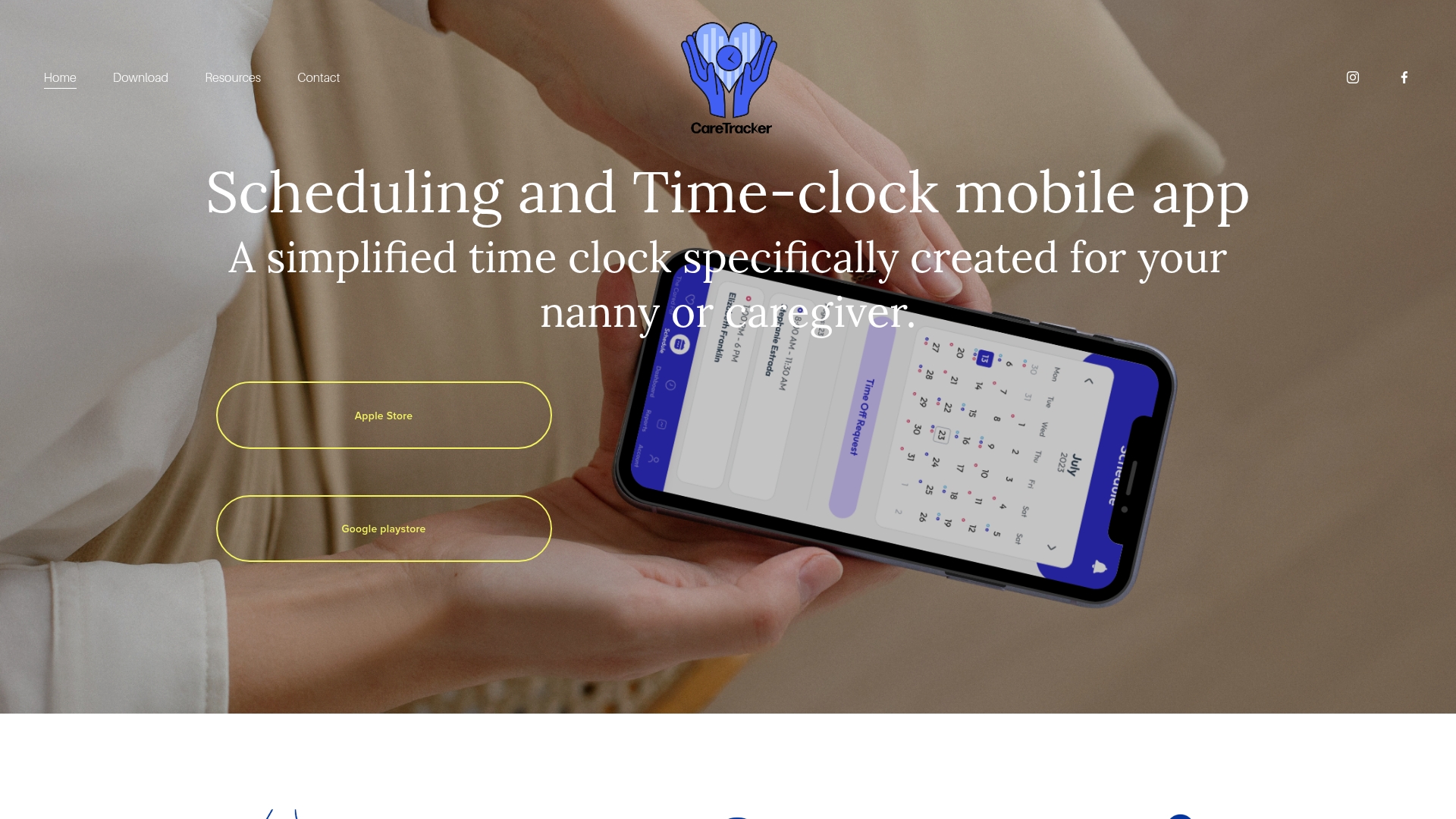
This is where our app fits. Your nanny uses the Caretracker mobile app free to track her weekly hours, and she sees all her jobs in one calendar. The app also supports state-specific pay period and overtime tracking and flexible reports, so you can see what was worked, week by week, instead of relying on memory.
5. Share the care details that make a break possible
A nanny who has the child's nap schedule, allergies, medications and emergency contacts in front of her needs fewer calls during her break. In Caretracker, caregivers can view this care information, including allergies, medications, emergency contacts, nap schedules and daily activities, instantly. That means fewer reasons to interrupt a break.
6. Review the record weekly
Before payday, check the hours against the agreement. If breaks were interrupted, pay for them. Catching it each week is far easier than reconstructing months of hours later.
Common mistakes
- Deducting 30 minutes automatically. If your nanny never leaves duty, the deduction is wrong under the federal rule.
- Assuming "sleeping child" means off duty. The DOL says a nanny who must watch the child while he sleeps is on duty.
- Verbal agreements. Where the law needs the agreement in writing, a handshake does not count.
- Ignoring local law. A city such as Seattle can have rules that a neighboring town does not.
- No records. Without them, a dispute becomes your word against hers.
When a consultation makes sense
If you have been paying your nanny for years without a break policy, deducting meal breaks, or keeping no timesheets, you may have wage reporting or payroll questions that are hard to untangle alone. We offer a Standard Payroll Consultation package for $150 one-off, and a Premium consultation for $150 one-off. Our Prior Wage Reporting & Household Payroll Cleanup Services help families who need to put earlier years in order. You can also start with the Caretracker app so your caregiver tracks her hours from day one.
For a legal question about a specific dispute or a claim, speak to an employment attorney or your state labor department.
Our perspective
Most families we talk about this with are not trying to shortchange anyone. They simply never wrote down what a break is. A nanny sits down with a sandwich, the baby is in the high chair, and nobody is sure whether that is lunch or work.
We built Caretracker around the idea that accurate records protect both sides. Caregivers use it free to track hours, approve schedule requests and see every job in one calendar. Families get a clear picture of the week, with reports and state-specific pay period and overtime tracking. When the record is clear, the break question has an answer.
Our advice is simple. Decide the break in advance, put it in writing, keep it free of interruptions, and record what actually happened. Trust grows when both sides can see the same numbers, and that peace of mind is worth more than the 30 minutes you might have deducted.
mercedes
FAQ
Is there a federal law requiring meal breaks for nannies?
No. The DOL's FLSA guidance says the law does not require breaks or meal periods. In states without a break law, breaks are a matter of agreement between you and your nanny. Your state or city may have its own rule, so check it.
Can I deduct 30 minutes for lunch from my nanny's pay?
Only if she is completely relieved of duty during that time and free to use it as she wishes. If she is still watching your child, the time is paid. Where a live-in worker's meal period is excluded, it should be by written agreement, and any interruption counts as hours worked.
How long should a nanny's lunch be on an 8-hour day?
Where a state law applies, it sets the minimum. New Jersey and Seattle, for example, call for a 30-minute meal period after five hours. Elsewhere, 30 minutes is the usual length, and the DOL treats meal periods of about that length as unpaid only when the worker is fully off duty.
What happens if my nanny's break is interrupted?
The interrupted time counts as hours worked. In Seattle, an interrupted break restarts until the worker gets a full consecutive 30 minutes. In New Jersey, the break must be uninterrupted, or it becomes an on-duty meal period that is paid and covered by a written agreement.
Do these rules apply to au pairs and senior caregivers?
The on-duty and off-duty test applies to any household worker, including live-in caregivers. Seniors who hire caregivers should check their state's domestic worker rules, because many cover caregivers as well as nannies.
Sources
- Questions and Answers About the Fair Labor Standards Act, U.S. Department of Labor
- Breaks and Meal Periods, U.S. Department of Labor
- Rest Breaks and Meal Breaks, U.S. Department of Labor
- Fact Sheet #79D: Hours Worked Applicable to Domestic Service, U.S. Department of Labor
- Fact Sheet #79B: Live-in Domestic Service Workers, U.S. Department of Labor
- New Jersey Revised Statutes 34:11-72
- My Work Rights, New Jersey Department of Labor
- New Jersey domestic workers' rights law takes effect, New Jersey Monitor
- Domestic Workers Ordinance Q&A, Seattle Office of Labor Standards
- Domestic Workers Ordinance Notice of Rights, Seattle Office of Labor Standards
- Domestic workers, Mass.gov
- Nevada Revised Statutes 613.620, FindLaw