
The minimal packet is five things: the medicine in its original labeled container, a written authorization with your signature, the correct dosing instrument, a medication log, and, if your child has a serious allergy or condition, an emergency care plan with physician orders. Parents supply and label everything; nannies verify the label, dose, and time before every single dose. Emergency medications like an EpiPen® are never handed over without explicit training and written instructions from the prescriber.
TL;DR:
- A medication packet for a nanny must include the original labeled container, a signed written authorization, the correct dosing instrument, a medication log, and an emergency care plan if necessary.
- The medication list should detail each drug with verification dates, organized by purpose, and updated immediately with any prescription or schedule changes.
- Special training is required for administering EpiPens, nebulizers, and seizure medications, with proper demonstration and written instructions from healthcare providers.
- Nannies must check labels three times per dose, use approved dosing tools, and store medications securely in their original containers out of children's reach.
- CareTracker enables families to maintain an up-to-date, shared medication profile, reducing errors and ensuring all parties have current information accessible in real time.
Table of Contents
- What Should Be on a Medications List for a Nanny?
- How Do You Safely Give Different Types of Medication?
- What Belongs in a Written Medication Authorization?
- When Does a Nanny Need Special Training for Medications?
- What if a Medication Causes an Allergic Reaction?
- How Should Parents and Nannies Communicate About Medication Changes?
- How Often Should the Medication List Be Reviewed?
- What Should You Do if There's a Medication Error?
- What Are the Legal Risks of a Nanny Giving Medication?
- A Nanny Educator's Take on What Actually Gets Missed
- Keep the Whole Medication Packet in One Place With CareTracker
- Where to Find Forms and Templates
- Sources
- FAQ
What Should Be on a Medications List for a Nanny?
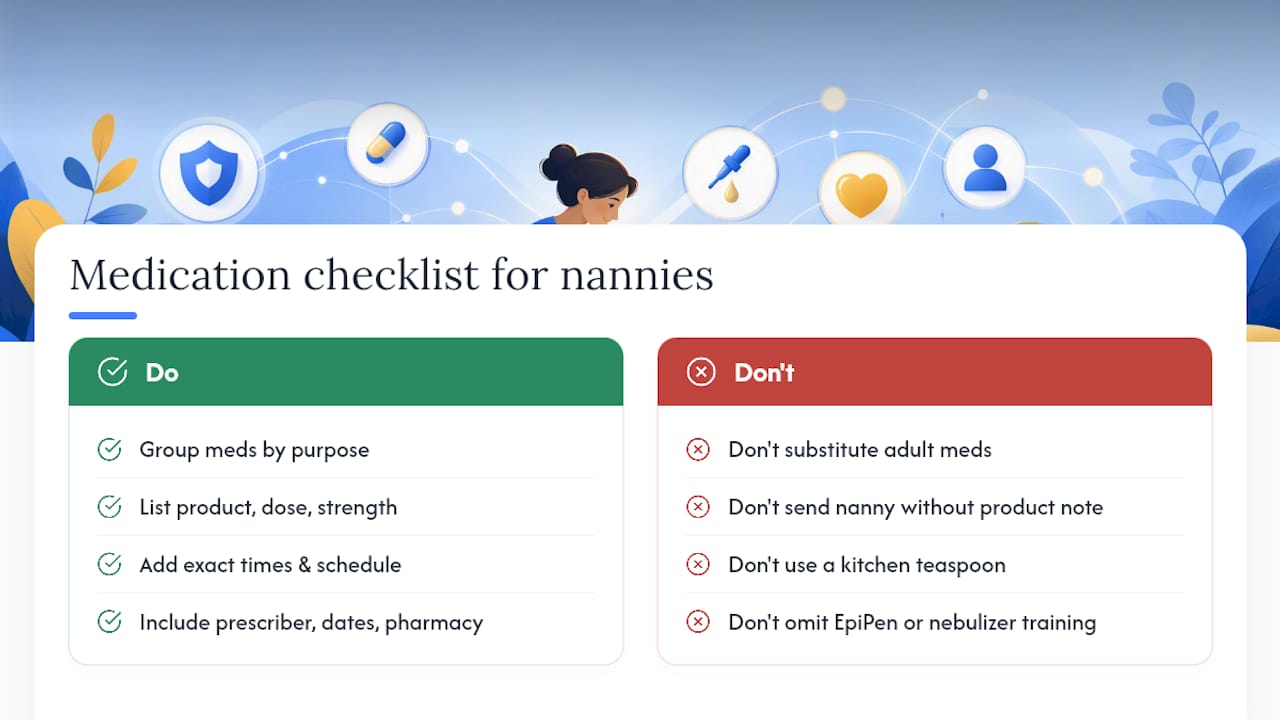
A workable medications list for a nanny isn't a vague note taped to the fridge. It's a grouped inventory with enough detail that someone who has never met your pediatrician could still administer the right dose at the right time. Organize it by purpose, because that's how emergencies unfold, one category at a time, and it's how your nanny will scan it under pressure.
Fever and pain relief: acetaminophen and ibuprofen are the two most common medications given in child care settings, and they're also the two most frequently dosed incorrectly when concentration isn't checked against the product label. Infant and children's formulations vary in strength, so the label, not memory, sets the dose.
Allergy medications: antihistamines like diphenhydramine or cetirizine, whether daily or as-needed, with clear notes on which situation triggers which drug.
Respiratory medications: rescue inhalers, nebulizer solutions, and spacers, each with printed usage steps, since nebulizers require training most nannies won't already have.
Emergency medications: EpiPen® for anaphylaxis, with training documentation attached, not just the device itself.
Topical and eye medications: prescription creams, ointments, and eye drops, noted by exact body location and eye (left, right, or both).
Antibiotics: full course details, since stopping early is a common parent-driven error that nannies should be trained to flag, not fix.
Vitamins and supplements: often skipped, but a nanny giving a daily gummy vitamin needs the same clarity as any prescription.
For every single item, record: product name, dose and strength, route, schedule with exact times, purpose, prescribing physician, start and end dates, pharmacy phone number, and a last-verified date. A caregiver medication list template built for family handoffs recommends exactly this level of detail, including pharmacy contact information, because a nanny who needs a refill or has a question at 4 PM shouldn't be stuck guessing.
Never let a nanny substitute an adult medication "just this once," and never send a nanny to a pharmacy without a written note specifying the exact product and strength you want. Dosing instruments matter more than parents think: the syringe or cup that came with the bottle is calibrated to that product, and a kitchen teaspoon is not a medical device.
How Do You Safely Give Different Types of Medication?
Every dose starts with the same habit: check the label three times. Once when you take the bottle out, once when you measure the dose, and once before you give it to the child. This "rule of three" catches the two most common errors, wrong child and wrong bottle, before they happen.
- Confirm identity, dose, and time against the written authorization, out loud if it helps, before opening the bottle.
- Measure liquids with the oral syringe or cup provided with the medicine, never a kitchen spoon. If a child vomits within 15 minutes of a dose, don't automatically re-dose. Call the parent or pharmacist first.
- For eye drops or ointment, tilt the head back, pull down the lower lid gently, and drop into the pocket that creates, never directly on the eyeball. Ointments go in a thin line along the inner lid.
- For topical creams, wash hands or wear gloves, apply to clean, dry skin, and wash hands again afterward, especially with prescription-strength products.
- For inhalers and nebulizers, follow the manufacturer's written instructions exactly, including spacer use and mask fit, and clean nebulizer parts after each use as directed. Do not attempt nebulizer treatments without hands-on training from the parent or a healthcare provider first.
Storage is half the safety equation. Keep medications in their original containers with pharmacy labels intact, at the temperature the label specifies, and out of a child's reach, locked if the household has other young children around. Emergency medications like EpiPen® belong in their own clearly marked kit, separate from routine medicine, so nobody wastes precious seconds searching during a reaction.
Pro Tip: Keep a small photo of each medication label on your phone. If you're ever on the phone with poison control or a pediatrician, you can read the exact product name and concentration instead of trying to describe a bottle from memory.
What Belongs in a Written Medication Authorization?
A written authorization is the document that legally and practically clears a nanny to give medicine, and it needs to hold up to scrutiny, not just good intentions. At minimum, it should include the parent's signature, the child's full name, the medication name and exact dose, the route (oral, topical, inhaled), the schedule, start and end dates, prescriber name and phone number, and any special instructions like "give with food" or "skip if child is asleep." A medication authorization and administration record built for licensed child care settings includes all of these fields for good reason: it's the same information a court, a pediatrician, or an insurance adjuster would ask for after the fact. For over-the-counter medications, many families still require a quick check with the pediatrician's office before the first dose, especially for children under two.
The dose log is separate from the authorization and gets filled in every single time medicine is given: date, time, dose given, nanny's initials, and a notes field for anything unusual, refusal, vomiting, drowsiness, or a rash.
One person should own the master medication list, usually the parent, and update its last-verified date every time something changes. Anything uncertain gets flagged "needs confirmation" rather than guessed at. A medication log built for caregivers and printable authorization templates for caregivers both give you a starting format instead of building one from scratch.
One consistent finding across caregiver documentation guides: a single master list with a clear owner and a last-verified date prevents the conflicting-version problem that causes most medication mix-ups during handoffs.
When Does a Nanny Need Special Training for Medications?
Some medications cross a line from "follow the label" into "requires hands-on instruction." Insulin, nebulizer treatments, seizure rescue medications, and EpiPen® use all fall here, and no nanny should attempt any of them for the first time during an actual emergency.
- EpiPen®: parents should demonstrate use on a trainer device and provide written step-by-step instructions before the nanny's first shift alone.
- Nebulizer and inhaler protocols: require written physician instructions covering dose, frequency, and equipment cleaning.
- Insulin and seizure rescue medications: require direct training from the prescriber or a licensed professional, plus documentation of who provided that training and when.
Get medical orders in writing from the prescriber, not just verbal instructions relayed secondhand. Some jurisdictions treat certain tasks as "incidental medical services" that require registration or specific forms, so check your state's childcare licensing rules if your nanny will be doing blood glucose checks or administering inhaled medications regularly.
Pro Tip: If your child has ever had an anaphylactic reaction, run a full mock drill with your nanny: locate the EpiPen®, say the steps aloud, and call a non-emergency number to practice the sequence. Muscle memory beats a laminated instruction card during a real event.
In an actual emergency: use the EpiPen® first, then call 911, then call the parent. For seizures, follow the written care plan exactly and call EMS if it specifies or if the seizure passes the time threshold the plan sets.
What if a Medication Causes an Allergic Reaction?
Every medication packet needs an allergy section that's impossible to miss, not buried on page three of a form. List known drug allergies by name, along with the reaction they caused, hives, swelling, breathing trouble, so your nanny recognizes a repeat instantly rather than guessing whether a new rash is normal.
If your child has no known drug allergies yet, note that explicitly rather than leaving the field blank. A blank field reads as "unknown," while "no known drug allergies as of [date]" reads as verified information.
For a first-time reaction to any medication, mild or otherwise, the nanny's job is simple: stop the medication, note the time and symptoms, and call the parent immediately. For anything involving swelling of the face or throat, difficulty breathing, or widespread hives, that's a 911 call first, EpiPen® if prescribed and authorized, then a call to the parent. Write this escalation order directly into the packet so there's no hesitation about sequence during the actual event.
Adverse reactions that aren't full allergies, drowsiness, upset stomach, mood changes, still belong in the log with enough detail that a parent can relay them to the pediatrician accurately. "Seemed sleepier than usual after the 2 PM dose" is more useful three weeks later than no note at all. If your family works with allergen introduction planning resources, that history is worth cross-referencing against the medication list, since food and drug sensitivities sometimes travel together in young children.
How Should Parents and Nannies Communicate About Medication Changes?
Medication changes are where most packets quietly go stale. A pediatrician adjusts a dose over the phone, a prescription runs out and gets swapped for a generic, or a course of antibiotics ends early, and the printed sheet on the counter never catches up.
Set a simple rule: any change to dose, timing, or medication itself gets communicated to the nanny before the next scheduled dose, not after. A text message alone isn't enough if it can get buried; update the written list itself, and have the nanny acknowledge she's seen it.
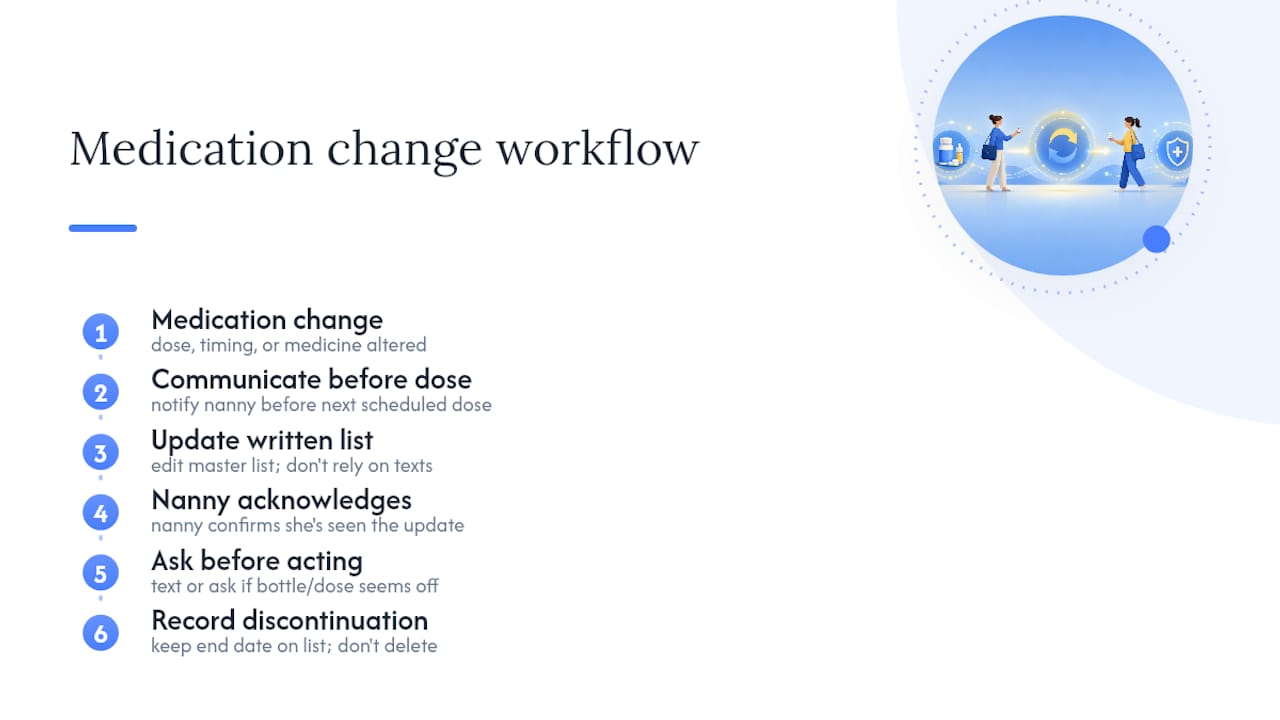
Build in a standing check, not just a reactive one. A quick two-minute conversation at pickup or drop-off, "any changes to meds this week?", catches things a busy parent might forget to mention. When a medication is discontinued, note the end date on the list rather than deleting the row entirely; that history matters if a symptom recurs later.
The nanny should feel free to ask questions rather than assume. If a dose looks different from what's written, or a bottle looks unfamiliar, that's worth a text before administering, not after. This isn't about distrust. It's about making sure a five-second confirmation catches a mistake before it happens rather than after.
How Often Should the Medication List Be Reviewed?
A medication list is only as good as its most recent update, and "recent" needs a real date attached, not a vague sense that it's probably still accurate. Put a last-verified date at the top of the master list every time anything changes, and review the whole thing at set intervals even when nothing seems different.
A reasonable rhythm: check the list every time a prescription changes, every time a course of medication starts or ends, and at minimum once a month for anything ongoing. Seasonal allergy medications and as-needed items are the ones parents forget to update most often, since they don't follow a fixed schedule.
Assign one owner. Usually that's the parent managing the household, and that person is the only one who edits the master copy, even if a co-parent or grandparent also has access to view it. Multiple editors create multiple versions, and multiple versions are exactly how a nanny ends up working from an outdated dose. Anything the owner isn't fully sure about gets marked "needs confirmation" until a pharmacist or physician clears it up, rather than left ambiguous.
What Should You Do if There's a Medication Error?
If a nanny gives the wrong dose, the wrong medication, or misses a dose entirely, the first call is to Poison Control at 1-800-222-1222, available around the clock across the United States, followed immediately by a call to the parent. Poison Control staff can tell you within minutes whether a given error requires emergency care or just close observation.
Keep this number, along with your pediatrician's after-hours line and the nearest emergency room, posted directly on the medication packet itself, not buried in a phone's contacts list where a panicked person has to search for it. Seconds matter, and a laminated card taped inside a kitchen cabinet works better than any app in a true emergency.
Log the error the same way you'd log a normal dose: time given, what was given, what should have been given, and what actions were taken afterward. This isn't about assigning blame. It's the information a pediatrician or Poison Control will actually ask for, and it protects both the parent's ability to get good medical advice and the nanny's ability to explain clearly what happened.
If the error involves a controlled substance, a prescription with a narrow safety margin, or any medication a child took by accident rather than through a dosing mistake, treat it as a medical emergency and call 911 rather than waiting to see symptoms develop.
What Are the Legal Risks of a Nanny Giving Medication?
Household employment doesn't come with the same licensing structure as a daycare center, but that doesn't mean medication administration happens in a legal vacuum. Written authorization protects both sides: it shows the nanny had explicit permission and specific instructions, and it shows the parent gave clear direction rather than a vague verbal request.
Licensed child care settings in many states require written authorization and, for certain tasks, formal registration before staff can perform what regulators call incidental medical services, things like blood glucose testing or inhaled medication administration. Private household employment generally isn't licensed the same way, but the underlying principle still applies: a nanny giving specialized medical care benefits from the same written orders and training documentation a licensed provider would need.
Liability runs in both directions. A nanny who administers medication without authorization, or outside the instructions given, takes on personal risk if something goes wrong. A parent who fails to provide clear written instructions, proper labeling, or training for emergency medications carries exposure too. Neither side benefits from working off a verbal understanding. If your family also employs a nanny under a formal household payroll arrangement, it's worth confirming that your work agreement or handbook references medication administration expectations directly, so responsibilities aren't left to assumption.
A Nanny Educator's Take on What Actually Gets Missed
The three gaps that show up again and again: no last-verified date on the list, a medicine sent without its dosing syringe, and unclear permission for basic over-the-counter drugs like children's ibuprofen. None of these require complicated fixes. They require someone to check before the first shift, not after a problem.
A three-minute pre-shift routine catches most of it: confirm the last-verified date is current, confirm every bottle has its matching dosing tool, and confirm OTC permissions are written down, not assumed. A guide on medication safety for nannies makes the same point from the caregiver's side: ambiguity is the actual risk, not the medications themselves.
— mercedes
Keep the Whole Medication Packet in One Place With CareTracker
Thecaretracker gives families a free way to keep the exact packet this article describes accessible to a nanny in real time, not stuck on a kitchen counter or buried in a group text. Instead of juggling a paper form, a separate log, and a text thread every time something changes, parents can update medication fields, allergies, and emergency contacts in one shared profile that both sides can check before a dose.
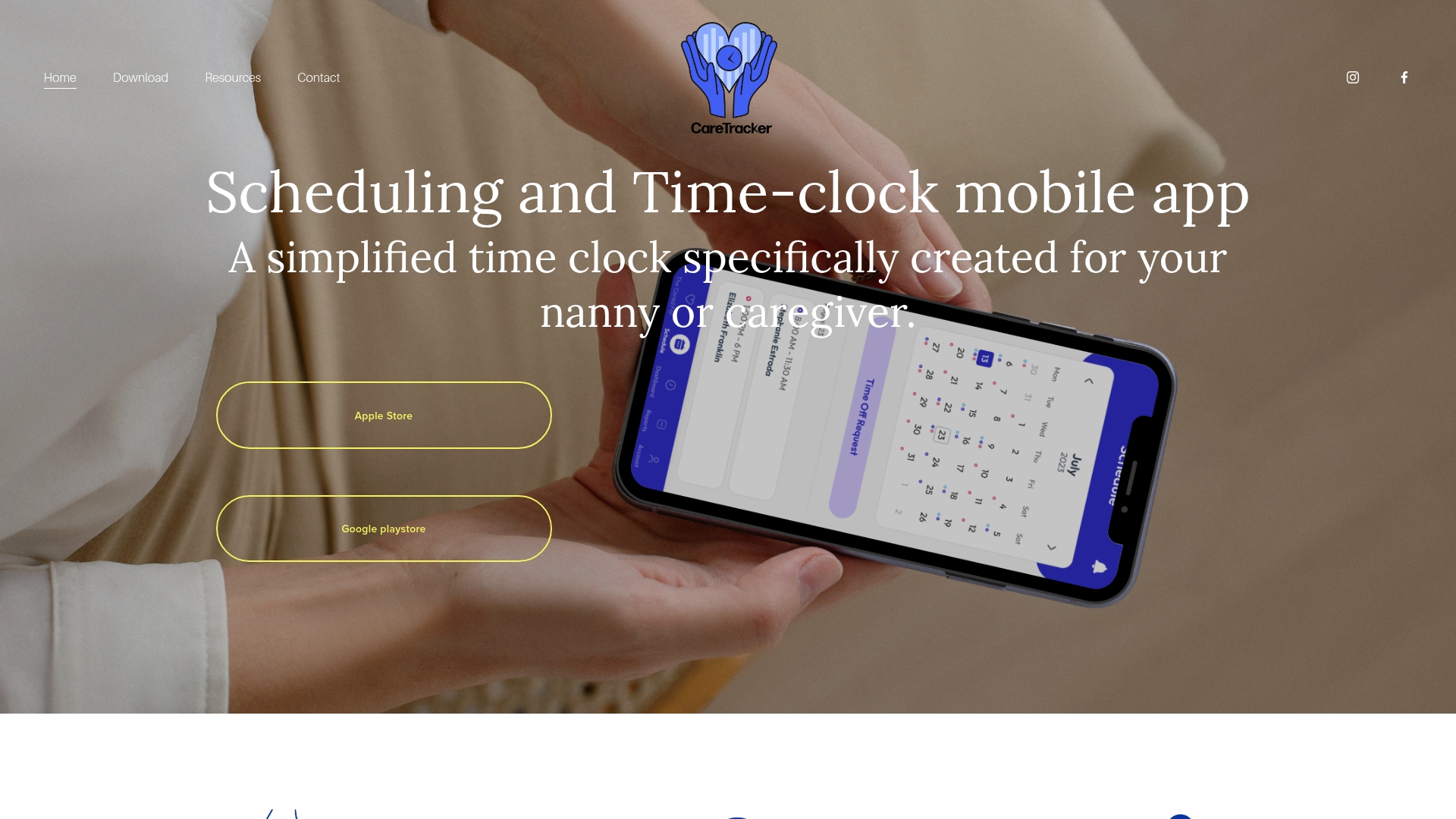
The app mirrors the printed master list: a medication field for each drug, a schedule view for timing, and a log entry option for recording each dose given, so the "last-verified" habit this article recommends becomes something built into the workflow rather than something you have to remember. Keep a printed backup for the emergency kit itself, but let a caregiving app be the single source parents and nannies both trust for day-to-day accuracy. Pair it with a medication log built for caregivers for the paper-based backup, and try the free scheduling and time-clock app to get your child's care profile set up before the next shift starts.
Where to Find Forms and Templates
For the actual paperwork, start with UCSF's medication administration guidance for step-by-step how-to instructions, your state's childcare licensing office for legal requirements on incidental medical services, and a caregiver medication list template to build your own list from scratch.
This article is general information, not a substitute for advice from a qualified doctor. Consult a qualified healthcare professional about your own circumstances before acting on anything here.
Sources
- Medication administration guidance (UCSF Child Care Health Program)
- Know the law about giving medications and incidental medical services in licensed child care in California
- Medication authorization and documentation template (4-C)
- Caregiver medication list template for families (MySageBeam)
FAQ
What Five Items Must Be in a Nanny's Medication Packet?
The medicine in its original labeled container, a written authorization signed by the parent, the correct dosing instrument, a medication log, and an emergency care plan if the child has a severe allergy or chronic condition. Every item should carry a last-verified date so nothing goes stale between updates.
Can a Nanny Legally Give a Child Prescription Medication?
Yes, with written parental authorization that names the exact medication, dose, and schedule, plus training for anything requiring special equipment or technique, like inhaled medications. Some tasks, like blood glucose testing, may require formal registration depending on your state's childcare regulations.
Does a Nanny Need Training to Use an EpiPen®?
Yes. Parents should demonstrate proper use on a trainer device and provide written instructions before a nanny's first unsupervised shift, since EpiPen® administration is not something to learn during an actual reaction. Call 911 immediately after use, then notify the parent.
How Often Should a Family Update the Nanny Medication List?
Update it immediately whenever a prescription, dose, or schedule changes, and review the entire list at least monthly even without changes. A single owner should maintain the master copy and mark its last-verified date every time it's touched.
Does CareTracker Help With Medication Tracking for Nannies?
Yes. CareTracker lets families share medication fields, schedules, and emergency contacts directly with a nanny through a free caregiver app, keeping the packet accessible and current instead of relying on paper alone. Current pricing and features for any additional services are listed directly on the site.