
The best nanny share schedule matches your families' real overlap: a full simultaneous share with guaranteed hours when both households need care at the same time, or a split shift when your work hours barely touch. Whichever you choose, guaranteed hours protect the nanny's income, and the trade-off is always the same: more overlap means lower cost per family but less flexibility. Templates, payroll basics, and contract language for both approaches follow below.
TL;DR:
- Full simultaneous shares are most cost-efficient and predictable but require close proximity and aligned parental work hours.
- Split and staggered schedules are better for differing parent shifts or wider age gaps but involve more transit and billing complexities.
- Guaranteed hours must be paid regardless of attendance, and clear templates with separate solo and shared hours prevent disputes.
- Each family should treat payroll separately with its own EIN and consider professional services to ensure compliance and smooth tax filing.
- Consistent communication through shared calendars, regular reviews, and formal contracts helps sustain the nanny share long-term.
Table of Contents
- What Are the Main Nanny Share Schedule Types?
- How Do You Build a Nanny Share Schedule Template?
- What's the Right Way to Split Pay and Set Up Payroll?
- What Should Go in Your Nanny Share Contract?
- How Do You Keep Communication Running Smoothly?
- Which Tools Help You Run the Schedule Day to Day?
- What Actually Keeps a Nanny Share Running for Years?
- Make Your Schedule Easier to Run, Not Just Easier to Plan
- Sources
What Are the Main Nanny Share Schedule Types?
Most nanny share arrangements fall into one of five structures, and picking the right one depends less on preference and more on how closely your two families' work hours actually line up.
Full or simultaneous share. Both children are cared for at the same time, in the same location, for the same hours. This is the most common setup when parents in both households work traditional 8 a.m. to 6 p.m. jobs. It's also the easiest for a nanny to manage, since she isn't splitting attention across two different daily rhythms.
Split schedule. One family covers mornings, the other covers afternoons or evenings, and the nanny works a longer combined day across two households. This works well when one parent has an early shift and the other family runs on a later schedule, but it means more transit time for the nanny and less overlap for cost-sharing.
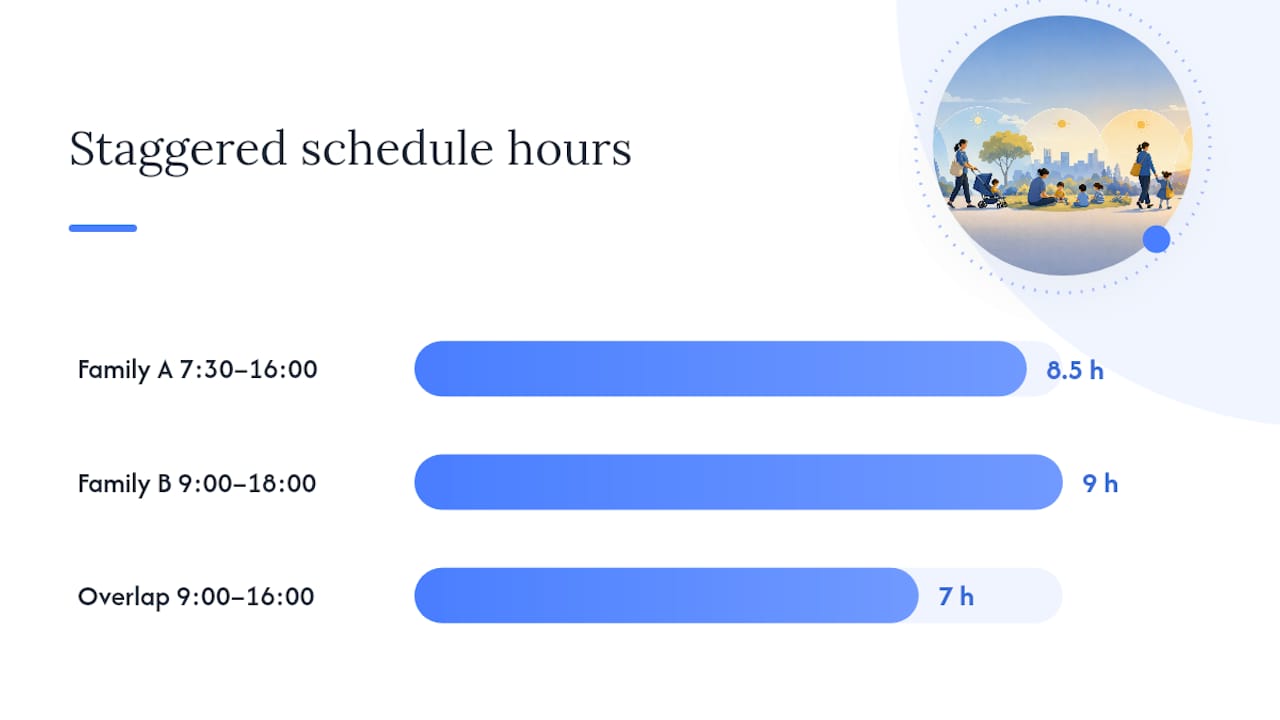
Staggered or overlap schedule. Similar to a split schedule but with a middle block where both children are present. A common version has Family A's child arriving at 7:30 a.m., Family B's child joining at 9 a.m., and Family A leaving at 4 p.m. while Family B's child stays until 6 p.m. This spreads solo hours across both families rather than concentrating them in one.
Rotating host. Care happens in Family A's home for one week and Family B's home the next. This distributes the wear on furniture, toys, and utilities evenly, but it requires duplicate supplies (cribs, high chairs, backup clothes) in both locations and can be harder for very young children who thrive on a single consistent environment.
Part-time blends. Each family only needs care two or three days a week, and the two schedules combine to give the nanny a fuller workweek. This is common with one working parent and one who works part-time or freelances.
Here's how they stack up on the factors that matter most:
- Age proximity: Full shares work best when children are close in age and developmental stage; a wide age gap (infant and preschooler) often favors staggered schedules so the nanny isn't managing nap time and a scavenger hunt simultaneously.
- Parental hours overlap: The more your work schedules overlap, the more a full share saves you money, since both families split the same guaranteed hours rather than paying for separate solo blocks.
- Travel and backup risk: Rotating-host and split schedules add more moving parts, meaning more chances for a delay to ripple through both households.
- Proximity between homes: A split or staggered schedule only works logistically if the two homes are a short drive or walk apart; rotating host schedules matter less here since the nanny only travels once a week.
- Predictability for the nanny: Full simultaneous shares tend to score highest on predictability, which matters when negotiating a shared childcare schedule that keeps a good nanny long term.
- Perceived fairness: Families report more disputes over split and staggered schedules, simply because solo hours have to be tracked and billed carefully to avoid one household quietly subsidizing the other.
How Do You Build a Nanny Share Schedule Template?
A written template removes almost all the ambiguity that causes nanny share disputes. Below are four adaptable formats. Copy the structure, plug in your own hours, and adjust the notes column as your arrangement evolves.
-
Full simultaneous share template. Monday through Friday, 8:00 a.m. to 5:30 p.m., both children present the entire day. Both families are billed for the full 9.5 hours daily regardless of attendance, since this is the guaranteed-hours block. Note any half-day early pickups directly on the calendar so the nanny isn't guessing.
-
Split-shift template. Family A covers 7:00 a.m. to 1:00 p.m. (guaranteed, billed whether or not the child is present), and Family B covers 1:00 p.m. to 6:30 p.m. (also guaranteed). Mark the 1:00 p.m. handoff time clearly, and note which family supplies lunch versus snack, since split shifts often create confusion over meal responsibility.
-
Staggered/overlap template. Family A's child arrives at 7:30 a.m.; Family B's child arrives at 9:00 a.m., creating an overlap block from 9:00 a.m. to 4:00 p.m. Family A's solo morning hour (7:30 to 9:00) is billed only to Family A at a pre-agreed solo rate, while the overlap hours are split. Family B's solo evening hours (4:00 to 6:00) follow the same solo-rate logic.
-
Rotating-host template. Week one, care happens at Family A's home, Monday through Friday, 8:00 a.m. to 5:00 p.m. Week two, the same hours shift to Family B's home. Both families pay the same guaranteed hours regardless of location, but the hosting family typically adds a documented host fee to offset extra wear and utility use.
For every template, mark guaranteed hours in one color and solo hours in another if you're using a shared digital calendar. Guaranteed hours get paid whether or not the child shows up; solo hours get billed only to the family whose child is actually present, usually at a slightly higher hourly rate to compensate the nanny for the reduced ratio.
Adapting for vacations, holidays, and sick days is where most templates fall apart if you haven't planned ahead. Build in three rules from day one: guaranteed hours are still paid if a family is on vacation and gives proper notice (commonly one to two weeks), holidays follow a pre-agreed list built into the calendar at the start of the year, and sick days for the child don't reduce guaranteed pay, but sick days for the nanny should trigger your backup coverage plan instead of an unpaid gap.
What's the Right Way to Split Pay and Set Up Payroll?
Families typically split pay one of three ways, and picking the wrong one for your situation is a common source of resentment down the line.
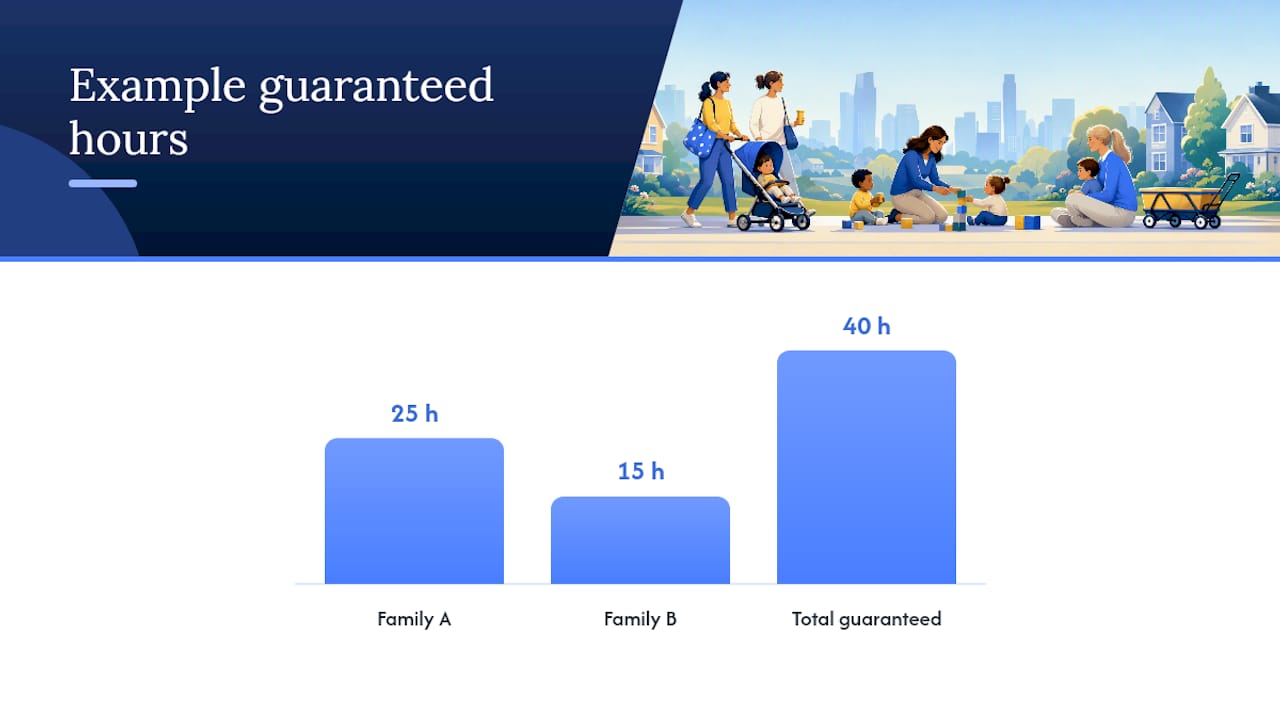
50/50 split works cleanly for full simultaneous shares where both children are present the same hours every day. Proportional-by-hours splitting fits staggered or part-time blends, where Family A might use 25 guaranteed hours a week and Family B uses 15, so the cost divides accordingly. Host fee adjustments apply on top of either model when care happens primarily or exclusively in one family's home. A modest weekly stipend, spelled out in the family agreement, keeps that arrangement from quietly souring over time.
Nanny share pay ranges commonly cited by industry guides fall within a moderate hourly gross rate range, split between the two families, which translates to about $1,200 to $2,400 per family per month for full-time care. Actual rates vary by region, nanny experience, and number of children.
Guaranteed hours are the backbone of a stable nanny share. The principle is simple: the nanny is paid for an agreed number of hours every week, regardless of whether a child is sick, a family travels, or a snow day cancels plans. Nest Payroll's guidance on nanny shares treats this as close to standard practice among professional arrangements, because it removes the need to renegotiate pay every time one family's plans change.
Payroll setup requires each family to treat itself as a separate employer, even when only one nanny is involved:
- Each family generally needs its own EIN (Employer Identification Number) to legally run payroll, since each household is its own employer for tax purposes.
- Families can either use a payroll service that handles withholding and year-end forms, or designate one family as the primary payroll processor while the other reimburses them in writing each pay period.
- W-2s are issued based on who actually processes payroll. If one family handles it centrally, that family issues the W-2 and the reimbursing family should keep documentation showing their share of the cost.
- A dedicated payroll service comparison can help you weigh the cost of outsourcing this against doing it manually.
Getting the household-employer basics right from the start avoids the scramble that happens every January when tax forms are due and nobody remembers who paid for what.
What Should Go in Your Nanny Share Contract?
A nanny share agreement isn't one document. It's two: a personal employment contract each family signs individually with the nanny, plus a shared family agreement that governs how the two households coordinate with each other. Care recommends this dual structure specifically because it protects everyone if one family decides to leave the arrangement.
Your schedule clause needs to spell out the specifics, not just the general idea:
- Exact days and hours of care, including any staggered start or end times.
- The host-location plan (single home, rotating, or split by day).
- A pre-agreed holiday list covering which days are paid, unpaid, or covered by backup care.
- Guaranteed hours language stating the nanny is paid for the agreed weekly total regardless of attendance.
- A solo-day pay formula for staggered schedules, spelling out the higher rate for hours when only one child is present.
- Overtime terms, since hours beyond 40 in a week typically require time-and-a-half under federal law, and this applies the same way whether the nanny is working solo hours for one family or shared hours for both.
- PTO and sick policy for both the nanny and the families, including how much notice is required.
- A notice period for exiting the arrangement, commonly two to four weeks, so the remaining family has time to find a new share partner or adjust pay.
Beyond the schedule itself, build in a backup coverage plan naming who steps in if the nanny is sick, a review cadence (monthly is common) to revisit pay and hours as children grow, and a simple dispute-resolution step, even something as basic as agreeing to a 48-hour cooling-off period before either family makes a unilateral change.
How Do You Keep Communication Running Smoothly?
The nanny shares that last the longest almost always share one habit: a shared calendar that both families actually check, not one that exists in theory. Practitioner guides consistently link routine communication and weekly reviews to longer-lasting arrangements, and the mechanics are simpler than most families expect.
Set three rules early. First, use one shared calendar for schedule changes, vacation requests, and holiday planning, and treat it as the single source of truth rather than texting updates that get lost. Second, agree on a daily check-in format, even a two-line end-of-day summary from the nanny covering naps, meals, and mood. Third, hold a short weekly review, five to ten minutes, where both families and the nanny confirm the coming week's hours and flag anything unusual.
Designate one point of contact per family for scheduling questions, so the nanny isn't fielding conflicting messages from four different adults. If you're using a rotating-host model, build a simple handoff checklist: supplies that travel with the child, any medication instructions, and a note on what worked or didn't work that week.
Pro Tip: Put a 60-second buffer into every handoff time on your calendar. A five o'clock pickup that's actually scheduled for 5:00 sharp turns into stress the moment traffic runs long; scheduling it as 4:55 to 5:05 gives both families room to breathe.
For anything bigger than a scheduling hiccup, agree in advance on an escalation path. A monthly sit-down to review pay, hours, and satisfaction catches small frustrations before they become a reason to end the share. Naming a neutral third party, even a mutual friend, as a pre-agreed mediator for serious disagreements gives both families somewhere to go besides a tense group text.
Which Tools Help You Run the Schedule Day to Day?
Once your schedule, pay split, and contract are in place, the harder part is running it consistently for months. That's where a scheduling and time-tracking app takes over what a shared spreadsheet usually fails to do.
A scheduling app can give nannies a single calendar view of every job across both households, which matters most in rotating-host or staggered schedules where hours shift week to week. Families can submit and approve schedule requests directly in an app instead of over text, and weekly hours can be tracked automatically, so guaranteed-hours math doesn't rely on someone's memory at the end of the month.
Practical features that map directly onto the templates above include:
- A unified calendar showing both families' shifts in one place, useful for coordinating a shared childcare schedule without duplicate texts.
- Schedule requests and approvals built into the app rather than scattered across messages.
- Weekly hours tracking that separates guaranteed hours from solo-day hours automatically.
- Exportable timesheets for payroll processing or reimbursement documentation between families.
- Job-level notes covering allergies, medications, nap schedules, and daily activities, so care information travels with the nanny rather than living in someone's head.
For households setting this up from scratch, a downloadable nanny schedule template built for mobile use and a nanny timesheet template for tracking hours give you a starting point before you commit to a full digital workflow. Two workflows worth setting up early: automatic guaranteed-hours recording so neither family has to recalculate pay manually each week, and rotating-host notifications that remind both households when the supplies list and handoff location change.
What Actually Keeps a Nanny Share Running for Years?
The nanny shares that survive past the first year almost always have one thing in common: a rule that guaranteed hours don't get renegotiated informally. The moment one family starts quietly adjusting pay because their child was out sick or on vacation, the whole structure starts to drift, and drift is what eventually breaks these arrangements, not conflict.
Negotiating a host fee or solo-day rate is less awkward than it sounds if you frame it as math, not a personal ask. A host fee covering an extra $30 to $50 a week in wear and utilities is a small number next to what either family saves compared to solo care, and most nannies appreciate a solo-day rate that's simply their regular rate plus 15 to 20 percent, since it reflects the reduced ratio without requiring a new negotiation every time.
What surprises new nanny share families most is how much the schedule itself, not the personalities involved, determines whether the arrangement lasts. A clear caregiver scheduling workflow removes far more friction than any amount of goodwill between two households.
— mercedes
Make Your Schedule Easier to Run, Not Just Easier to Plan
A written template and a solid contract get your nanny share off the ground, but the daily grind of tracking guaranteed hours, approving schedule changes, and keeping care notes straight across two households is where most families lose momentum. A scheduling app built specifically for that gap can be free for nannies to use, and it turns the templates and payroll logic covered above into an actual working calendar instead of a document that gets stale by week three.
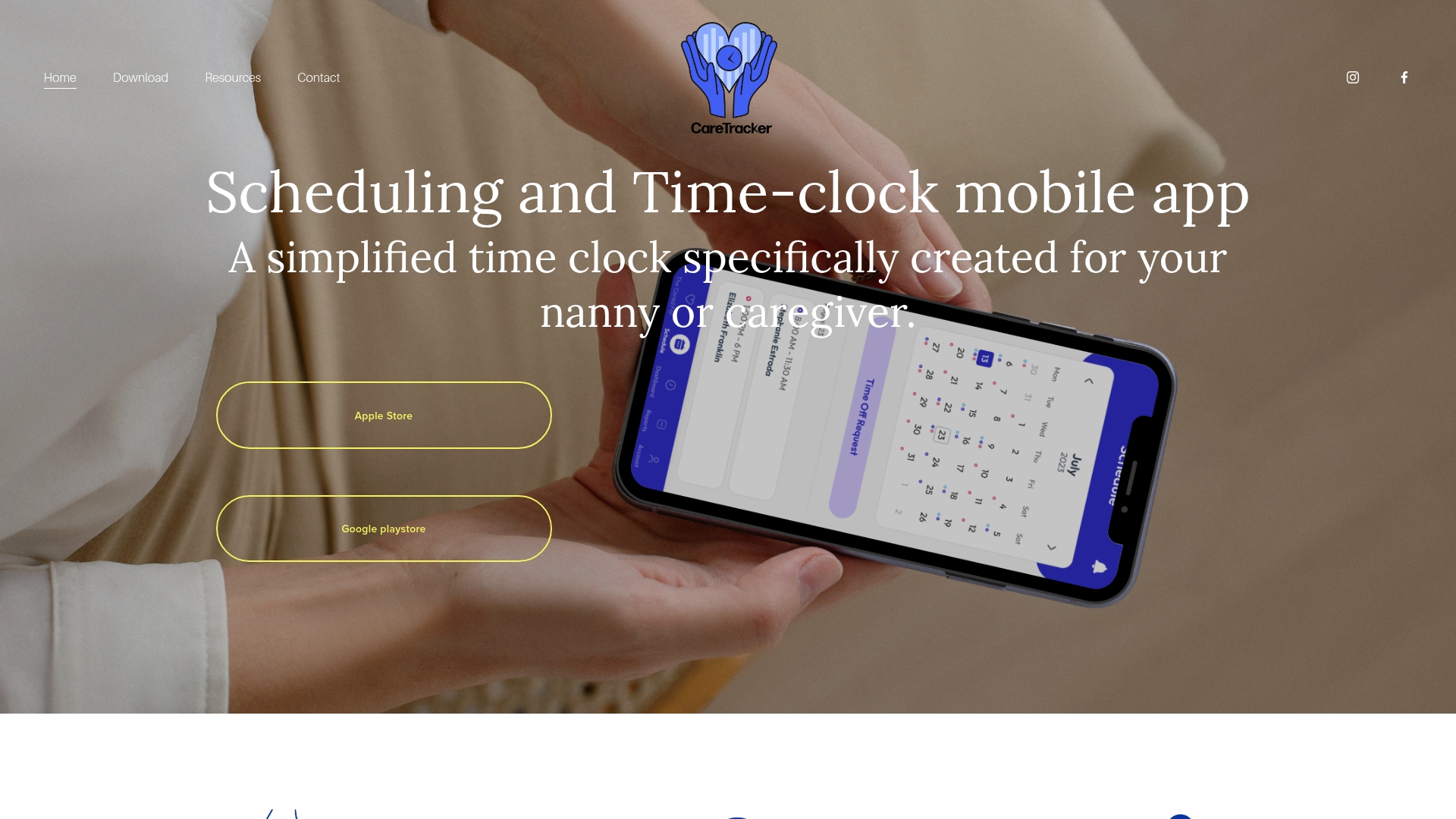
Picture a rotating-host week where the nanny gets an automatic notification the moment the location and supplies list change, instead of hunting through old texts to remember whose turn it is. Or a family relying on guaranteed hours who no longer has to manually recalculate pay when a child is out sick, because the app already separated guaranteed hours from solo-day hours in the weekly tracker. Families managing more complex payroll questions, like proportional splits or multi-nanny households, can also get hands-on help through Thecaretracker's payroll consultation service.
Using the app alongside your contract is optional. The templates and rules in this guide work with a shared spreadsheet just fine. But if you want the guaranteed-hours math, the calendar, and the care notes in one place, start with Thecaretracker's free app and see how it fits your schedule before your next payroll cycle.
Sources
For the tax side of running a household payroll, IRS Publication 926 covers household employer reporting obligations directly from the source. Nest Payroll's nanny share cost and tax breakdown walks through EIN setup and guaranteed-hours math in more depth, and Care.com's contract guidance offers a fuller checklist for the employment agreement itself. For families building daily routines around childcare more broadly, Baby Bare Essentials' planning resources offer additional scheduling perspective worth a look.
- Nanny Share Guide: How They Work, Cost Math, and Tax Setup | Nest Payroll
- Care
- Nanny Share Guide: How They Work | ChildCarePath
- Nanny Share Legal Guide: Contracts & Tax | Beverly