
No federal law requires a special premium for split shifts, but you can't skip hourly tracking or overtime math because the day is broken up. The FLSA still requires overtime past 40 hours a week, some states like New York add spread-of-hours pay, and market practice fills the rest with a 15–25% premium or flat fee. Track hours precisely, check your state's rules, and put the arrangement in writing.
TL;DR:
- Families should document and track split shift hours precisely, including premiums, guarantees, and any applicable state spread-of-hours pay rules.
- Average premiums for split shifts typically range from 15% to 25% above the regular hourly rate, with flat fees and guaranteed minimums also common.
- Overtime calculations must include affected shifts at the adjusted hourly rate, with total weekly hours crossing 40 triggering additional pay at 1.5 times the regular rate.
- Disputes are most often resolved through clear, written agreements and verified time records, with state labor departments providing guidance on legal compliance.
- Consistent, transparent pay premiums for split shifts improve caregiver retention and should be built into overall compensation, not treated as optional extras.
Table of Contents
- Do you legally have to pay more for a nanny split shift pay arrangement?
- How much extra do families typically pay for split shifts?
- What does the split shift pay math actually look like?
- How should you document and pay split shifts correctly?
- What happens when a nanny and family disagree on split shift pay?
- How does split shift pay affect a nanny's total compensation?
- Why fair split shift pay is a retention strategy, not a courtesy
- How Thecaretracker keeps split shift pay accurate
- Where to check the current rules
- Sources
Do you legally have to pay more for a nanny split shift pay arrangement?
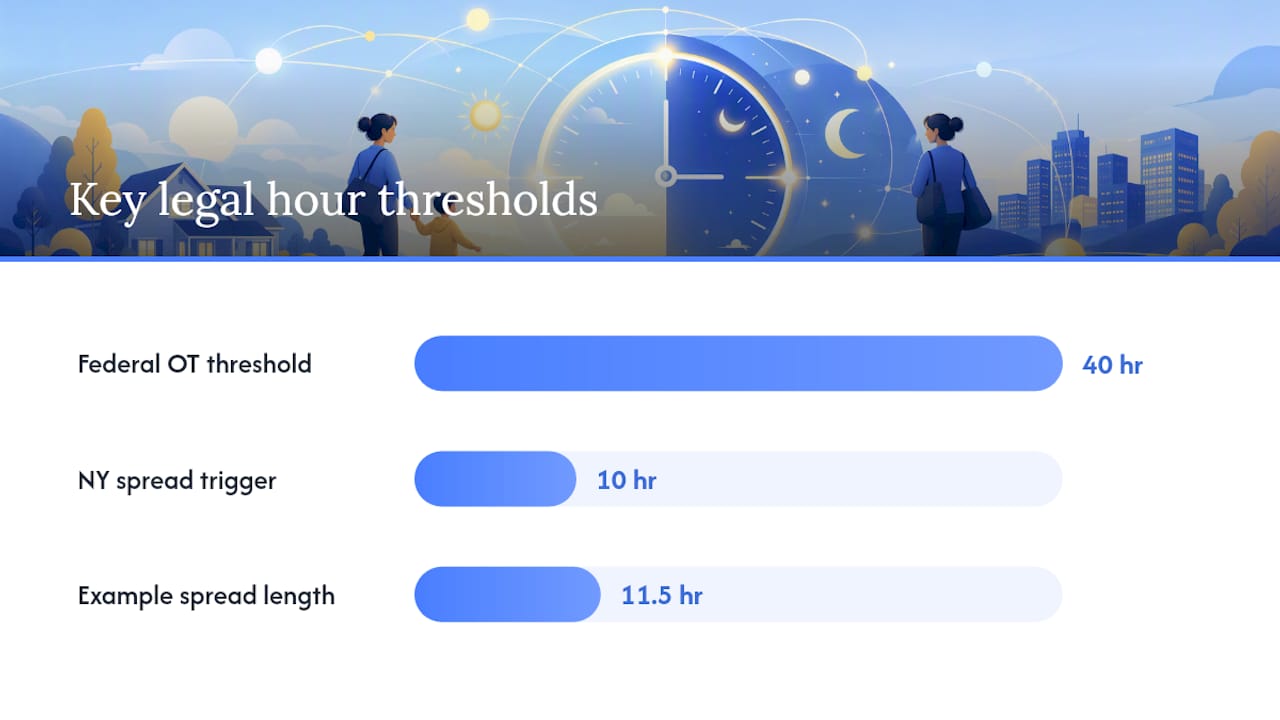
Federal law sets the floor, and it's simpler than most household employers expect. The Fair Labor Standards Act treats nannies as nonexempt employees, which means overtime kicks in at 1.5 times the regular rate once weekly hours cross 40, split shift or not. Paying a flat weekly salary doesn't erase this obligation. You still have to track hours and calculate the effective hourly rate to confirm you're not shortchanging overtime pay.
Where it gets more complicated is state law. New York's Domestic Workers Bill of Rights requires spread-of-hours pay: an extra hour at minimum wage on any day the workday spans more than 10 hours from start to finish, even if the nanny wasn't actively working the whole time. A nanny who clocks in at 7 a.m., leaves for a five-hour midday break, and returns until 6:30 p.m. has an 11.5-hour spread, which triggers that extra hour regardless of total hours worked.
Not every state has an equivalent rule, and the ones that do vary in trigger thresholds and formulas. That's why the research consistently flags one habit: check your state labor department early, before you finalize a schedule, not after a dispute starts.
A few situations call for a lawyer or your state labor office rather than a guess:
- The nanny's classification as exempt or nonexempt is unclear (rare for nannies, but it happens with live-in arrangements).
- The family splits time across two states in the same week.
- A dispute has already surfaced over back pay or missed premiums.
Pro Tip: Print your state's domestic worker wage page and keep it with your household payroll file. State labor departments update thresholds occasionally, and you want the current version, not a rule you remember from a friend two years ago.
How much extra do families typically pay for split shifts?
Most families land on one of three structures once they get past the legal floor: a percentage premium, a flat daily fee, or guaranteed minimum hours. None of these are required by federal law outside overtime, but they're what keeps reliable caregivers from walking away from a fragmented schedule.
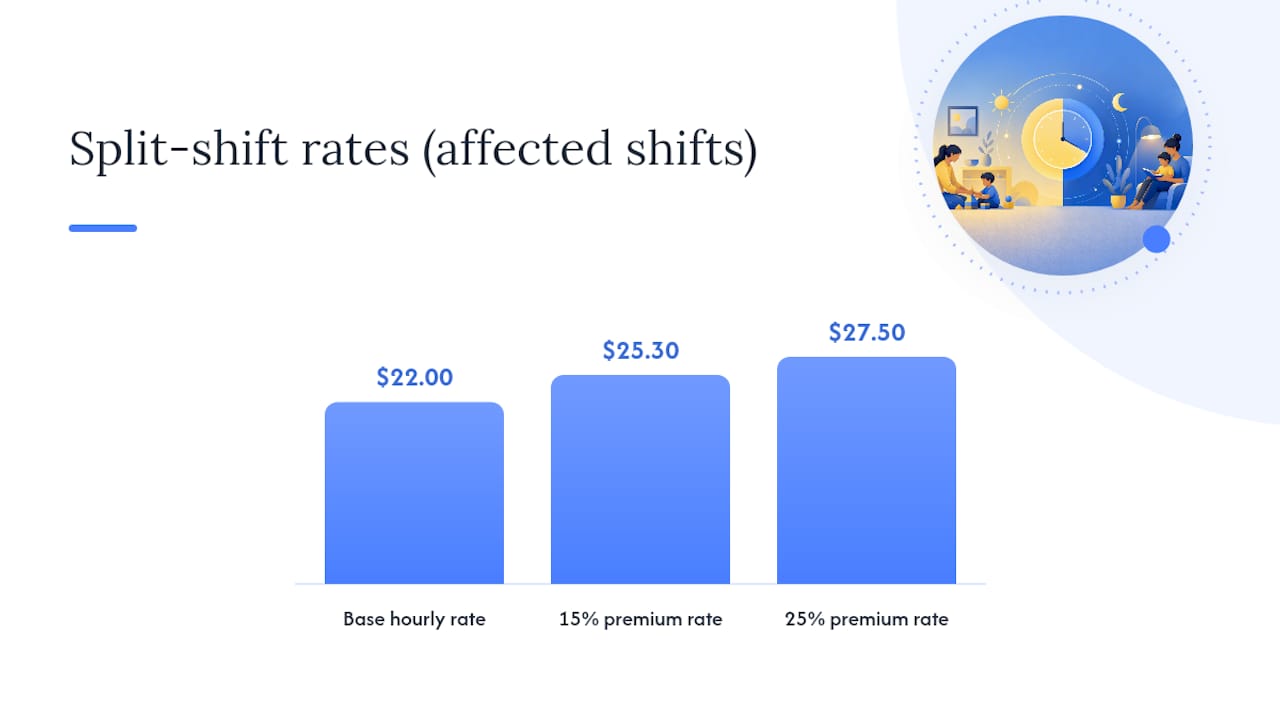
Percentage premiums are the most common. Market data on nanny pay shows early morning, evening, weekend, and split-shift premiums commonly falling in the 15–25% range above the nanny's standard hourly rate. If your base rate is about $22 an hour, a typical split-shift premium can increase the effective rate for shifts affected by the split.
Flat fees work better for families with a predictable gap every day. Instead of recalculating a percentage, you agree on a set add-on, say $15 to $25 per split day, paid regardless of how the hours break down. It's easier to budget but less precise if the gap length varies week to week.
Guaranteed hours solve a real fairness problem: a nanny generally can't pick up other paid work during a three-hour midday gap, so some families guarantee pay for a minimum block even if actual caregiving hours run shorter. Per-child rate add-ons, often $1 to $3 an hour per additional child, typically stack on top of whichever split-shift structure you choose.
Whatever premium you apply, it usually becomes part of the "regular rate" used to calculate overtime, not something layered on separately after the fact. Keep that math transparent in your payroll records so nobody is surprised later.
Pro Tip: Ask your nanny which structure she prefers before you decide. A caregiver managing school pickups elsewhere may value a flat guaranteed fee over a percentage premium that shrinks on shorter gap days.
What does the split shift pay math actually look like?
Numbers make this concrete faster than percentages alone. For example, a 7 a.m. to 9 a.m. morning block and a 3 p.m. to 7 p.m. evening block:
| Item | Calculation | Result |
|---|---|---|
| Hours worked | 3 + 3 | 7 hours |
| Adjusted hourly rate | $22 × 1.15 | $25.30 |
| Daily pay | 7 × $25.30 | $184.80 |
| Workday spread | 7 a.m. to 7 p.m. | 13 hours |
That 13-hour spread would trigger New York's spread-of-hours extra hour of pay, on top of the $184.80.
For a full week, overtime enters once total hours worked (not the spread) cross 40:
- Add up all hours across every day, including split-shift hours, using your adjusted rate for affected shifts.
- If the weekly total exceeds 40, calculate overtime at 1.5 times the regular rate, which includes the split-shift premium baked in, not the unadjusted base.
- Add employer-side payroll tax costs, often estimated at 10–15% on top of gross wages, when budgeting your true weekly cost.
A nanny working five split days at 7 hours each logs 35 hours, no overtime yet. Add a sixth day and you're at 42, meaning 2 hours land in overtime territory at the adjusted rate times 1.5.
How should you document and pay split shifts correctly?
Good recordkeeping is what turns "we agreed on this" into something you can actually prove later. At minimum, log clock-in and clock-out times for each block, total daily hours, any paid break time, whether the nanny was genuinely off-duty or on-call during the gap, and the specific premium or guarantee that applies.
Two documents make this manageable:
- A written employment agreement with a split-shift clause spelling out the premium formula or flat fee, plus how overtime interacts with it.
- A weekly timesheet, signed or digitally confirmed, that both sides can reference if a pay question comes up months later.
On the payroll side, premiums and overtime need to show up as separate line items, not buried into a single number the nanny can't verify. Most household employers issue a W-2, not a 1099, since nannies are legally employees, and that status carries its own quarterly tax obligations.
A scheduling and time-tracking tool removes most of the guesswork here, since it captures start and stop times for each block automatically instead of relying on memory at the end of a long week.
Pro Tip: Revisit your written agreement every few months. Schedules shift, gap lengths change, and a clause that made sense in January might not reflect what's actually happening by summer.
What happens when a nanny and family disagree on split shift pay?
Disputes usually trace back to one of three gaps: the premium formula was never written down, the hours logged don't match what either party remembers, or one side didn't realize a state rule like spread-of-hours applied.
The fix starts before the disagreement, not during it. A written clause specifying the exact premium percentage or flat fee, plus a shared timesheet both parties check weekly, eliminates most "I thought we agreed" conversations. When a dispute does surface, pull the actual time records first. If they're incomplete or based on memory, that's usually where the disagreement is really coming from.
For unresolved pay disputes involving wage law, not just a personal disagreement about fairness, your state labor department is the right first stop. Federal wage claims route through the U.S. Department of Labor's Wage and Hour Division. Most families never need to go that far. A calm conversation backed by accurate records resolves the majority of split-shift disagreements without anyone filing a complaint. The records are what make that conversation short instead of circular.
How does split shift pay affect a nanny's total compensation?
Split-shift premiums don't exist in isolation. They interact with base pay, overtime, and benefits in ways that shape whether a job offer is actually competitive.
A nanny comparing two offers with the same base hourly rate will weigh the split-shift terms heavily, since a fragmented 7 a.m. to 7 p.m. day with unpaid gap time pays meaningfully less in practice than a contiguous 10-hour shift at the same base rate. Families who build the premium into the offer upfront tend to see stronger retention, because the nanny isn't recalculating whether the schedule is worth it every week.
Split-shift pay also affects paid time off and sick leave calculations if those benefits are based on average weekly earnings rather than a flat rate. Skipping this detail is a common way well-intentioned families underpay time off without realizing it. Building the premium consistently into every relevant calculation, not just the paycheck itself, is what keeps overall compensation fair.
Why fair split shift pay is a retention strategy, not a courtesy
Split shifts are objectively harder to staff than contiguous days. A nanny who can't reasonably book other paid work during a three-hour gap is absorbing a real cost that a flat hourly rate doesn't capture, and treating the premium as optional generosity misreads the market. Families who pay it consistently tend to keep caregivers longer, which matters more than the extra dollars once you count the cost of rehiring and retraining.
If you're introducing a split-shift premium for the first time, offer a 30 to 90 day trial period, document what actually happens with hours and pay, and revisit the terms with your nanny once you both have real data instead of guesses. Be upfront about your own payroll costs and the reasoning behind the premium you're offering. Transparency here builds trust faster than a generous number handed over without explanation.
— mercedes
How Thecaretracker keeps split shift pay accurate
Thecaretracker turns the math above into something you don't have to redo by hand every week. Instead of piecing together clock-in times from texts or memory, the app lets your nanny log each block of a split shift directly, so your weekly hour totals, including anything approaching overtime, stay accurate without a spreadsheet.

The free caregiver features cover schedule requests and approvals, a unified calendar for every job, and care notes for allergies, medications, and daily routines, all of which reduce the back-and-forth that turns into pay disputes. For families setting up payroll around premiums, overtime, and spread-of-hours rules, Thecaretracker's payroll consultation walks through the setup so your records hold up if a question ever comes up later. Start by exploring the time tracking tool to see how split shifts get logged in practice, or visit Thecaretracker to set up your household's account today.
Where to check the current rules
For federal overtime rules, start with the Department of Labor's Wage and Hour Division. For state-specific spread-of-hours requirements, check your state labor department directly, since thresholds vary and change over time.
Sources
- U.S. Department of Labor — Wage and Hour Division
- New York State Department of Labor — Domestic Workers Bill of Rights
- How Much Should You Pay Your Nanny? 2026 Rates + Calculator Guide | PAYHROLL
- Care