
Most families pay their nanny weekly or biweekly, and that choice is more than a preference. Some states require a shorter interval than others, and once you pay $3,000 or more in cash wages during 2026, the IRS expects you to withhold taxes and issue a W-2. Get the schedule and the paperwork right together, and payday stops being a source of stress for anyone.
TL;DR:
- Most states require weekly or biweekly pay for household workers, so check local laws before finalizing your schedule to ensure compliance.
- Paying in arrears simplifies payroll calculations and reduces disputes, especially when tracking hours worked through real-time logging tools.
- Semi-monthly pay cycles can complicate overtime calculations due to misalignment with a weekly work schedule, increasing the risk of errors.
- Once cash wages reach $3,000 in 2026, household employers must withhold taxes, issue W-2s, and maintain records regardless of pay frequency.
- Clearly documenting the pay schedule and hours, and updating your agreement accordingly, prevents common payroll mistakes and minimizes legal risks.
Table of Contents
- What Are the Common Nanny Pay Frequencies?
- Does Your State Set a Minimum Pay Frequency?
- Should You Pay in Arrears or Pay Current?
- Does Pay Frequency Change Overtime Math?
- What Tax Rules Apply Once You Start Paying?
- How Do You Choose a Pay Schedule and Document It?
- How Thecaretracker Keeps Pay Frequency Errors Off Your Plate
- A Practical Perspective on Nanny Pay Timing
- When It's Time to Bring in Payroll Help
- Sources
- FAQ
What Are the Common Nanny Pay Frequencies?
Weekly, biweekly, semi-monthly, and monthly all show up in nanny contracts, but they are not interchangeable, especially once overtime enters the picture.
- Weekly: about one pay period every week, the most frequent schedule. Easiest for nannies to budget around and the simplest math for overtime.
- Biweekly: roughly every two weeks, a popular choice as it reduces payroll runs compared to weekly.
- Semi-monthly: paid twice a month on fixed dates like the 1st and 15th; the period length varies week to week, complicating overtime math.
- Monthly: paid once per month. Rare for nannies, since a full month without pay strains most household budgets.
Nannies tend to favor weekly or biweekly pay because steady cash flow matters more to an hourly worker than it does to a salaried employer. Guaranteed-hours arrangements also behave differently across cycles: a weekly guarantee is easy to track, while a semi-monthly guarantee requires converting weekly hours into a monthly average, which is exactly where families set up nanny payroll incorrectly the first time.
Does Your State Set a Minimum Pay Frequency?
Pay frequency is not just a household decision. Many states set a minimum frequency or a maximum lag, the longest stretch of time allowed between the end of a pay period and the paycheck itself, and household employers are expected to follow it just like any other employer.
- New York requires weekly pay for domestic workers under its Domestic Workers' Bill of Rights, so biweekly pay is not an option there.
- California limits how long employers can wait to pay after a pay period ends, which is part of why semi-monthly cycles need extra care to stay compliant.
- Massachusetts also enforces set lag limits for wage payment, and enforcement varies by employer type.
Because these rules shift from state to state and change periodically, check the DOL's state contact listings or your state labor department before finalizing a schedule. Once you know your state's requirement, write it directly into the nanny agreement so there is no ambiguity about payday.
Should You Pay in Arrears or Pay Current?
"In arrears" means you pay for hours already worked, once the pay period has closed. "Current" means the pay period includes the days between the period's end and payday itself, so the nanny is paid before all those hours are technically finished. Most household payroll runs weekly or biweekly, in arrears, because it is far easier to calculate exact hours worked before cutting a check.
- First paycheck: Decide upfront whether the first check will be short (covering only partial days worked) or paid slightly in advance to smooth the transition, and say so in writing.
- Final paycheck: Confirm your state's timing rule for a nanny's last paycheck, since some states require immediate or next-day payment upon termination.
- Contract wording: A line as simple as "Wages are paid in arrears; the pay period ending [date] is paid on [date]" prevents almost every dispute about missing hours.
Documenting this once, before the first day of work, according to household payroll guidance on arrears versus current pay, saves both sides from an awkward conversation three months in.
Does Pay Frequency Change Overtime Math?
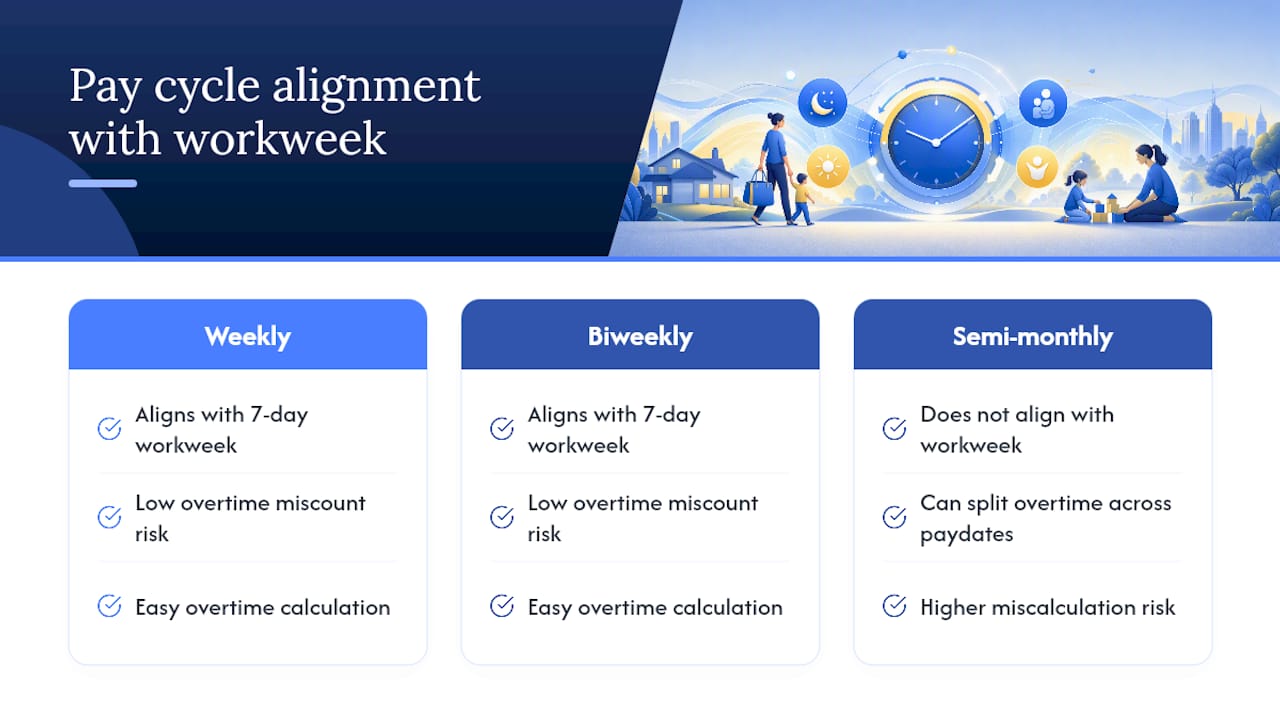
No. Overtime under the federal Fair Labor Standards Act is calculated on a fixed seven-day workweek, no matter how often you actually cut a check. A nanny who works 45 hours in one workweek earns five hours of overtime that week, whether you pay weekly, biweekly, or semi-monthly.
The confusion almost always shows up with semi-monthly payroll. Because semi-monthly periods do not align with a clean seven-day workweek, splitting hours across two pay dates makes it easy to miscalculate. Weekly and biweekly cycles align naturally with the workweek, so overtime is far less likely to be miscounted with either one.
Pro Tip: Pick your pay cycle before your nanny's first day, and write the exact workweek start day (say, Sunday at midnight) into the contract. That single decision, made early, prevents most of the overtime disputes families run into later.
What Tax Rules Apply Once You Start Paying?
Once you pay a nanny $3,000 or more in cash wages during 2026, you're required to withhold Social Security and Medicare taxes and pay your matching employer share. That threshold, laid out in IRS Publication 926, is the line between an informal arrangement and a legal household payroll.
Crossing it comes with real obligations, not just withholding:
- You must issue a W-2 to your nanny at year's end, as IRS Publication 926 requires.
- You're responsible for FICA, and in many cases federal and state unemployment tax, depending on total wages paid.
- You need pay stubs and wage records on file, both for your nanny's benefit and your own protection in an audit.
Sending money through Venmo or Zelle does not solve any of this. Those apps move money; they do not withhold taxes or generate pay stubs, and Venmo's own reporting thresholds exist for its own tax purposes, not yours. You still need an actual payroll process behind whatever payment method you choose.
How Do You Choose a Pay Schedule and Document It?
Picking a schedule is only half the job. Writing it down clearly is what actually protects you and your nanny later.
- Weigh the constraints: Balance your own cash flow, your nanny's preference for steady pay, and any state-mandated frequency before choosing weekly, biweekly, or another cycle.
- Put it in the contract: Spell out pay frequency, the exact payday, arrears or current wording, guaranteed hours, and how pay stubs will be delivered.
- Build the operational habit: Track hours consistently, run payroll with enough lead time for tax withholding, and keep records for at least four years, as IRS guidance recommends.
A schedule that looks good on paper but ignores your nanny's actual bills, or your state's lag rules, tends to unravel within a few months.
How Thecaretracker Keeps Pay Frequency Errors Off Your Plate
Most pay-frequency mistakes trace back to unclear time records, not bad intentions. The app gives caregivers a way to log hours as they happen, view every scheduled shift in one calendar, and share care details like allergies, medications, and nap schedules with the family they work for.
- Hours are tracked in real time, so there is no end-of-period guessing about what was actually worked.
- Care profiles keep essential information in one place, cutting down on scattered texts and missed handoffs.
- Exportable reports give you a clean record to hand to a payroll provider or reference when preparing pay stubs.
Once your hours are tracked accurately, pairing that data with a payroll service or a payroll consultation is what turns clean records into compliant filings.
A Practical Perspective on Nanny Pay Timing
Predictable paydates do more for a working relationship than almost any other single decision a family makes. Two mistakes come up constantly: employers who switch from biweekly to semi-monthly without redoing the overtime math, and families who pay a week or two late because payroll wasn't scheduled around a bank holiday. Both are avoidable with a written schedule and a habit of running payroll a few days early. Mercedes has spent years working directly with household employers and caregivers on exactly these payroll timing questions, and the pattern is always the same: the families with the fewest disputes are the ones who wrote the rules down before day one.
— mercedes
When It's Time to Bring in Payroll Help
Tracking hours accurately is only half the equation. Once you've settled on a pay frequency, converting it into compliant withholding, filings, and W-2s is where most families get stuck, and where a traditional payroll agency charges ongoing monthly fees just to keep your account open. Thecaretracker takes a different approach: a one-time Standard Payroll Consultation package for $150 walks you through setting up compliant payroll around the schedule you've chosen, no recurring contract required.

If you're behind on filings from a schedule that wasn't properly documented, the Premium consultation and Prior Wage Reporting & Household Payroll Cleanup Services, also $150 one time, help you correct past payroll and get current. Pair either service with the free Thecaretracker app, which gives your nanny a simple way to log hours and gives you exportable reports ready to hand off. Start by downloading the app, then book a consultation once you know exactly what your payroll needs to cover.
This article is general information, not a substitute for advice from a qualified financial advisor. Consult a qualified financial professional about your own circumstances before acting on anything here.
Sources
- IRS — About Publication 926, Household Employer's Tax Guide
- DOL — Wage and Hour state contacts
- Homework Solutions — Nanny pay frequency / household employee pay rules
- Care
FAQ
Is $20 an Hour a Good Nanny Rate?
Hourly rates vary significantly depending on your metro area, the nanny's experience, and whether the role involves multiple children or additional duties.
Which State Pays Nannies the Most?
Nanny pay tends to run highest in states with a high cost of living and dense demand for childcare, such as New York, California, and Massachusetts. Local market rates matter more than any national average, so checking pay in your specific city gives a far more accurate picture than a statewide figure.
Is It Better to Pay a Nanny Weekly or Biweekly?
Weekly pay is easier for most nannies to budget around and keeps overtime math simple, while biweekly pay cuts your payroll runs in half without much added complexity. Some states, including New York, require weekly pay for domestic workers, so check your state's rule before deciding.
What's the Average Hourly Rate for a Nanny in the U.S.?
Nanny rates vary widely by region, experience, and job scope, so there is no single national number that applies evenly everywhere. Families typically research local rates through nanny agencies or care platforms in their own metro area rather than relying on a nationwide average.
When Does a Nanny's Pay Trigger Tax Withholding?
Once you pay a nanny $3,000 or more in cash wages during 2026, you must withhold FICA taxes and issue a W-2 at year's end. That threshold applies regardless of whether you pay weekly, biweekly, or on another schedule.