
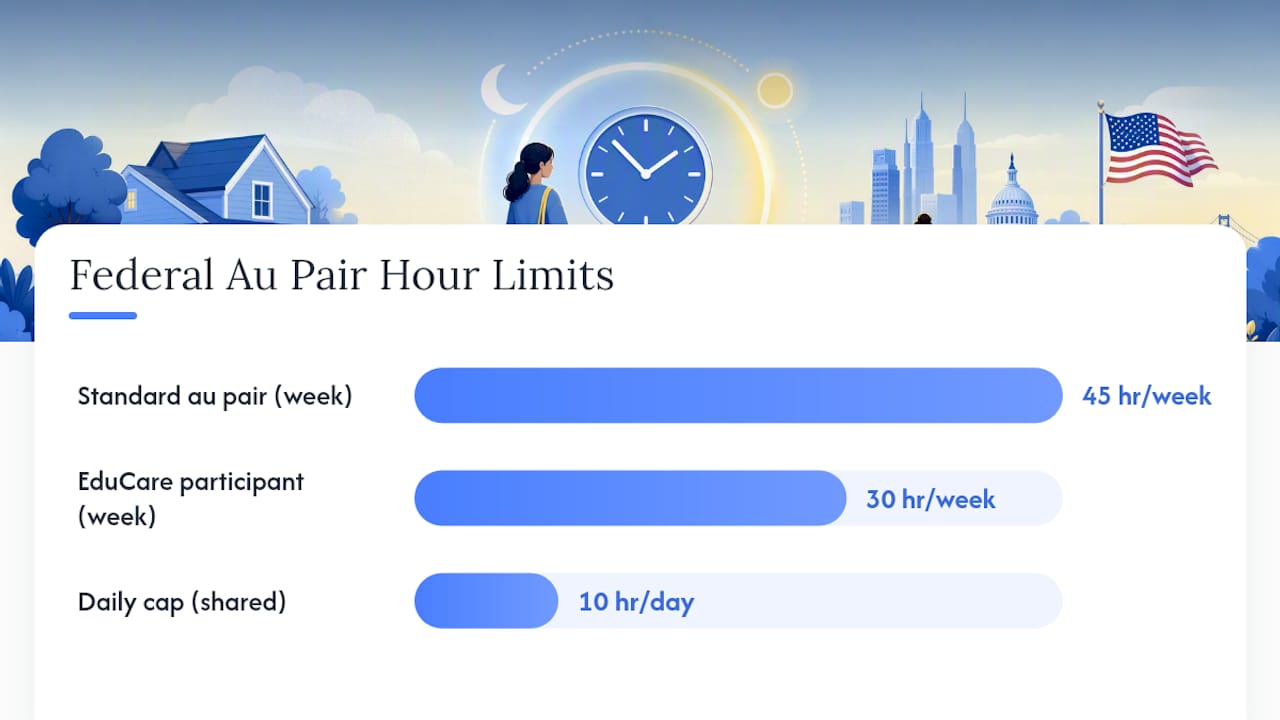
Federal rules cap au pair hours at no more than around 45 hours per week and 10 hours per day, and the State Department's program structure does not include a separate overtime payment mechanism. That said, state law can override this baseline. Massachusetts already requires overtime pay for au pairs, and other states may follow. Start tracking hours daily now, then check your state's wage laws before assuming the federal cap is your only obligation.
TL;DR:
- States like Massachusetts can require au pairs to receive overtime pay for hours worked over 40 per week, regardless of federal stipend assumptions.
- Any time an au pair must be present, responsible, or unable to leave counts as working hours, including supervising naps, driving, waiting, and on-call periods.
- A proposed rule could reduce the federal workweek cap from 45 to 40 hours and mandate overtime pay for excess hours, possibly requiring immediate adjustment.
- Maintaining precise, daily logs of hours, duties, and breaks, with both family and au pair agreement, is essential to ensure legal compliance and prevent disputes.
- Using shared, automated time-tracking apps simplifies adherence to evolving rules, provides clear records, and helps families prepare for potential regulatory changes.
- ✓Track weekly hours accurately
- ✓Receive and approve schedule requests
- ✓View jobs in one calendar
- ✓Access important care information
Table of Contents
- What Do Federal Au Pair Overtime Rules Actually Say?
- Can State Law Require Au Pair Overtime Pay?
- What Counts as Working Time for an Au Pair?
- Is a 40-Hour Au Pair Workweek Coming?
- Building a Compliant Weekly Schedule and Recordkeeping System
- How Time-Tracking Tools Turn Compliance Into a Habit
- Where to Verify the Current Rules Yourself
- An Editorial Note on Schedules, Boundaries, and Trust
- Put Your Compliance Checklist Into an App
- Sources
What Do Federal Au Pair Overtime Rules Actually Say?
The State Department's Exchange Visitor Program sets the ceiling most host families think of as "the rules." Under 22 C.F.R. § 62.31, sponsors must require that au pairs provide no more than 10 hours of childcare a day and no more than 45 hours a week. EduCare participants, who split their time between coursework and childcare, are capped lower: 30 hours a week and still 10 hours a day.
Here's where it gets confusing for a lot of families. The program's weekly stipend is designed around the assumption of a 45-hour week paid at least at the federal minimum wage, not calculated as an hourly overtime rate. That's a program design choice, not a statement that overtime law does not apply to domestic workers generally.
DOL Fact Sheet #79D clarifies how the Fair Labor Standards Act treats domestic service employees, au pairs included, when it comes to what counts as hours worked. A few things worth knowing:
- Domestic service employees, including live-in workers, must generally be paid at least the federal minimum wage. Overtime at time-and-a-half generally applies under the FLSA once an employee exceeds 40 hours in a workweek unless exempted. Rules for live-in domestic workers and treatment of sleep time vary depending on agreements and applicable laws.
The practical tension is this: the State Department program caps hours near 45 per week, but the FLSA's overtime threshold is 40 hours. Whether that gap gets closed by federal enforcement, sponsor policy, or state law is exactly why the rest of this guide matters.
Can State Law Require Au Pair Overtime Pay?
Yes, and Massachusetts already proved it. In Capron v. Attorney General of Massachusetts, the state concluded that its own Domestic Workers Bill of Rights and Fair Wage Law apply to au pairs working in the Commonwealth. That ruling means Massachusetts host families may owe state minimum wage and time-and-a-half overtime for hours worked over 40 in a week, regardless of what the federal stipend framework assumes.
Massachusetts is not necessarily unique. Other states have their own domestic worker protections, wage-and-hour statutes, or pending legislation that could produce the same result. Legal analysts tracking this shift point to consistent, accurate time-tracking as the most defensible move host families can make while the law continues to evolve state by state.
Here's how to figure out where your state stands:
- Search your state's department of labor site for "domestic worker" or "household employee" wage and hour rules.
- Check whether your state has a Domestic Workers Bill of Rights or similar statute, since these often extend overtime protections beyond what federal exemptions allow.
- Call your au pair agency or sponsor organization and ask directly whether they've issued state-specific compliance guidance.
- If you get conflicting answers, consult an employment attorney familiar with household employer law in your state.
Don't assume silence means safety. A state that hasn't ruled on au pair status yet isn't necessarily exempt. It just hasn't been tested in court.
What Counts as Working Time for an Au Pair?
Working time is broader than the hours your au pair spends actively entertaining kids. Under DOL guidance and the logic courts have applied in cases like Capron, if your au pair must be present, responsible, or unable to leave, that time typically counts as hours worked.
Examples that commonly get miscounted as "free time" but usually are not:
- Supervising a child during a nap, even if the au pair is scrolling their phone nearby.
- Driving kids to and from school, practice, or appointments.
- Waiting at the sidelines of a sports practice or piano lesson.
- Being "on call" during a parent's work-from-home day, even without active tasks.
- Supervising meals, including breakfast before a parent leaves for work.
Some employers try to exclude sleep periods or meal breaks from paid time through a written agreement. That's permitted only under narrow conditions defined by DOL rules, and it requires a genuine, uninterrupted break, not a nominal one on paper.
Pro Tip: If you're asking your au pair to "just watch the monitor" during a nap or "grab something quick" on a scheduled day off, that's working time. Log it the same way you'd log an afternoon at the park.
Split shifts are a frequent trap. A morning block followed by an evening babysitting request can quietly push a week past 45 hours, even when each shift looks small on its own.
Is a 40-Hour Au Pair Workweek Coming?
A pending rulemaking docket proposes cutting the federal cap from 45 hours to 40 hours a week and adding a formal overtime pay requirement for hours worked beyond that. As of the most recent Regulations, the proposal remains under consideration and has not been finalized. The Federal Register listing is the authoritative place to track the rule's actual text and any implementation date.
If this rule finalizes, families who currently schedule au pairs for close to 45 hours a week will feel it fast, both in scheduling and in the household budget, since those extra five hours could shift from stipend time to overtime pay.
You don't have to wait for a final rule to prepare:
- Start logging exact hours now so you have a real baseline, not a guess.
- Sketch what your weekly schedule would look like capped at 40 hours, and identify which activities would need backup coverage.
- Set aside a small contingency fund in case overtime pay becomes mandatory mid-year.
Waiting until the rule passes to figure this out is the expensive way to learn about it.
Building a Compliant Weekly Schedule and Recordkeeping System
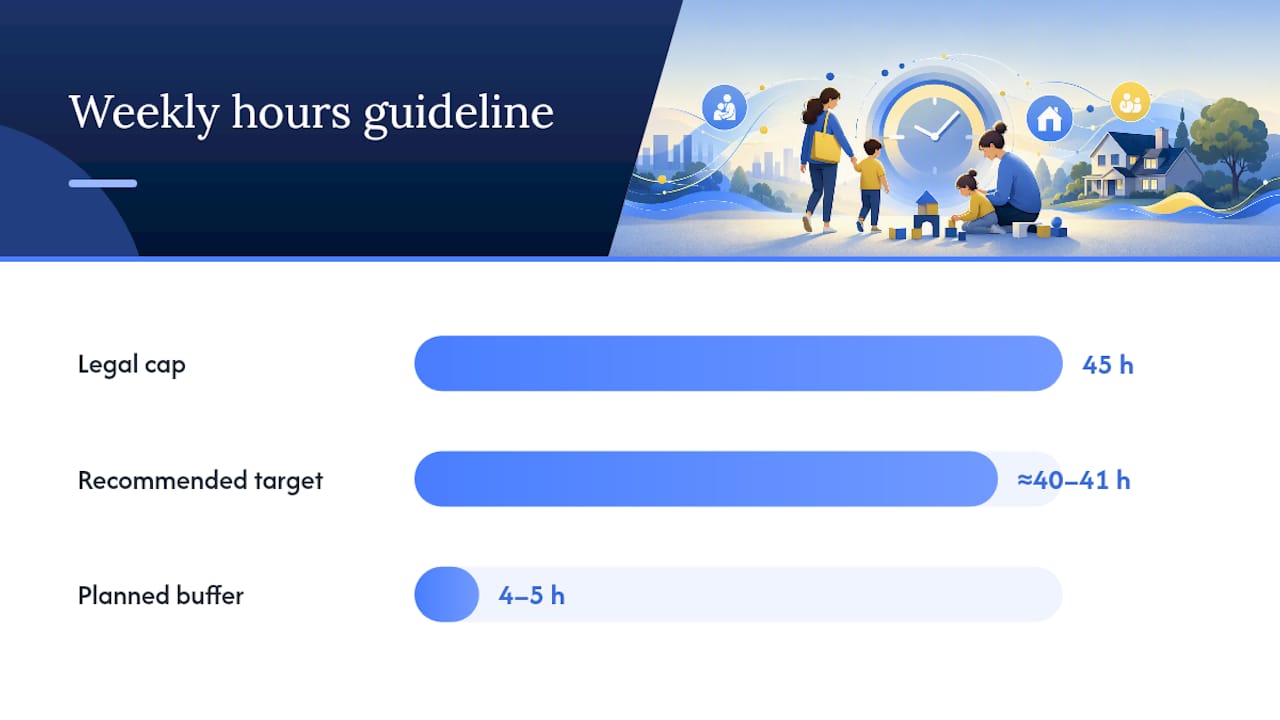
A defensible schedule starts with math, not good intentions. Lock in your au pair's days off first, then build working hours around that fixed point, leaving a buffer under the 45-hour cap rather than scheduling right up against it. A four or five hour cushion absorbs the unpredictable stuff: a delayed pickup, a sick day that turns into a longer shift, a last-minute request.
DOL recordkeeping guidance under Fact Sheet #79D makes clear that employers of domestic service workers need accurate hour and wage records. Here's what that looks like day to day:
- Log start and end times for every shift, not just a weekly estimate.
- Note the actual duties performed, especially anything that blurs into "on-call" or supervisory time.
- Record breaks separately, and flag any period claimed as unpaid to confirm it met the conditions for exclusion.
- Track on-call hours even when no active task occurred, since presence requirements usually still count.
- Retain records for at least a few years in case a sponsor, agency, or state labor office requests them.
A well-documented household typically produces one thing consistently: a weekly total that both the family and the au pair agree on before the week closes. Building in a joint sign-off, even a quick five-minute check-in, catches discrepancies before they become disputes. A caregiver time-tracking system makes that review painless instead of another chore nobody wants to do on a Friday night.
One more decision point worth planning for in advance: if you need extra hours beyond the weekly cap, that's not a scheduling adjustment, it's paid babysitting on top of the au pair arrangement, tracked and compensated separately from program hours.
How Time-Tracking Tools Turn Compliance Into a Habit
A good tracking tool should do more than store numbers. Look for shared timesheets both you and your au pair can see, automatic alerts when hours approach the weekly cap, and exportable logs you can hand to a sponsor or state labor office without recreating a week from memory.
Mercedes has spent years writing about nanny and au pair employment compliance for household employers navigating exactly this kind of ambiguity. A shared, simple nanny timesheet template does more preventive work than any verbal agreement. When both sides can see the same numbers in real time, disputes about "I thought that was covered" tend to disappear before they start.
Where to Verify the Current Rules Yourself
Don't take any single blog's word for it, including this one, when the rule set is actively shifting. Check these directly:
- DOL Fact Sheet #79D for the legal definition of hours worked and FLSA overtime mechanics.
- The State Department's Au Pair Program page for current caps and sponsor obligations.
- The Federal Register docket for the proposed 40-hour rule's status and text.
- Your state labor department's website, plus your sponsor agency, for state-specific guidance.
An Editorial Note on Schedules, Boundaries, and Trust
Compliance and kindness aren't opposing goals here. A vague schedule that quietly expects an au pair to be "flexible" almost always turns into unpaid overtime disguised as generosity, and it usually breaks trust long before it breaks the law. Au pairs are cultural exchange participants with real legal protections, not backup labor for whenever a parent's plans change.
The families who avoid disputes are the ones who write the schedule down, review the hours together weekly, and treat a documented boundary as a form of respect rather than a legal formality.
— mercedes
Put Your Compliance Checklist Into an App
Every step in this guide, from logging daily hours to reviewing weekly totals with your au pair, gets easier with a system built for it instead of a notebook you keep forgetting to update. A mobile app gives host families a way to do exactly that: caregivers log hours directly, families approve them, and the totals stay visible to both sides in one calendar instead of scattered across texts and sticky notes.
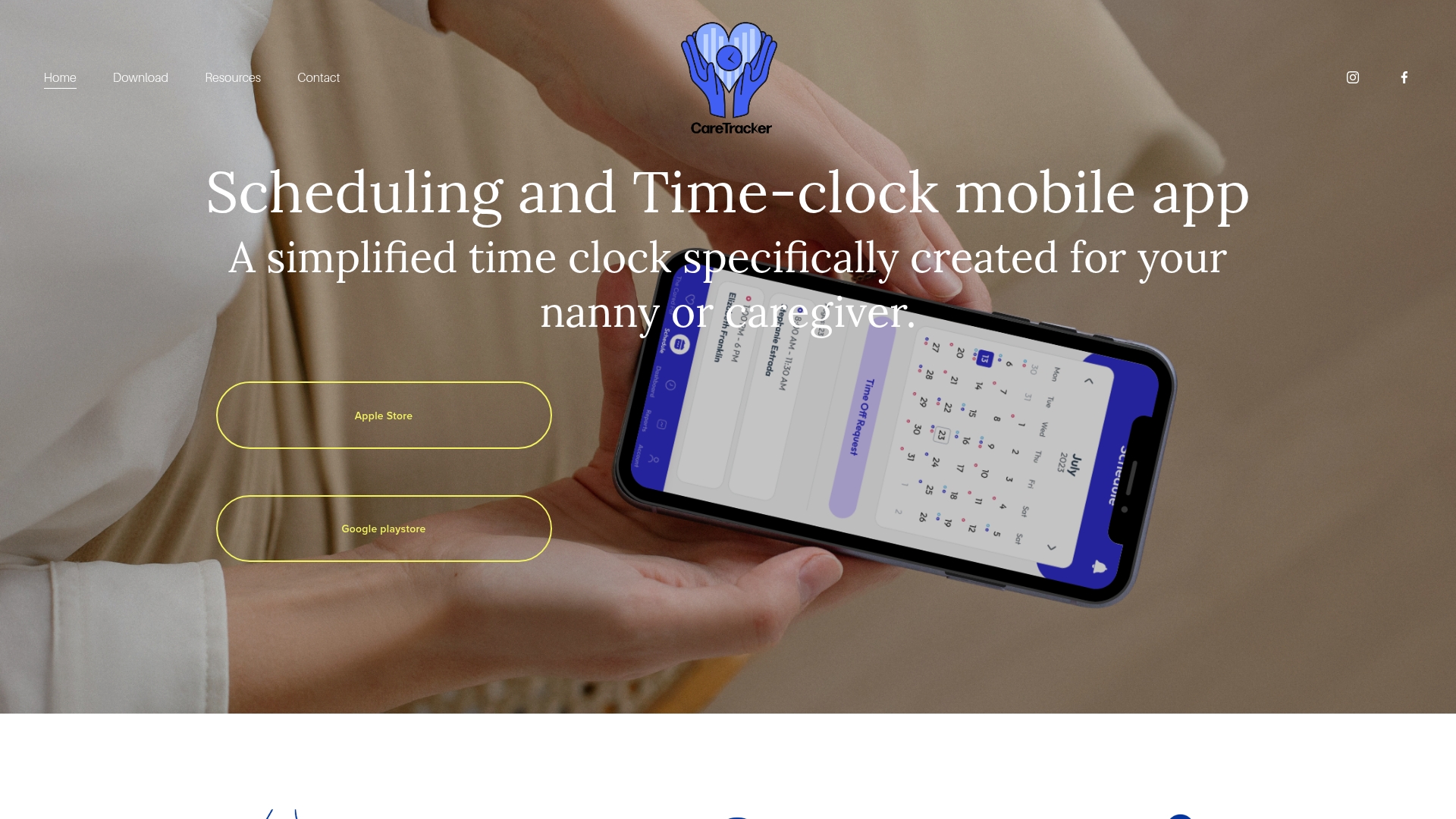
The app's time-tracking features generate exportable logs that map directly to what a sponsor, agency, or state labor office might ask to see: daily start and end times, weekly totals, and a shared approval history that shows both parties signed off. That kind of record is worth building before you need it, not after a dispute starts. Visit Thecaretracker to set up your first shared schedule and start tracking hours the way this guide recommends, today, not after a question about overtime pay catches you unprepared.
Sources
- Au Pair Program — Exchange Visitor Program (J-1) | U.S. Department of State
- Fact Sheet # 79D: Hours Worked Applicable to Domestic Service Employment Under the FLSA
- Regulations
- Massachusetts Wage and Hour Laws Apply to Au Pairs — Boston Bar Association
- Exchange Visitor Program: Au Pairs — Federal Register