
Most au pairs on J-1 status must file a U.S. federal tax return, and the filing deadline is real whether or not a single dollar was withheld from your stipend. The IRS treats au pair stipends as taxable wages, and most J-1 au pairs file as nonresident aliens using Form 1040-NR. If you earned no income at all during your placement year, you still need to submit Form 8843 to document your exempt-individual status.
Here is what you need to know before you do anything else:
- Most J-1 au pairs are nonresident aliens and file Form 1040-NR, not the standard Form 1040 used by U.S. citizens.
- Stipends are taxable wages. No withholding does not mean no tax owed.
- Many au pairs pay a moderate portion of their earned stipend as federal income tax in practice, making it a real but manageable amount.
- Your first step: gather your passport with entry/exit stamps, your DS-2019 form, all stipend payment records, and your Social Security Number (SSN) or Individual Taxpayer Identification Number (ITIN).
- Host families are not automatically required to withhold, but choosing to do so creates specific payroll obligations.
Tax filing is a normal part of the cultural exchange experience. Handled correctly, it protects your visa record and avoids penalties that can complicate future immigration applications.
Table of Contents
- Which taxes apply to an au pair in the U.S.?
- How does residency status affect your tax filing?
- What forms and documents do you need to file?
- How do you calculate what you owe and pay throughout the year?
- What are host family responsibilities for au pair taxes?
- Why do state income taxes vary so much for au pairs?
- Common filing mistakes and how to avoid them
- How Thecaretracker helps au pairs and host families stay tax-ready
- What are the key filing deadlines for au pair taxes?
- Key Takeaways
- The part of au pair taxes most people overlook
- Thecaretracker makes tax prep less stressful for au pairs and families
- Useful sources and official resources
Which taxes apply to an au pair in the U.S.?
Understanding the tax types that could apply to your situation is the clearest way to avoid surprises at filing time. Not every tax applies to every au pair, and J-1 status changes several of the usual rules.

Federal income tax is the most common obligation. Your stipend counts as taxable wages, and as a nonresident alien you generally cannot claim the standard deduction. You report income on Form 1040-NR and pay tax at the applicable nonresident brackets.
Social Security and Medicare taxes (FICA) are usually not required for J-1 au pairs while they remain nonresident aliens. This is one of the clearest benefits of nonresident status. However, if an au pair becomes a U.S. tax resident during their stay, FICA taxes may apply and the host family could face additional payroll-tax withholding obligations.
Federal Unemployment Tax (FUTA) generally does not apply to nonresident au pairs either. Residency changes can trigger FUTA liability above certain wage thresholds, so tracking your status throughout the year matters.
Federal withholding is not mandatory for household employment. Host families and au pairs can voluntarily agree to withhold federal income tax, which requires the family to obtain an Employer Identification Number (EIN), file Schedule H, and issue a W-2. Without that agreement, no withholding occurs and the au pair owes the full amount at filing.
State and local taxes vary widely. Some states have no individual income tax at all; others require a return at any earned income level. Your host state's rules apply regardless of your federal residency status.
Pro Tip: Even if your host family does not withhold, you can make voluntary estimated payments throughout the year using Form 1040-ES (NR) to avoid a large bill in April.
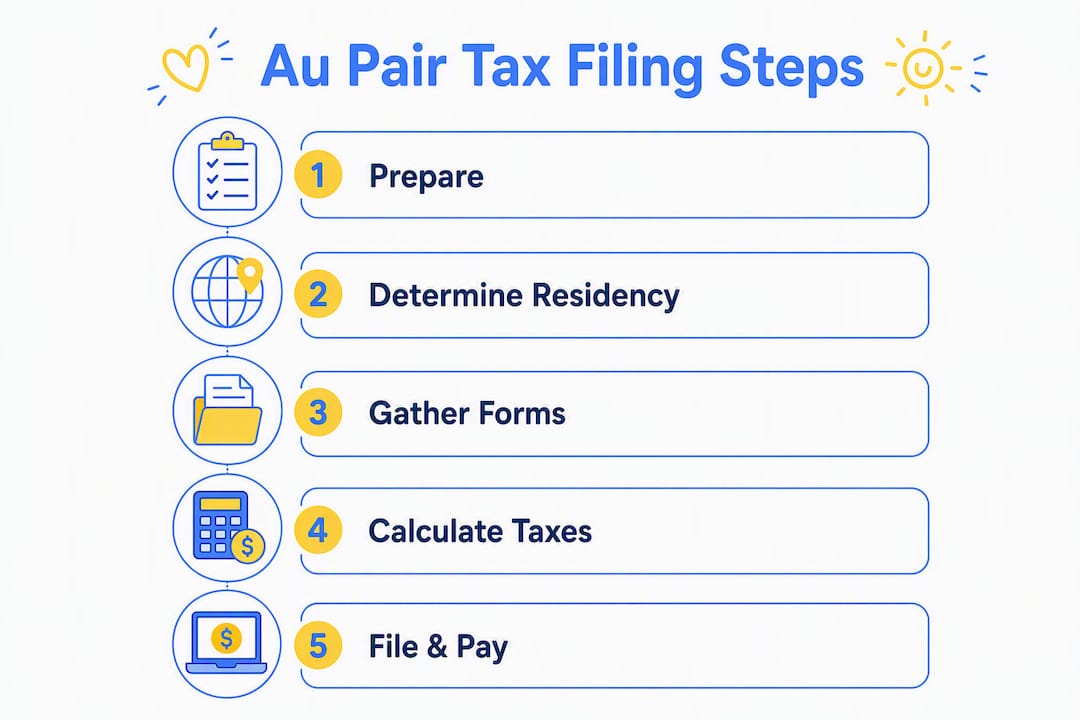
How does residency status affect your tax filing?

Your tax residency status determines which form you file, which deductions you can claim, and whether FICA applies. Getting this right is the foundation of accurate au pair income tax reporting.
The exempt-individual rule is what most J-1 au pairs rely on. Under IRS rules, J-1 visa holders are generally treated as "exempt individuals" for the Substantial Presence Test, meaning days spent in the U.S. on a J-1 visa do not count toward the 183-day threshold that would make you a resident alien. Most au pairs remain nonresident aliens for up to two years under this rule, which means filing Form 1040-NR and forgoing the standard deduction.
The Substantial Presence Test becomes relevant if you have had prior U.S. visits or held other visa statuses (F, J, M, or Q) in previous years. Days from those earlier stays can count and could push you into resident-alien status sooner than expected.
- Collect your passport with all entry/exit stamps.
- Keep your DS-2019 form accessible — it documents your J-1 program dates.
- If you held a prior U.S. visa, count those days carefully before assuming nonresident status.
- File Form 8843 to formally declare your exempt-individual status, even when you have no income.
Tax treaties offer limited relief for au pair wages. Most U.S. tax treaties do not specifically exempt au pair stipends, and treaty benefits for wages vary significantly by country. Check the IRS treaty table for your home country before assuming any exemption applies. When a treaty benefit does exist, it must be claimed on Form 1040-NR with the appropriate disclosure.
What forms and documents do you need to file?
Getting organized before you sit down to file saves time and prevents errors. Here is a complete reference for the forms and records both au pairs and host families need.
| Form / Document | Who Needs It | Purpose |
|---|---|---|
| Form 8843 | All J-1 au pairs (even with zero income) | Declares exempt-individual status |
| Form 1040-NR | Au pairs with taxable income | Nonresident federal income tax return |
| Form 1040 | Au pairs who qualify as resident aliens | Standard U.S. income tax return |
| W-2 | Au pairs whose host family withheld | Reports wages and withholding |
| Form 1042-S | Au pairs with treaty-exempt income | Reports treaty-exempt wages |
| SSN or ITIN | All filers | Required tax identification number |
| DS-2019 | All J-1 au pairs | Documents program dates and status |
| Passport (stamped) | All J-1 au pairs | Proves entry/exit dates |
| Bank deposit records | All au pairs | Verifies stipend amounts received |
| State tax forms | Varies by host state | State income tax compliance |
Au Pair International recommends collecting your passport, DS-2019, SSN or ITIN, bank records, and any W-2 or Form 1042-S before beginning tax preparation. Having these documents in one place before you open any tax software cuts preparation time significantly.
A few additional points worth noting:
- No SSN yet? Apply for an ITIN using Form W-7 and attach it to your tax return. Allow extra processing time if mailing from outside the U.S.
- Zero income? File Form 8843 anyway. Failing to file it creates an official gap that can complicate future visa adjudication.
- Education allowance: Amounts paid by the host family for educational expenses may be taxable depending on how they are structured. Keep receipts.
- A nanny timesheet template can serve as a ready-made stipend ledger if your host family has not kept formal payment records.
How do you calculate what you owe and pay throughout the year?
Calculating your federal tax as a nonresident au pair follows a straightforward sequence. The numbers below use a sample stipend to illustrate the process.
Step-by-step federal tax calculation
- Check for treaty adjustments — If your home country has a treaty that covers wages, subtract the exempt amount and recalculate. Most au pairs will find no adjustment applies.
Payment options
| Option | How It Works | Best For |
|---|---|---|
| Voluntary withholding | Host family withholds from weekly stipend; issues W-2 at year end | Au pairs who want zero surprise at filing |
| Quarterly estimated payments | Au pair pays IRS directly via Form 1040-ES (NR) or IRS Direct Pay | Au pairs without withholding who want to spread payments |
| Pay at filing | Full balance due April 15 of the following year | Au pairs with small expected liability |
| IRS payment plan | Online Payment Agreement if you cannot pay in full | Au pairs who owe more than expected |
The most common surprise is an unexpected tax bill because stipends lack withholding. Planning ahead with estimated payments or voluntary withholding prevents that situation entirely.
Tax preparation tools: Sprintax is widely used by nonresident filers and walks you through Form 1040-NR step by step. H&R Block's expat and au pair filing service offers professional preparation for au pairs who want human review. Both handle state returns as an add-on. Sprintax is generally the lower-cost self-service option; H&R Block suits au pairs with more complex situations (prior visa history, treaty claims, or multiple states).
Pro Tip: Run your numbers through a guided calculator like Sprintax before deciding whether to request withholding. If your estimated liability is under $1,000, paying at filing is often simpler than setting up quarterly payments.
What are host family responsibilities for au pair taxes?
Host families are not passive bystanders in the au pair tax process. Your decisions about withholding and recordkeeping directly affect the au pair's ability to file accurately.
Voluntary withholding: what it requires
Host families are not required to withhold federal income tax, but choosing to do so creates specific payroll obligations. Once you agree to withhold, you must:
- Obtain an Employer Identification Number (EIN) from the IRS.
- Have the au pair complete Form W-4 to determine withholding amounts.
- Withhold the agreed amount from each weekly stipend payment.
- File Schedule H with your personal tax return to report household employment taxes.
- Issue a W-2 to the au pair by January 31 of the following year.
Recordkeeping every host family should maintain
- A weekly payment log showing the date and exact amount of each stipend payment.
- Bank transfer records or check copies confirming each payment.
- Receipts for any education allowance paid on the au pair's behalf.
- A copy of the au pair's DS-2019 and SSN or ITIN for your records.
- Documentation of any agreement to withhold, including the completed W-4.
Accurate records protect both parties. If the IRS questions a return, a clean payment log resolves most issues quickly. A nanny daily log approach works equally well for au pair payment documentation.
Correcting past gaps: If you withheld in prior years but never issued a W-2, you can file amended returns and issue late W-2s. A payroll consultation service can walk you through the correction process and help you avoid repeat errors. Thecaretracker's payroll consultation service covers exactly this kind of household payroll cleanup.
Why do state income taxes vary so much for au pairs?
Federal filing gets most of the attention, but state tax obligations depend entirely on the host state, and the rules vary more than most people expect.
Some states, including Texas, Florida, and Washington, have no individual income tax. An au pair placed in those states owes nothing at the state level. Other states, like California and New York, require a return at very low income thresholds and apply their own nonresident rules to J-1 visa holders.
Common state-level complications include:
- Part-year residency: If you moved between states during your placement, you may owe returns in both.
- Reciprocity agreements: A handful of states have agreements that affect which state taxes income earned near a border.
- City and local taxes: Some municipalities (Philadelphia and New York City, for example) levy their own income taxes on top of state taxes.
To check your host state's rules, go directly to that state's Department of Revenue website. Search for "nonresident individual income tax" and look for the filing threshold. If you earned any income in-state, file the state return even when your federal liability is small.
Pro Tip: Keep your stipend deposit records organized by state if you moved during your placement year. Filing two state returns is straightforward when you have clean records; reconstructing payment history months later is not.
Common filing mistakes and how to avoid them
Both au pairs and host families make predictable errors. Knowing them in advance is the simplest way to stay clear of penalties and visa complications.
Filing Form 8843 is not optional, even with zero income. The IRS uses it to confirm your exempt-individual status. Missing it creates a gap in your immigration record that can surface during future visa applications — sometimes years later.
Pre-filing checklist
- Passport with all entry/exit stamps for the filing year.
- DS-2019 form showing your J-1 program dates.
- Complete stipend ledger: every payment date and amount.
- W-2 from host family (if withholding was agreed upon).
- Form 1042-S (if any treaty-exempt income was reported).
- SSN or ITIN — confirm it matches your name exactly as it appears on your passport.
- Bank statements covering the full placement year.
- Any education allowance receipts.
- Prior-year tax returns if you filed in the U.S. before.
- Host state's filing requirements confirmed.
Frequent mistakes to avoid:
- Assuming no withholding means no tax owed. It does not.
- Skipping Form 8843 because income was zero.
- Filing Form 1040 (resident) instead of Form 1040-NR (nonresident) without verifying residency status.
- Ignoring state filing obligations because the federal amount was small.
- Claiming FICA exemption without confirming current nonresident status.
Tax professionals consistently note that accurate filing protects future visa options for program participants. A missed return is rarely catastrophic the first time, but a pattern of nonfiling can create serious immigration complications.
How Thecaretracker helps au pairs and host families stay tax-ready
Good tax preparation starts with good records, and that work happens week by week, not in April. Thecaretracker's time and payment tracking features are built for exactly this kind of ongoing documentation.
Here is how the app supports tax readiness directly:
- Timestamps on every entry — mean you can prove payment dates if the IRS or a state agency ever asks.
For host families, Thecaretracker's payroll consultation services cover two specific situations: Prior Wage Reporting and Household Payroll Cleanup for families that missed withholding in past years, and a Standard Payroll Consultation to set up voluntary withholding correctly from the start. Both services help families issue accurate W-2s and file Schedule H without guessing at the process.
A practical workflow: the au pair exports a payment report from Thecaretracker at year end, hands it to their tax preparer, and the preparer uses it to populate Form 1040-NR. The host family uses the same records to reconcile their Schedule H. No reconstructing payments from memory, no missing dates.
Pro Tip: Export your Thecaretracker payment report at the end of each month and save it to a dedicated tax folder. By December, your stipend ledger is already complete.
What are the key filing deadlines for au pair taxes?
Missing a deadline costs money. Here is the timeline that matters for the 2025 tax year (returns filed in 2026).
- Quarterly estimated payment dates (2026): — April 15, June 16, September 15, and January 15, 2027. Use Form 1040-ES (NR) or pay via IRS Direct Pay online.
Set calendar reminders for each quarterly payment date at the start of your placement year. Paying in four smaller installments is far easier than managing a single large bill in April.
Key Takeaways
Most J-1 au pairs owe U.S. federal income tax on their stipend, must file Form 1040-NR (or Form 8843 with zero income), and can avoid year-end surprises by tracking payments weekly and planning for estimated payments or voluntary withholding from day one.
| Point | Details |
|---|---|
| File Form 1040-NR or 8843 | Most J-1 au pairs file as nonresident aliens; Form 8843 is required even with zero income. |
| Expect some federal tax | Stipends typically carry no withholding, so budget a portion of your annual stipend for federal income tax. |
| Host families control withholding | Voluntary withholding requires an EIN, W-4, Schedule H, and a W-2 — but it eliminates the au pair's year-end balance due. |
| State rules vary by host state | Check your host state's Department of Revenue; some states require a return at any income level. |
| Thecaretracker simplifies recordkeeping | Weekly stipend tracking and downloadable payment reports from Thecaretracker give tax preparers exactly what they need. |
The part of au pair taxes most people overlook
The filing mechanics get plenty of coverage. What gets less attention is the timing problem: most au pairs discover they owe tax in March or April, after a full year of receiving stipends with nothing withheld. By then, the only option is to pay the full balance at once or set up a payment plan.
The fix is simple and available from week one of a placement: either ask the host family to withhold voluntarily, or make quarterly estimated payments yourself. Neither option is complicated. Both require one conversation and a small amount of planning. Yet most au pairs skip both steps because no one explains the consequence clearly enough at the start of the program.
There is also a subtler issue with Form 8843. Many au pairs treat it as a technicality for zero-income years and forget about it entirely once they start earning. The form still needs to be filed. Its purpose is to document your exempt-individual status with the IRS, and that documentation matters for future visa applications, not just for the current tax year. Filing it takes about ten minutes. Not filing it can create a paper gap that surfaces at the worst possible moment.
The practical habit worth building: update your stipend ledger every week, export it monthly, and keep a copy of your DS-2019 and passport stamps in a dedicated folder. When April arrives, you will have everything a tax preparer needs in one place. That is the difference between a filing that takes an hour and one that takes a week.
Thecaretracker makes tax prep less stressful for au pairs and families
Keeping accurate payment records is the single most useful thing you can do before tax season, and Thecaretracker makes it free for caregivers and au pairs. The app's time and payment tracking tools log every stipend payment with a timestamp, so your year-end report is ready to hand directly to a tax preparer or upload into Sprintax or H&R Block.

For host families who need more than recordkeeping, Thecaretracker's payroll consultation service covers household payroll cleanup, prior wage reporting, and voluntary withholding setup. Whether you missed issuing a W-2 in a prior year or want to start withholding correctly from the beginning of a new placement, the consultation service walks you through each step.
Start by downloading the Thecaretracker app for free, exporting your first payment report, and sharing it with your tax preparer before your first filing appointment.
Useful sources and official resources
Use these primary sources to verify forms, rules, and deadlines directly.
- IRS Au Pairs page — the authoritative federal source for au pair tax obligations, withholding rules, and form guidance.
- IRS Online Payment Agreement — apply for a payment plan if you cannot pay your balance in full by the filing deadline.
- Social Security Administration — SSN applications — apply for a Social Security Number if you are eligible; otherwise use Form W-7 to apply for an ITIN.
- U.S. Department of State — J-1 Au Pair Program — official program rules and DS-2019 guidance.
- H&R Block Au Pair Tax Service — professional tax preparation for au pairs filing Form 1040-NR and state returns.
- Thecaretracker payroll consultation — household payroll cleanup and W-2 issuance support for host families.
This article provides general information about U.S. tax filing for au pairs and host families. It is not legal or tax advice. Confirm current rules and your specific filing obligations with the IRS, a qualified tax professional, or your host state's Department of Revenue before filing.