
Yes, you can legally pay an in-home elder caregiver, and in most cases you must run payroll to do it. If you set the caregiver's hours, tell them how to do the job, and supervise the work, the IRS almost always treats that person as your household employee, not an independent contractor. Your immediate next step is to decide who the legal employer is and write a simple caregiver agreement before any money changes hands.
TL;DR:
- Families must determine who the legal employer is before paying a caregiver to ensure proper payroll and tax compliance.
- Household employees must have taxes withheld once yearly wages surpass $2,800, and detailed records are essential for audits or inquiries.
- Most in-home elder caregivers hired directly by families fail the independent contractor test because families dictate work specifics.
- State and federal programs, such as Medicaid and VA benefits, can fund family caregiving but vary widely in rules and availability.
- Using a payroll service or consultation simplifies compliance steps like EIN registration, tax filings, and recordkeeping, especially for complex setups.
Table of Contents
- What Counts As Elder Caregiver Payroll and Who Pays It
- Household Employee or Independent Contractor? Why the Answer Matters
- Setting Up Household Payroll: The Federal Compliance Checklist
- Finding State Medicaid, VA, and Local Program Help
- How Much Should You Pay an Elder Caregiver?
- Recordkeeping That Protects You and the Caregiver
- A Straight Answer From Someone Who's Seen This Go Wrong
- Let CareTracker Handle the Parts You Shouldn't Guess At
- Sources
- FAQ
What Counts As Elder Caregiver Payroll and Who Pays It
Elder caregiver payroll covers every dollar that moves from a family, a state program, or an agency to the person providing hands-on senior care, along with the taxes and paperwork attached to it. The money can come from four main directions, and each one changes who is legally responsible for withholding and reporting.
- Household payroll (private pay): You hire the caregiver directly, control the schedule, and become the employer of record under IRS rules.
- VA caregiver and pension programs: Veterans may qualify for Veteran-Directed Care, respite benefits, or Aid and Attendance pension add-ons that can fund family caregiving.
- Agency-employed care: A home care agency pays the caregiver directly and handles payroll itself, though you typically lose the ability to pick your own family member for the role.
- Long-term care insurance or paid family leave: Some LTC policies reimburse informal caregiving, and a handful of states allow paid family leave to cover short-term caregiving stretches.
Private pay is the most common route for families who want a specific relative or trusted aide in the home, and it's also the route most likely to trigger federal payroll obligations.
Household Employee or Independent Contractor? Why the Answer Matters
The IRS doesn't care what you call the arrangement on paper. It cares who controls the work. Under IRS Publication 926, a worker is your household employee if you decide what gets done and how it gets done, even if the caregiver sets their own hours within limits you approve. An independent contractor, by contrast, typically works for multiple clients, sets their own methods, and brings their own tools or business structure. Most family-hired, in-home elder caregivers fail the contractor test because the family dictates the schedule, the duties, and often the care techniques.
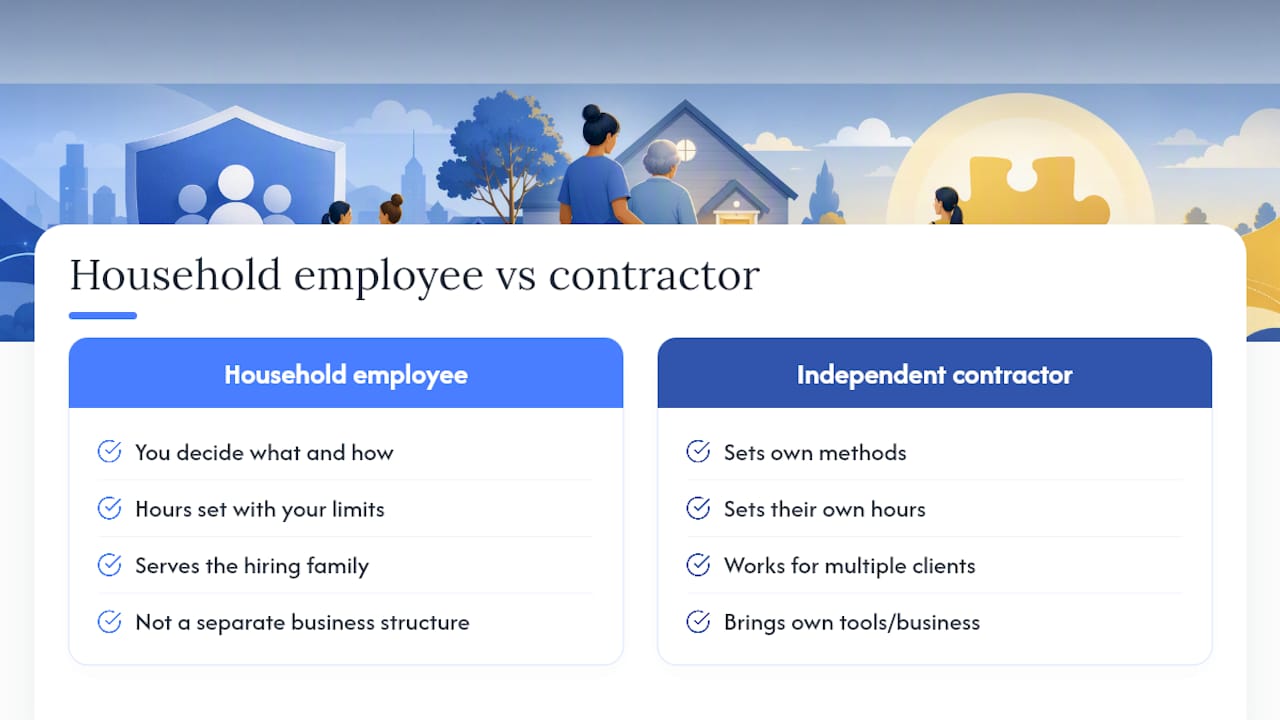
Getting this wrong is expensive. Common mistakes families make include paying in cash with no records, handing the caregiver a 1099 form to avoid payroll taxes, or relying on a verbal agreement with no documentation. Each of these can trigger back taxes, penalties, and interest if the IRS or a state agency later determines the caregiver was misclassified. Misclassifying caregivers as contractors is one of the most common compliance failures in senior care, largely because aging-in-place arrangements feel informal even when they legally aren't.
There's also a lesser-known wrinkle: certain family relationships are exempt from FICA withholding. Wages paid to a spouse, to a child under 21, or to your own parent (with exceptions) generally don't trigger Social Security and Medicare withholding. But whether that exemption applies can depend on whose money pays the wage. If an adult child pays a parent's caregiver from the child's own funds, the rules differ from a scenario where the elderly parent pays from their own account. That single detail, who is the employer, determines almost everything else.
Pro Tip: Decide who the legal employer is before the first paycheck is written. Payroll experts consistently point to this as the step families skip, and it's the one that determines which tax rules apply from day one.
Setting Up Household Payroll: The Federal Compliance Checklist
Once you've confirmed the caregiver is a household employee, the process follows a predictable sequence. Skipping steps is what turns a manageable task into a stressful cleanup project two years later.
- Write the agreement. Put the hourly rate, weekly hours, job duties, and start date in writing. This document becomes your primary evidence if a Medicaid audit or IRS inquiry ever questions the arrangement.
- Get an Employer Identification Number (EIN). You'll need this to report wages, even as a household employer. Apply directly through the IRS; it's free and usually issued immediately online.
- Register for state employer accounts. Most states require a separate account number for unemployment insurance and, in some cases, state income tax withholding. Do this before the caregiver's first paycheck.
- Check the federal thresholds. For 2025, you generally owe Social Security and Medicare (FICA) taxes once you pay a household employee $2,800 or more in cash wages during the year, and federal unemployment tax (FUTA) once you pay $1,000 or more in any calendar quarter, according to IRS Publication 926.
- Collect a completed Form W-4 from the caregiver if you'll withhold federal income tax at their request, since it's optional unless they ask for it.
- Withhold and set aside FICA taxes from each paycheck, matching the caregiver's share with your own as the employer.
- File Schedule H with your personal federal income tax return to report household employment taxes for the year.
- Issue a W-2 to the caregiver by January 31, and file the corresponding W-3 with the Social Security Administration.
- Consider quarterly estimated payments so you're not stuck owing a large lump sum at tax time, especially if you're also withholding federal income tax.
The IRS's own guidance encourages employers to withhold and remit taxes as they go rather than trying to catch up retroactively, since underpayment penalties accrue quarterly, not annually.
If this list feels heavier than expected, that reaction is normal. A payroll service or a dedicated consultation can absorb most of these steps, particularly the EIN setup, quarterly filings, and Schedule H preparation, if you'd rather hand off the compliance work than manage it solo.
Finding State Medicaid, VA, and Local Program Help
A few other resources are worth bookmarking before you need them:
- DOL state labor contacts clarify wage, overtime, and unemployment insurance rules that vary significantly from state to state.
- Area Agencies on Aging, coordinated through the Administration for Community Living, offer local guidance on benefits, respite care, and caregiver support specific to your county.
- VA Veteran-Directed Care and pension programs may fund family caregiving for veterans, though families should ask specifically how program enrollment affects who is treated as the employer for payroll purposes.
If a veteran or Medicaid recipient is the one technically paying the caregiver, that shifts payroll responsibility away from the adult child managing logistics. Confirm this in writing with the program administrator, not just verbally, so you know exactly whose EIN and whose Schedule H the arrangement runs through.
How Much Should You Pay an Elder Caregiver?
Wages for home health and personal care aides carry a national median that's a useful starting benchmark, though your area, the caregiver's experience, and the complexity of care all move that number up or down. The Bureau of Labor Statistics Occupational Outlook Handbook tracks median pay for this occupation, and direct care worker wages also vary widely by state, according to ASPE and PHI workforce research.
- Set an hourly rate, not a flat daily rate, whenever possible. Flat pay still requires you to track actual hours worked for overtime compliance.
- Overtime rules generally require time-and-a-half after 40 hours a week for household employees, though some states set stricter thresholds, so confirm with your state labor office.
- Reimbursements for mileage or supplies are usually not taxable wages if documented separately, but noncash benefits like free housing may need to be reported.
Recordkeeping That Protects You and the Caregiver
Good records are what turn a stressful audit into a five-minute phone call. Keep the signed caregiver agreement, weekly timesheets, pay stubs showing withholdings, and copies of every W-2 and Schedule H you file, ideally for at least four years.
- Track hours daily, not from memory at the end of the pay period.
- Pay on a consistent weekly or biweekly schedule and provide a written pay stub each time.
- Store agreements and tax filings somewhere both you and the caregiver can access them if questions come up later.
Accurate time logs and a signed agreement are the simplest evidence families can produce to show a legitimate household employment relationship, whether the question comes from the IRS or a Medicaid caseworker. An app that logs shifts, timestamps approvals, and stores care details in one place removes a lot of the guesswork from this process, particularly when multiple family members or backup caregivers are involved in a rotating schedule.
Pro Tip: If you're transitioning a loved one into home care after a move, coordinate the caregiver schedule before moving day, not after. Services like Butler Moving's senior relocation team work with families managing exactly this kind of transition.
A Straight Answer From Someone Who's Seen This Go Wrong
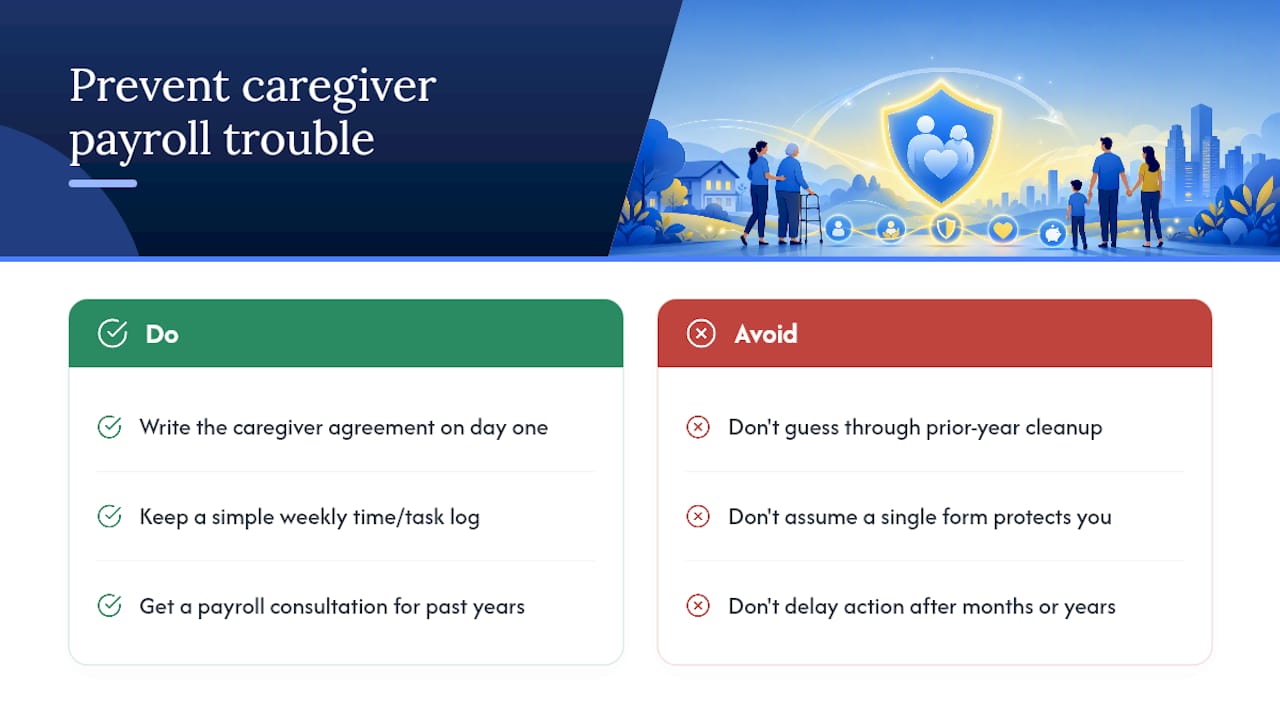
Families almost always underestimate how quickly informal caregiving turns into a legal employment relationship. The moment you're setting a schedule and correcting how a task gets done, you've crossed into household employer territory, whether you've filed a single form or not.
The families who avoid trouble aren't the ones with the most complicated systems. They're the ones who wrote down the agreement on day one and kept a simple weekly log from the start. If you're already several months or years into an informal arrangement, don't try to guess your way through a prior-year cleanup. That's exactly the situation where a payroll consultation earns its cost many times over.
— mercedes
Let CareTracker Handle the Parts You Shouldn't Guess At
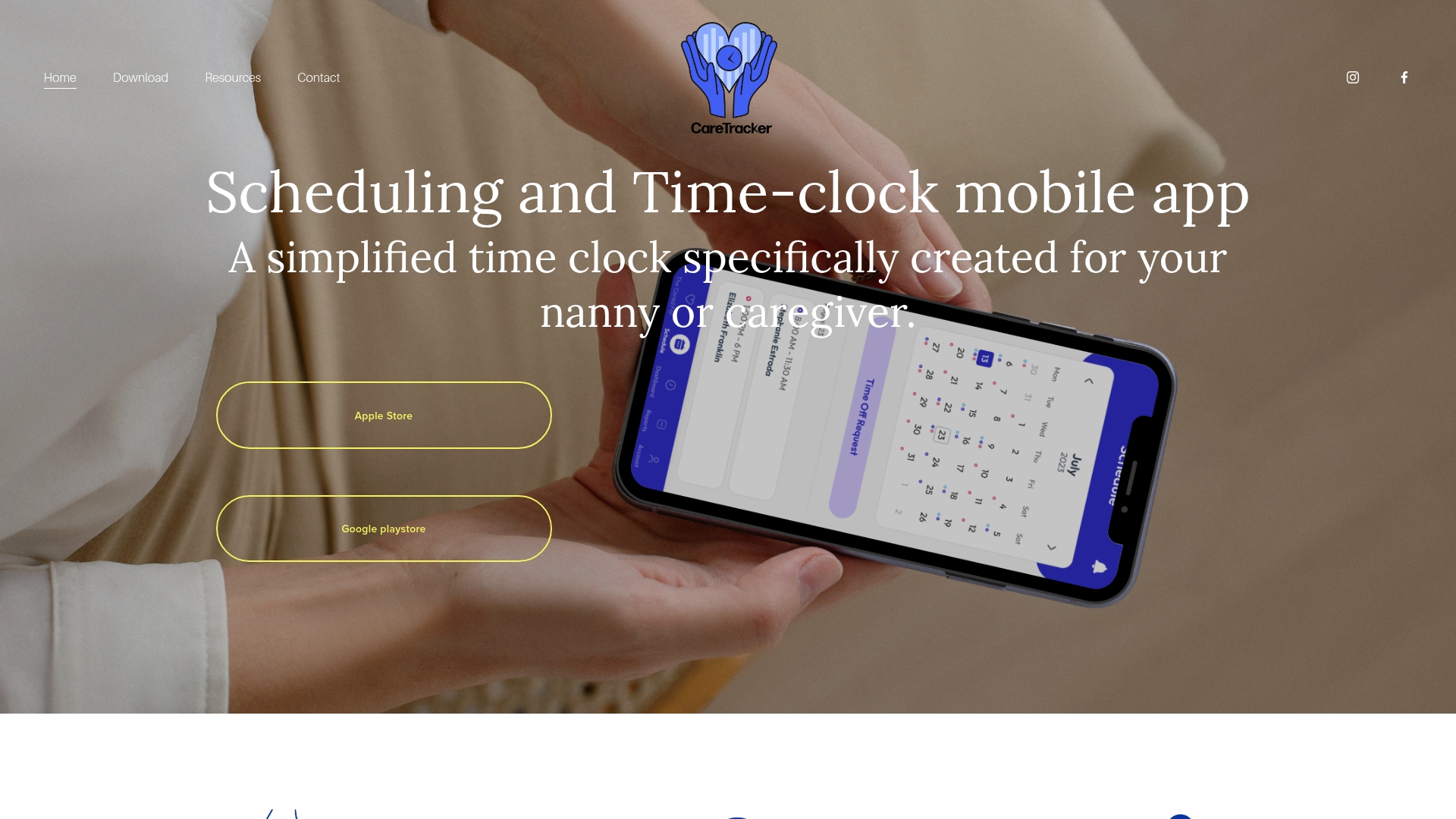
CareTracker is the practical alternative to piecing together a payroll system from scattered advice and spreadsheet templates. The Scheduling and Time-clock mobile app is free for caregivers to log shifts, submit hours, and share care details like medications and emergency contacts directly with the family managing payroll.
For the payroll side, families facing a first-time setup or a messy prior-year situation can book the Premium Consultation, priced at $150 one-off, to walk through EIN registration, state accounts, and Schedule H prep with someone who does this daily. If you've already discovered you should have been running payroll months ago, the Prior Wage Reporting & Household Payroll Cleanup Services are built specifically for that catch-up work. Families with a straightforward, single-caregiver setup often do fine handling payroll themselves once the app is tracking hours accurately; families juggling multiple caregivers, prior-year exposure, or multi-state rules usually save time and money by booking the consultation instead. Start by downloading the app to track hours this week, then decide from there whether you need the extra help.
Sources
- Publication 926 (2025) — IRS
- Home health and personal care aides — OOH (BLS)
- DOL state labor contacts — U.S. Department of Labor
FAQ
How much do caregivers get paid per hour in the U.S.?
Pay varies by state and experience level, and the Bureau of Labor Statistics tracks median wage data for home health and personal care aides as a benchmark. Your actual rate should reflect local demand, the caregiver's certifications, and the complexity of the care involved.
Can family members get paid to take care of an elderly parent?
Yes, through routes like state Medicaid consumer-directed programs, VA caregiver benefits for veterans, or a private household payroll arrangement where the family pays a relative directly. Availability and rules for Medicaid programs vary significantly by state, so checking your state's listing is the fastest way to confirm eligibility.
Which states pay caregivers the most?
Median caregiver wages differ widely across states, and ASPE and PHI workforce data shows this variation is tied to cost of living, state minimum wage laws, and local demand for home care workers. There's no single fixed ranking, since rates shift year to year with local labor markets.
How do you pay a private caregiver legally?
Treat the caregiver as a household employee if you control their hours and duties, obtain an EIN, withhold FICA taxes once you cross federal thresholds, and file a W-2 and Schedule H annually as outlined in IRS Publication 926. Families who want help setting this up can use a payroll consultation service, like the ones offered through CareTracker, to handle registration and filings correctly the first time.