
Each family in a nanny share is its own household employer under IRS rules, and each one carries payroll duties for the wages it pays. Once you cross the $3,000 threshold for the year, you must get an EIN, withhold and remit FICA, and plan to file Schedule H and a W-2 for your share of the nanny's pay. The other family's obligations are calculated separately, on their own payment history.
TL;DR:
- Each family in a nanny share must handle its own payroll registration, EIN, and tax filings independently, even if they coordinate pay or scheduling.
- Crossing the $3,000 annual wages threshold for one family triggers full payroll tax obligations for that family, regardless of when the amount is exceeded.
- Overtime pay is based on the nanny’s combined hours across both households, with split methods like proportional or cause-based sharing being IRS acceptable.
- State-specific requirements like unemployment insurance, workers' compensation, and income withholding vary and should be addressed before the first pay period.
- Keeping detailed records, clear agreements, and using shared time-tracking systems reduces compliance risk and facilitates proper tax reporting and benefits claims.
Table of Contents
- Who Counts as the Employer, and When Does the $3,000 Threshold Kick In?
- Setting Up Payroll: What Each Family Needs To Do
- Splitting Wages, Overtime, and Reporting on W-2s
- FUTA, State Unemployment, and Other Employer Obligations
- Dependent Care FSA and the Child and Dependent Care Credit
- Should One Family Run Payroll, or Should Each Handle Its Own?
- Records, Family Agreements, and the Mistakes That Cause Trouble
- How Time Tracking and Centralized Records Cut Your Risk
- A Few Ground Rules Before You Start a Nanny Share
- CareTracker: Track Hours, Then Get Real Payroll Help When You Need It
- Sources
Who Counts as the Employer, and When Does the $3,000 Threshold Kick In?
The IRS decides who the employer is based on control, not on who writes the biggest check. If you set the nanny's schedule, direct how the work gets done, and can end the arrangement, you are an employer. In almost every nanny share, that means both families meet the test, even though only one family might handle the actual bank transfer.
Each family's tax threshold is figured independently, using only what that family paid the nanny during the year. Three scenarios show how this plays out:
- Both families pay over $3,000. Both are household employers with full FICA, Schedule H, and W-2 obligations.
- One family pays $3,500, the other pays $2,400. Only the first family owes FICA and files Schedule H; the second stays under the threshold and files nothing.
- Both families pay under $3,000 (rare in a true share, but possible with a very part-time arrangement). Neither owes household employment tax, though income tax reporting rules for the nanny may still apply.
Crossing $3,000 anytime during the year triggers taxes on all wages paid that year, not just the amount above the line. A family that pays $2,900 through October and adds a $200 December bonus owes FICA on the full $3,100, retroactive to January.
Setting Up Payroll: What Each Family Needs To Do
Payroll setup is not a group project. Even when two families coordinate closely on scheduling and pay rates, each one runs its own compliance track. Here's the order that works:
- Get your own EIN. Apply free through the IRS. You need this even if the other family already has one; Publication 926 treats each household as a separate employer, so EINs cannot be shared or reused.
- Register for state unemployment insurance. Most states require this once you cross a wage threshold, and the registration process, rates, and reporting cadence differ by state. Some states also mandate income tax withholding registration at the same time.
- Set pay frequency and collect Form W-4. Weekly or biweekly is standard. Ask your nanny to complete a W-4 so you know whether to withhold federal income tax, which is optional for household employers but often requested by the nanny to avoid a large bill in April.
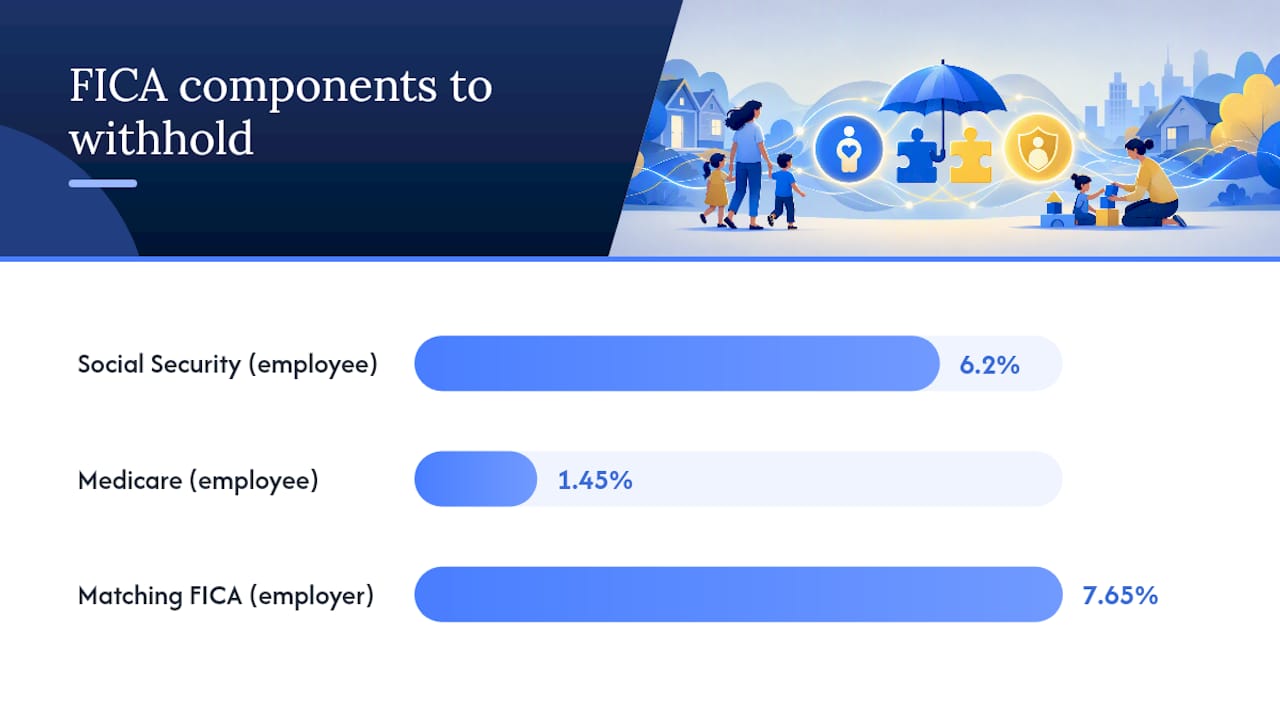
- Withhold FICA and match it. Withhold 6.2% for Social Security and 1.45% for Medicare from the wages you pay, then add a matching 7.65% from your own funds. Depending on your total tax liability, you may owe quarterly estimated payments rather than waiting until year end.
- File Schedule H and issue a W-2. Schedule H attaches to your personal Form 1040 and reports the wages you paid and taxes owed. You issue a W-2 covering only your portion, and file a W-3 transmittal alongside it.
The nanny payroll setup guide walks through each of these steps with state-specific notes if you want a second reference before you start.
Pro Tip: Set a shared calendar reminder for the last week of January. That's when W-2s are due to the nanny and W-3s to the Social Security Administration, and it's easy to lose track when you're only handling a slice of the paperwork.
Splitting Wages, Overtime, and Reporting on W-2s
Each family reports and taxes only the wages it actually paid, never a blended total. If Family A pays $22 an hour for 20 hours a week and Family B pays $20 an hour for 25 hours a week, Family A's annual wages come to roughly $22,880 and Family B's to about $26,000. Each family calculates its own FICA, Schedule H, and W-2 based on those separate figures. Neither owes tax on the other's payments.
Overtime works differently because it's based on the nanny's combined hours across both households, not hours worked for either family alone. A nanny working 20 hours for one family and 25 for another has worked 45 hours that week, five over the federal overtime line. Families typically split that overtime cost one of three ways:
- Proportional to hours worked. Each family pays its share of the premium based on how many hours it used that week; this is the easiest method to document and defend.
- Cause-based. Whichever family's extra request pushed the week over 40 hours absorbs the overtime cost alone.
- Capped hours. Families agree in advance on a weekly hour ceiling for each household specifically to avoid triggering overtime at all.
Neither Social Security nor the IRS cares which split method you choose, as long as the total overtime premium actually gets paid and documented.
When a nanny works for two families in a share, she'll receive two separate W-2s, one from each household employer. Come tax season, she simply adds the wage totals from both forms onto her personal return, the same way any worker with two employers would.
FUTA, State Unemployment, and Other Employer Obligations
Federal unemployment tax (FUTA) applies once a family pays $1,000 or more in any calendar quarter, a separate and lower trigger than the $3,000 FICA threshold. The base FUTA rate is 6% on the first $7,000 of wages, but most employers who pay their state unemployment tax on time and in full get a credit that drops the effective rate to 0.6%. Miss a state payment deadline, and that credit shrinks or disappears.
State unemployment insurance (SUTA) registration is where nanny shares run into the most variation:
- Wage thresholds for mandatory registration differ by state, and some states count combined-employer wages differently than the IRS does for federal purposes.
- A few states also require state income tax withholding registration at the same time you register for unemployment insurance.
- Workers' compensation rules matter too. California, New York, and New Jersey all have specific household-employer workers' comp requirements, and skipping coverage can leave a family exposed to a lawsuit if the nanny is injured on the job.
- Paid family leave programs in states like New York and New Jersey may require separate payroll deductions on top of standard withholding.
Check your state's resources before your first pay period, not after; retroactive registration is possible but always more expensive than doing it up front.
Dependent Care FSA and the Child and Dependent Care Credit
Each family in a nanny share can claim dependent-care tax benefits independently, based only on what that family paid. A Dependent Care FSA lets you set aside pretax dollars, typically capped around $5,000 per household for a married couple filing jointly, to cover your share of the nanny's wages.
- FSA dollars reduce your Care Credit base. Whatever you run through the FSA can't also count toward the Child and Dependent Care Credit; the two benefits stack up to a combined limit, not on top of each other.
- The Care Credit applies to the remainder. If your qualifying expenses exceed what you put in the FSA, the leftover amount, up to the credit's cap, can still generate a credit worth a percentage of those costs.
- Higher earners often lean on the FSA. If your marginal tax rate is high, the FSA's pretax treatment usually saves more than the credit percentage would.
- Keep receipts either way. Both benefits require documentation showing what you paid and to whom, which is exactly what a clean payroll record and timesheet history give you.
Should One Family Run Payroll, or Should Each Handle Its Own?
Nanny-share families generally pick one of two operational models, and both are legitimate as long as the underlying tax filings stay separate.
- Each family runs its own payroll. More setup work upfront (two EINs, two state registrations, two Schedule H filings), but total independence and no risk of one family's mistake bleeding into the other's tax return.
- One family processes payroll and the other reimburses. Simpler day-to-day logistics, since only one household deals with the payroll mechanics, but it requires a clear written reimbursement schedule to avoid the appearance that the reimbursing family isn't a real employer at all.
Household payroll services are built for exactly this friction. They let each family keep its own account and EIN while centralizing timekeeping and W-2 generation, which cuts down on the misfiling mistakes that come from juggling two sets of rules by hand.
Pro Tip: If your state has unusual SUTA rules, or the two families disagree on how to split overtime, that's your cue to call a payroll professional rather than improvise. A one-time consultation costs far less than an IRS notice.
Records, Family Agreements, and the Mistakes That Cause Trouble
Keep these on file for at least four years: your EIN confirmation letter, payroll registers, weekly timesheets, copies of every W-2 you issue, your Schedule H filings, and deposit receipts for FICA and FUTA payments.
Put the following in a written agreement between families before the nanny's first day:
- Cost-split method and rate per family
- Overtime-sharing method (proportional, cause-based, or capped hours)
- Who handles day-to-day payroll processing
- Notice period if either family wants to end the share
- A backup care plan if the nanny is unavailable
The most common compliance failure is treating the nanny as an independent contractor to skip payroll taxes entirely, a misclassification the IRS actively pursues. The second is combining both families' payments into one shared account without separate EINs and filings to support it.
How Time Tracking and Centralized Records Cut Your Risk
Accurate, contemporaneous timesheets are your best defense if a family agreement falls apart or a filing gets questioned. When both families and the nanny approve hours in the same place, you eliminate the "I thought we agreed on 22 hours" disputes that crop up months later, and you get clean records that support your FICA math, your overtime split, and your dependent-care credit substantiation all at once.
Thecaretracker tracks hours for free, gives each family and the nanny a shared calendar view, and stores care details like schedules in one place both households can reference. When your setup gets complicated enough that timesheets alone can't answer your questions, a payroll consultation is the next logical step.
A Few Ground Rules Before You Start a Nanny Share
Nanny shares fail on logistics more often than on money. Before the first paycheck goes out, put your cost split and overtime method in writing, track hours in one shared system both families and the nanny can see, and decide upfront who runs payroll versus who reimburses. Skipping that groundwork doesn't just create tax risk. It quietly erodes the trust between two families who chose to share a caregiver specifically because they wanted less stress, not more of it.
— mercedes
CareTracker: Track Hours, Then Get Real Payroll Help When You Need It
Running payroll for a nanny share by memory and text messages is how families end up with mismatched timesheets in April. Thecaretracker gives both families and the nanny one shared view of hours worked, schedules, and care details, so nobody's guessing what actually happened in week 14.

The free time tracker generates the hour-by-hour record you'll need for FICA calculations, overtime splits, and dependent-care credit documentation, all without either family paying a cent. When your situation gets more complicated, multiple families, a tricky overtime split, or a state with unusual SUTA rules, the payroll consultation service gives you direct access to someone who sets up compliant payroll for you instead of leaving you to piece it together from IRS instructions. Start by logging your nanny's hours this week, and book a consultation before your first quarterly deposit is due if you're unsure where you stand.
This article is general information, not a substitute for advice from a qualified financial advisor. Consult a qualified financial professional about your own circumstances before acting on anything here.