
The fastest way to track nanny PTO is a written policy paired with a combined PTO bank, accrued each pay period, and logged in a shared app like CareTracker so both you and your nanny always see the same balance. That single setup, contract clause plus visible tracking tool, solves the two most common household payroll headaches: disputed time off and payroll errors.
Your policy needs five things stated in plain language before the first paycheck: total PTO days or the accrual rate, which holidays are paid, how much notice a request requires, whether unused time rolls over or gets paid out, and when accrual starts relative to any probation period. Skip any one of these and you're negotiating from memory later, usually during a stressful week.
A few facts anchor everything that follows. The FLSA doesn't require paid time off for household employees, but a growing list of states and cities mandate paid sick leave regardless. PTO pay itself is taxed exactly like regular wages, meaning Social Security, Medicare, and income tax withholding all apply. And a purpose-built tool such as CareTracker removes the guesswork by keeping the balance, the request, and the approval in one place.
Write the policy down, pick one accrual method, and track it somewhere both people can see it. Everything else in nanny PTO management is a variation on that theme.
Key Takeaways
A written PTO clause paired with per-pay-period accrual tracked in a shared app eliminates the balance disputes and payroll errors that informal nanny time-off arrangements create.
| Point | Details |
|---|---|
| Put PTO in writing | Draft a clause covering total days, holidays, notice, rollover, and probation before onboarding starts. |
| Pick one accrual method | Per-pay-period accrual suits full-time schedules; hours-earned ratios suit part-time or variable hours. |
| Check state sick leave rules | Several states set separate paid sick leave minimums that can't be folded into a general PTO bank. |
| Reconcile every pay period | Confirm the PTO balance before running payroll, not after, to catch errors immediately. |
| Track balances in CareTracker | CareTracker shows shared timesheets and live PTO balances so parents and nannies see the same number. |
Table of Contents
- Why a Written PTO Policy for Track Nanny PTO Matters
- What Should a Nanny PTO Policy Include?
- Combined PTO Bank or Separate Buckets?
- How Do You Track PTO Requests Day to Day?
- Which Tools Actually Simplify PTO Tracking?
- Setting Up the Policy: A Step-by-Step Plan
- How Does PTO Affect Payroll Taxes and Overtime?
- What Does the Accrual Math Actually Look Like?
- My Take on the Simplest Approach That Actually Works
- Set Up Nanny PTO Tracking with CareTracker
- Sources
Why a Written PTO Policy for Track Nanny PTO Matters
A written PTO policy prevents the two most expensive mistakes families make with household employment: payroll miscalculations and relationship damage from unclear expectations. Verbal agreements about "a few weeks off a year" sound reasonable in an interview. They fall apart the moment your nanny asks for a specific week in July and you don't remember agreeing to it.
The legal backdrop makes this more than a nice-to-have. Federal law sets no floor for vacation or sick leave, but states including California, New York, Colorado, New Jersey, Connecticut, Massachusetts, and Oregon each require some form of paid sick leave with their own accrual rules. A policy that ignores your state's minimum isn't just bad practice, it's noncompliant.
Beyond compliance, a documented policy delivers real operational benefits:
- Predictable scheduling, since you know coverage gaps in advance instead of discovering them the morning of.
- Fewer disputes over what counts as "time off" versus a sick day taken without notice.
- Clear expectations that reduce turnover, one of the biggest hidden costs in household employment.
- A paper trail that protects you if a tax authority or state labor office ever asks questions.
Pro Tip: Write the PTO clause directly into the employment agreement, then hand your nanny a one-page plain-language summary during onboarding. People remember a single page far better than a paragraph buried in a longer contract.
What Should a Nanny PTO Policy Include?
Every nanny PTO clause needs to answer the same set of questions before either party signs anything. Leave one out and you've built ambiguity into your payroll from day one.
- Total PTO days per year or the exact accrual rate (for example, one day per month worked).
- How accrual is calculated: per pay period, hours worked, or a lump sum granted upfront.
- A specific list of paid holidays, not a vague reference to "major holidays."
- The notice and approval process, including how far in advance a request must be submitted.
- Rollover and payout rules for unused time, both during employment and at termination.
- The probationary period, and whether PTO accrues during it or starts only after.
- Rules for part-time nannies, since accrual usually needs to be prorated against scheduled hours.
- A clear line between paid downtime (hours the nanny is on the clock but idle) and actual PTO.
Gusto's guidance for household employers notes that some states require a written contract for domestic workers, and recommends spelling out hours, compensation, duties, and PTO explicitly rather than leaving any of it implied.
Adapt language like that to your own numbers, but keep the structure: rate, timing, cap, and what happens to the overflow.

Combined PTO Bank or Separate Buckets?
For most families, a combined PTO bank, one pool of days usable for vacation, illness, or personal time, is the simplest structure to run. Separate buckets for sick leave and vacation add administrative overhead but may be necessary where local paid sick leave law sets its own accrual floor independent of vacation time.
Three approaches cover almost every household:
- Combined bank: one number, maximum flexibility, easiest to track in an app or spreadsheet.
- Separate buckets: sick leave and vacation tracked independently, which helps when your state mandates a minimum sick accrual rate that can't be blended into general PTO.
- Lump-sum grant: the full annual allotment given upfront, simple to administer but harder to prorate fairly for mid-year hires.
Accrual method matters just as much as the bucket structure. Per-pay-period accrual (a fixed number of hours or days added each check) works well for full-time nannies on a stable schedule. Hours-earned-per-hour-worked suits part-time or variable-hour arrangements better, since it scales naturally with however much the nanny actually works that week.
Where state paid sick leave law sets a minimum, that minimum usually can't be waived by a "use it or lose it" clause. Check your state's rules before writing that language into any contract.
How Do You Track PTO Requests Day to Day?
A predictable four-step cycle keeps PTO accurate without turning every request into a negotiation: request, approve, record, reflect.
- The nanny submits a time-off request with the specific dates, ideally through the same app used for scheduling and hours.
- You approve or decline within an agreed window, generally 24 to 48 hours, so plans don't stall.
- The approved days get recorded against the running balance immediately, not at the end of the month.
- The updated balance appears on the next timesheet or paystub before payroll runs, so nobody is surprised.
Part-time schedules complicate step three slightly. If a nanny works three days a week and requests one full day off, that's a full PTO day, not a third of one, since it matches a scheduled workday. If hours fluctuate week to week, convert the missed hours into a fraction of the accrued balance rather than a flat day.
Pro Tip: Reconcile the PTO balance every pay period, before payroll runs, not after. Catching a math error before the check goes out takes five minutes; catching it three months later means an awkward conversation about back pay.
Which Tools Actually Simplify PTO Tracking?
A caregiver app that shows shared timesheets and running PTO balances is usually the fastest route to error-free tracking, because both parties see the same number in real time instead of comparing notes after the fact.
Three categories cover nearly every household's needs:
- Shared time-tracking apps with PTO features, like CareTracker, where hours, requests, and balances live in one calendar both people can check.
- Household payroll services, which automate tax withholding and often display PTO balances directly on paystubs. Poppins Payroll recommends configuring the pay schedule and PTO setup before the first check runs, not after.
- Spreadsheets or manual logs, workable for very short-term or informal arrangements but prone to drift once accrual math gets more than a few months old.
Decide between an app and a full payroll service based on complexity. One family, one nanny, one state: an app alone usually covers it. Multiple caregivers, multi-state households, or year-end tax filings: that's when a service like Gusto or a specialized platform such as TrackNannyPay, built for state-specific overtime rules and Schedule H support, earns its cost.
Whichever you choose, confirm it handles shared approvals, per-pay-period accrual math, rollover options, and exportable, paystub-ready timesheets. Missing any of those means you're back to manual reconciliation within a few months.
Setting Up the Policy: A Step-by-Step Plan
You can build a complete PTO policy and tracking system in a single onboarding session if you follow the steps in order rather than improvising as questions come up.
- Draft the PTO clause using the checklist above, before discussing numbers with your nanny.
- Agree on the accrual method, per pay period or lump sum, and confirm it in writing.
- Set the probationary period and whether accrual starts immediately or after it ends.
- Lock in the pay schedule, since accrual math depends on how many pay periods exist per year.
- Configure your tracking app or payroll service with the agreed rate and rules.
- Run a test pay period together to confirm the balance calculates correctly.
- Reconcile that first balance before the real payroll cycle starts.
- File the signed policy and a copy of the onboarding summary in your employee records.
Three clauses worth adapting directly:
Vacation/PTO bank: "Employee accrues PTO at a rate of 3.08 hours per biweekly pay period (10 days annually), usable for vacation, illness, or personal matters, beginning after a 30-day probationary period."
Sick leave (where state law requires separate tracking): "In addition to the PTO bank above, Employee accrues paid sick leave in accordance with [state] law, tracked separately and available for use after [state-required waiting period]."
Payout on termination: "Accrued, unused PTO will be paid out at the Employee's regular rate of pay upon termination, in accordance with [state] law."
Do the first reconciliation together with your nanny rather than behind the scenes. It catches misunderstandings immediately instead of a pay period later.
How Does PTO Affect Payroll Taxes and Overtime?
PTO pay is processed exactly like regular wages for tax purposes. Social Security, Medicare, and applicable income tax withholding all apply to PTO payments the same way they apply to hours actually worked. There's no special tax category for paid leave.
Overtime works differently, and this trips up a lot of families. Overtime calculations are based only on hours actually worked in a given week, never on paid time off. A nanny who works 32 hours and takes one paid vacation day didn't work 40 hours that week, regardless of what the paycheck totals.
- Include the current PTO balance on every paystub, not just at year-end.
- Check your state and city for paid sick leave minimums before finalizing rollover or payout language, since several states set their own accrual floors that can't simply be absorbed into a general PTO bank.
- Reconcile PTO figures before filing Schedule H or preparing year-end W-2 paperwork, so nothing is estimated after the fact.
One data point worth remembering: because PTO is taxed identically to wages, a miscounted PTO day doesn't just throw off a balance, it throws off the tax withholding calculated on that check.
What Does the Accrual Math Actually Look Like?
Converting an annual PTO allotment into per-pay-period accrual is simple arithmetic once you know the inputs: annual days, number of pay periods, and hours per day.
- Multiply annual PTO days by daily hours to get total annual PTO hours (10 days × 8 hours = 80 hours).
- Divide total annual hours by the number of pay periods (80 ÷ 26 biweekly periods = 3.08 hours per period).
- For part-time or variable schedules, use a ratio instead: one hour of PTO for every 30 hours actually worked, adjusted automatically as hours change.
- Round to two decimal places for pay-period accrual to avoid compounding rounding errors over a full year.
If a nanny's schedule changes mid-year, from three days a week to five, for example, prorate the new accrual rate from the effective date forward rather than recalculating the whole year retroactively. That keeps the math transparent if either party ever wants to check it by hand.
My Take on the Simplest Approach That Actually Works
Most families overthink PTO structure and underthink tracking discipline. The combined PTO bank with per-pay-period accrual, logged in a shared app, wins for one reason: it removes the two-spreadsheet problem where you have a number and your nanny has a different number.
Separate sick and vacation buckets make sense only when your state's paid sick leave law forces the split, or when you're managing multiple caregivers with different schedules where a single pool would get confusing fast. Outside those cases, splitting hairs between "sick" and "vacation" for a household of one nanny usually just adds a column nobody needs.
The exception worth flagging: multi-state families (a summer home in one state, primary residence in another) or households employing more than one caregiver benefit from a payroll service that handles jurisdiction-specific filings automatically. For everyone else, a written clause plus an app that shows both people the same balance covers the entire problem.
Set Up Nanny PTO Tracking with CareTracker
CareTracker solves the exact pain point this guide keeps circling back to: two people, two different memories of the PTO balance. The app gives you shared timesheets, a visible running PTO balance, a request-and-approve flow, and one-click timesheet exports ready for payroll, so nobody is reconciling numbers from memory the week before a check runs.
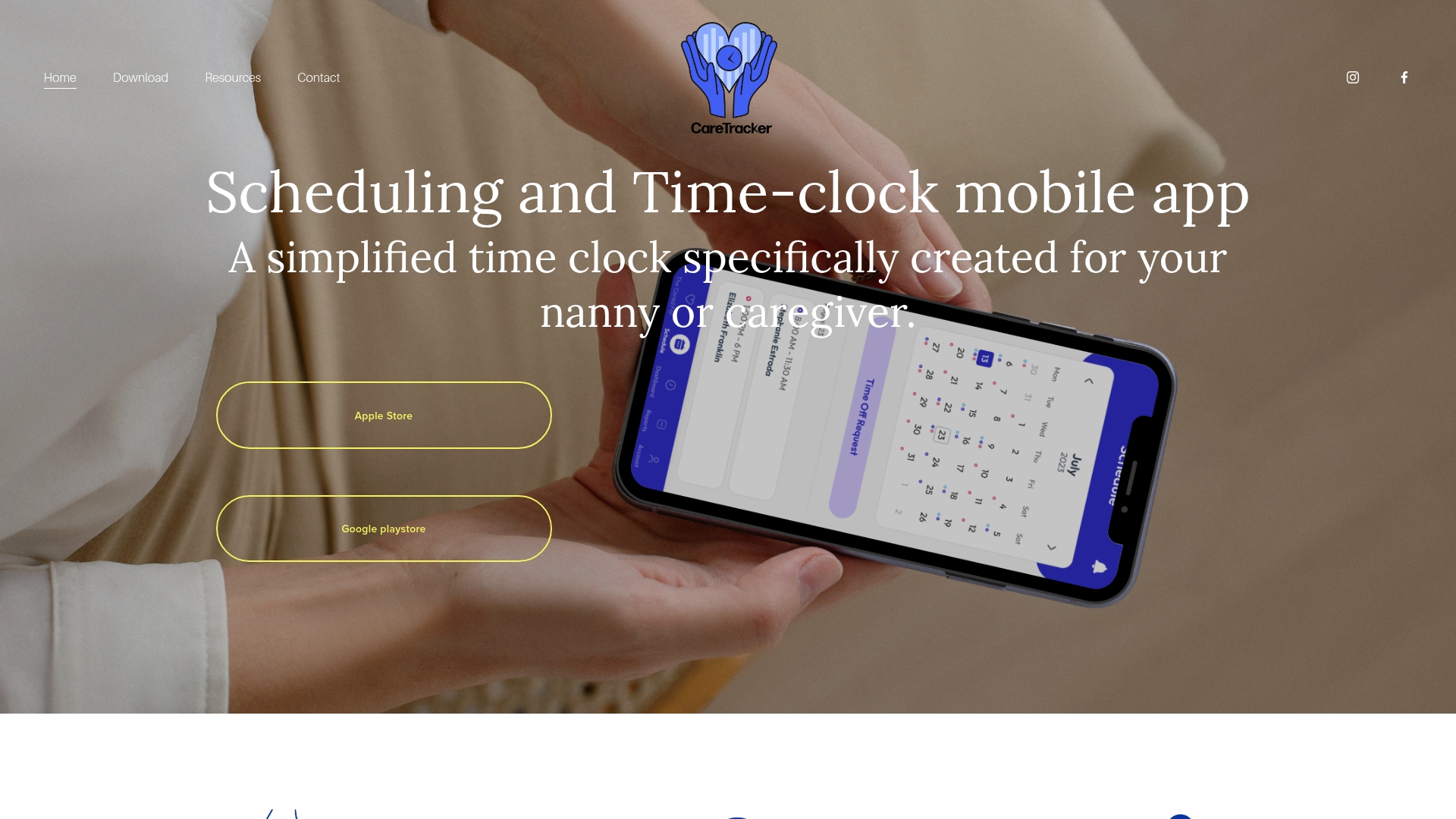
Set it up once with your accrual rate and pay schedule, and every request your nanny submits updates the same balance you see on your end. There's no separate spreadsheet to maintain and no guessing at what was approved three weeks ago. Explore CareTracker's time-tracking features to see exactly how the balance and export functions work together. If your household spans multiple states or you'd rather have someone handle Schedule H and year-end filings directly, CareTracker also offers a paid payroll cleanup and consultation service for exactly that. Start by creating your household profile at Thecaretracker and configuring your first pay period.
Sources
These sources back the payroll and legal guidance in this article and offer templates or tools for deeper implementation.
- Nanny PTO: vacation, sick, paid time off | NannyKeeper Blog
- Nanny Payroll and Tax Services | Poppins Payroll
- TrackNannyPay product info
Always confirm your specific state and city's paid sick leave requirements before finalizing rollover or payout language. This article offers general guidance, not legal or tax advice, and household employment rules vary enough that a quick check with a payroll professional or your state labor department is worth the ten minutes it takes.
This article is general information, not a substitute for advice from a qualified lawyer. Consult a qualified legal professional about your own circumstances before acting on anything here.