
A breastfeeding schedule by age is defined as a flexible, cue-based feeding framework that adjusts to your baby's nutritional needs at each stage of development. The American Academy of Pediatrics and the World Health Organization both recommend exclusive breastfeeding for approximately the first 6 months, followed by continued nursing alongside solid foods up to 2 years or beyond. Understanding how feeding frequency shifts from newborn to toddler gives you a realistic roadmap and helps you respond confidently to your baby's signals rather than watching the clock.
What does a breastfeeding schedule by age look like?
Feeding frequency changes significantly across your baby's first year. The clearest way to understand it is to look at each age window separately, because the shifts are real and predictable.
Newborn breastfed babies feed 8–12 times every 24 hours, roughly every 2–3 hours, including overnight. That number sounds intense, and it is. A newborn's stomach is the size of a marble at birth, so small, frequent feeds are a biological necessity, not a parenting failure. By 6 weeks to 3 months, most babies settle into 7–9 feeds per day spaced every 2–4 hours. From 3 to 6 months, the typical range drops to 6–8 feeds daily. Between 6 and 9 months, when solids enter the picture, feeds fall to 4–6 per day. By 9 to 12 months, most nursing babies feed 3–5 times daily.

These ranges are guidelines, not rules. Your baby's growth spurts, sleep patterns, and individual temperament all influence where they land within each window.
How often should you breastfeed a newborn to 3 months?
The newborn stage is the most demanding period of any infant feeding schedule, and knowing what to expect makes it far easier to manage.
From birth to 6 weeks, your baby feeds 8–12 times per day. The let-down reflex takes about 2 minutes after suckling begins, so patience in those first moments is normal and necessary. Newborns in the first few days may also need to be gently woken and stimulated to feed every 1.5–3 hours to prevent hypoglycemia. This is one of the few situations where watching the clock actually matters.
Cluster feeding is another normal feature of early infancy. Cluster feeding involves your baby nursing every hour or so for short stretches, typically in the evenings. It is not a sign of low milk supply. It is your baby's way of increasing your supply to meet their growing needs.
Key hunger cues to watch for include:
- Rooting (turning the head and opening the mouth)
- Sucking on fists or fingers
- Restlessness or squirming
- Soft murmuring sounds
- Fussiness (a late cue, meaning your baby is already quite hungry)
Crying is the last hunger signal, not the first. Responding to earlier cues makes latching easier for both of you.
Pro Tip: Feed on demand rather than by the clock. Watching your baby's cues rather than a timer builds your confidence and supports your milk supply more effectively than any rigid schedule.
Monitoring wet diapers is the most reliable way to confirm your baby is getting enough milk. Adequate intake produces 4–6 wet diapers daily after the first few days of life.
What changes in breastfeeding from 3 to 6 months?
Between 3 and 6 months, most babies become noticeably more efficient at nursing. Sessions that once took 40 minutes may now take 10–15 minutes. That efficiency is a sign of progress, not disinterest.
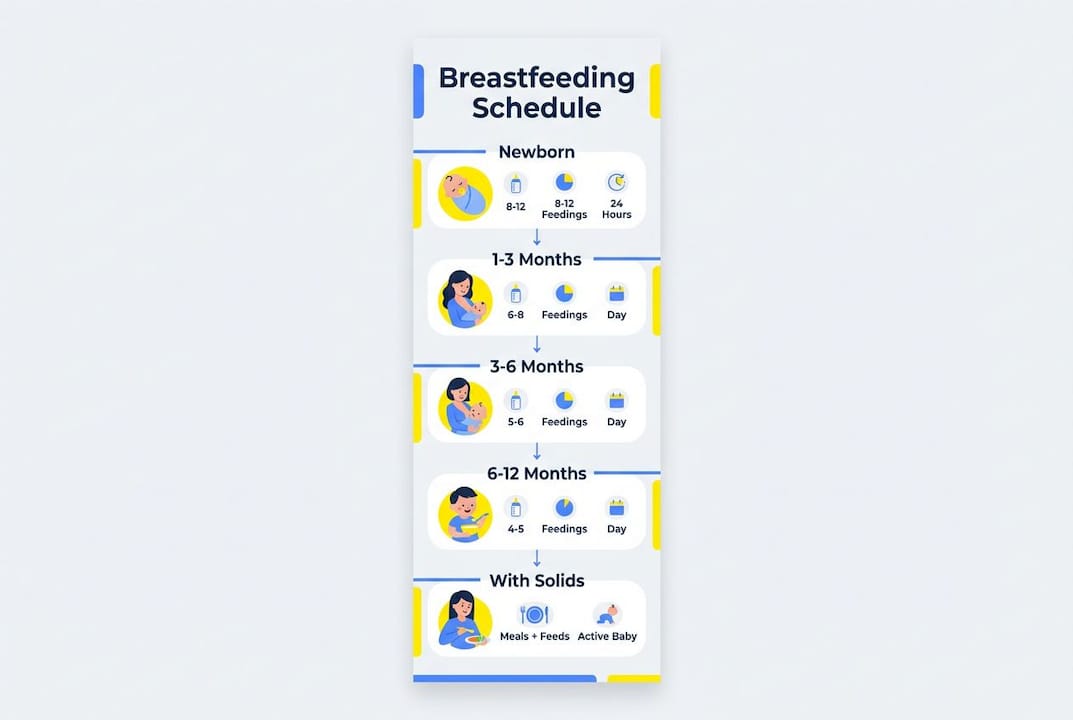
Feeding frequency typically drops to 6–8 times per day during this window. Many babies also begin sleeping longer stretches at night, which naturally spaces out feeds. You do not need to wake a healthy, thriving baby to maintain a feeding schedule at this stage.
Growth spurts still happen, usually around 3 months and again near 6 months. During a spurt, your baby may temporarily return to more frequent nursing for a few days. Schedules should flex around these phases rather than fight them. Babies also become more easily distracted during feeds at this age, so a quieter environment can help them focus.
Signs that feeding is going well during this period:
- Steady weight gain confirmed at well-child visits
- 4–6 wet diapers daily
- Baby seems satisfied and calm after feeds
- No signs of dehydration (dry mouth, sunken fontanelle)
Pro Tip: If your baby pulls off the breast frequently during feeds, try nursing in a dim, quiet room. Distractibility at this age is completely normal and not a sign of weaning.
How do you adjust breastfeeding from 6 to 12 months with solids?
Breast milk remains your baby's primary source of nutrition until at least 12 months, even after solids begin. Solids at this stage complement milk feeds; they do not replace them.
The introduction of solids should be based on developmental readiness, not calendar age alone. The three key signs of readiness are:
- Head control: Your baby can hold their head steady and upright.
- Sitting ability: Your baby can sit with minimal support.
- Interest in food: Your baby watches others eat and reaches toward food.
Solids should not be introduced before 4 months under any circumstances. Around 6 months is the typical target, aligned with both AAP and WHO guidance.
The table below shows how feeding frequency and solid food introduction typically evolve across the second half of the first year.
| Age | Breast milk feeds per day | Solids status |
|---|---|---|
| 6–7 months | 4–6 feeds | Starting single-ingredient purees |
| 7–9 months | 4–6 feeds | Expanding texture and variety |
| 9–10 months | 3–5 feeds | Soft finger foods added |
| 10–12 months | 3–5 feeds | Family foods with breast milk as primary drink |
A common mistake parents make is reducing nursing sessions too quickly once solids begin. Breast milk still delivers immune protection, fat, and calories that solid foods cannot fully replicate in the first year. Offer the breast before solids at most meals during the 6–9 month window to protect milk supply and ensure adequate nutrition.
How do you recognize hunger cues and feed responsively?
Responsive feeding, the practice of feeding based on your baby's behavioral signals rather than a fixed schedule, is the standard recommended by both the AAP and lactation professionals. It works at every age.
Feeding on demand using hunger cues like restlessness, sucking on fists, murmuring, and rooting is the recommended practice across all age groups. Adequate intake is confirmed by 4–6 wet diapers daily and consistent weight gain. These two metrics are your most reliable checkpoints.
The key hunger cues to recognize at any age include:
- Rooting reflex (turning toward touch on the cheek)
- Sucking motions with lips or tongue
- Bringing hands to mouth
- Increased alertness or squirming
- Fussiness or crying (late stage)
Cluster feeding can reappear during growth spurts even in older babies. Responding to it rather than resisting it protects your supply and reassures your baby. Breastfeeding is a skill that takes time for both parent and baby to develop, and there is no risk of overfeeding a breastfed baby.
Pro Tip: If your baby seems sleepy and is not waking to feed, try skin-to-skin contact or gently stroking their feet to encourage alertness before a feed. This is especially useful in the first two weeks.
Forcing a rigid schedule when your baby is signaling hunger creates stress for both of you and can reduce milk supply over time. Trust the cues. They are accurate.
Key Takeaways
A flexible, cue-based approach to nursing frequency is the most effective breastfeeding strategy across every stage of your baby's first year.
| Point | Details |
|---|---|
| Newborn feeding frequency | Newborns feed 8–12 times per day; this is normal and necessary for growth. |
| Frequency decreases with age | Feeds drop from 7–9 per day at 6 weeks to 3–5 per day by 9–12 months. |
| Hunger cues over the clock | Rooting, fist sucking, and restlessness are more reliable guides than a timer. |
| Solids complement, not replace | Breast milk stays the primary nutrition source until at least 12 months. |
| Wet diapers confirm intake | Four to six wet diapers daily is the clearest sign your baby is well fed. |
What I've learned about letting go of the feeding clock
New parents are handed a lot of conflicting advice about breastfeeding schedules. Some of it is helpful. Much of it creates unnecessary pressure. After working closely with families navigating the early weeks of infant care, the single most damaging belief I see is that a "good" baby feeds on a predictable schedule from day one.
Babies are not predictable. Their stomachs grow, their sleep shifts, and their needs change week to week. A proper latch and responsive feeding matter far more than any schedule. Bringing the baby to the breast rather than the breast to the baby, stimulating the lower lip to trigger the rooting reflex, and waiting through the let-down are skills that take practice. They are not instinctive for most parents, and that is completely fine.
The parents I see thriving are the ones who stop measuring success by the clock and start measuring it by wet diapers and weight gain. Those two numbers tell you everything you need to know. If both are on track, you are doing it right, regardless of whether your baby fed at 2:00 AM or 2:45 AM.
If you have genuine concerns about supply, latch, or weight gain, a certified lactation consultant is worth every minute of your time. Do not wait until you are exhausted and frustrated. Reach out early.
— mercedes
Thecaretracker makes infant care routines easier to manage
Keeping track of nursing sessions, sleep windows, and caregiver handoffs is a real challenge, especially in the early months when everything changes week to week. Thecaretracker is a free app built for caregivers and families who need one organized place for all of it.

With Thecaretracker, nannies and parents can log nursing schedules, track feeding times, and share care details instantly. The app stores allergy information, nap schedules, and emergency contacts so nothing gets missed during a shift change. Families can also use the nanny time tracking feature to coordinate caregiving hours around feeding routines. Thecaretracker is completely free for caregivers and takes minutes to set up.
FAQ
How many times a day should a newborn breastfeed?
Newborns typically feed 8–12 times per 24 hours, roughly every 2–3 hours. This frequency is normal and supports both milk supply and your baby's rapid early growth.
When does breastfeeding frequency decrease?
Feeding frequency naturally decreases as babies grow and become more efficient. Most babies drop from 8–12 feeds per day as newborns to 3–5 feeds per day by 9–12 months.
What are the signs my baby is getting enough breast milk?
The clearest signs are 4–6 wet diapers daily and steady weight gain confirmed at pediatric visits. A calm, satisfied baby after feeds is also a reliable indicator.
When should I introduce solid foods alongside breastfeeding?
Solids are typically introduced around 6 months when your baby shows developmental readiness, including head control, the ability to sit upright, and interest in food. Breast milk remains the primary nutrition source until at least 12 months.
What is cluster feeding and should I be concerned?
Cluster feeding is when your baby nurses every hour or so for short periods, usually in the evenings. It is a temporary and normal phase that helps increase your milk supply, not a sign that your supply is low.